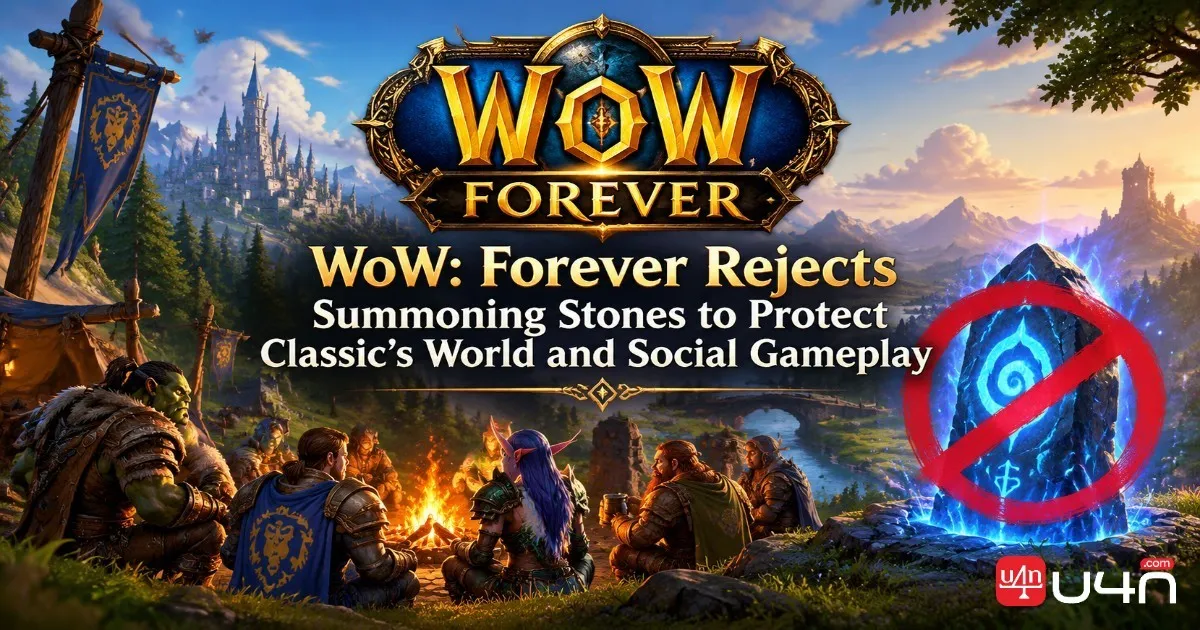
Blizzard has made its position clear: World of Warcraft: Forever will not include Summoning Stones, because easy access to teleportation could undermine the experience the team wants to preserve. For players following this Classic+ project, the decision reveals more than a preference for old-school mechanics. It shows how Blizzard intends to balance convenience, exploration, and meaningful player interaction in Azeroth. Even players planning their next adventure or managing resources such as WoW Forever Gold will need to understand the philosophy shaping this version of the game.

In an interview with TechRadar Gaming, Blizzard explained that fast, convenient teleportation can make the world feel smaller and weaken the identity of classes such as Warlocks. The team is building WoW Forever around a familiar version of Azeroth, where traveling, meeting other players, and preparing for group content remain part of the experience. Rather than modernizing every system simply because it would save time, Blizzard wants each change to support the game's broader design goals. Read the original TechRadar Gaming report on Blizzard's Summoning Stones decision for the team's explanation.
Why WoW Forever Is Leaving Summoning Stones Behind
Summoning Stones are a familiar convenience in modern World of Warcraft. They help groups bring players to dungeon or raid entrances without requiring everyone to travel the entire distance themselves. For players who have limited time or are joining a group late, this can remove a substantial amount of logistical friction.
However, Blizzard sees a potential cost to that convenience in WoW Forever. In the original Classic-style experience, reaching a dungeon is part of the journey. Players must consider their route, travel through contested or dangerous areas, and coordinate with teammates before the group can begin its run.
Removing that process would make group content easier to access, but it could also remove some of the interactions that make the world feel connected. Blizzard's position is that these trade-offs matter more than the time saved by adding another teleportation option.
How Fast Travel Can Change the Feel of Azeroth
The idea that teleportation can shrink a game world is not about changing its physical map. Azeroth can remain just as large, yet feel less significant when players rarely need to cross it.
We can break the effect down into three areas:
- Exploration becomes less necessary. When players can bypass long journeys, fewer trips expose them to unfamiliar routes, local threats, and unexpected discoveries.
- Travel creates fewer opportunities for interaction. Moving through the world can bring players into contact with strangers, guildmates, and other groups. Teleportation reduces some of those shared experiences, although it does not eliminate social interaction altogether.
- Locations can feel more like destinations than places. If players move directly between a capital city and a dungeon entrance, the regions connecting those points may become less relevant to their routine.
This does not mean every journey is inherently enjoyable. Experienced MMORPG players know that repeated travel can become tedious, especially when a group is waiting or a player has already completed the same route many times. The important distinction is between removing unnecessary friction and removing an activity that contributes to the game's identity.
For Blizzard, Summoning Stones appear to fall on the wrong side of that distinction.
The key question is not whether convenience is good or bad. It is whether a convenience feature preserves the activities that give a game its distinctive character.
Why Warlocks Matter to the Summoning Stones Debate
The decision also touches on class identity. Warlocks have traditionally offered a group-summoning ability that requires cooperation from other nearby players. This gives the class a practical role beyond combat, allowing it to help organize dungeon runs and other group activities.
If a universal convenience feature can perform a similar function with less dependence on a specific class, some of that utility may become less distinctive. Blizzard argues that adding Summoning Stones would marginalize part of the Warlock's identity.
We should not interpret this as meaning that Warlocks would become useless if Summoning Stones existed. Class value comes from several sources, including damage, utility, survivability, and group synergy. Instead, the concern is that a universal system could reduce the importance of one established class function.
That distinction matters in a Classic+ game. Preserving class identity does not necessarily mean freezing every ability exactly as it was. It means evaluating whether a new feature changes how classes contribute to the wider game.
Convenience Versus Classic Design: What Players Stand to Gain and Lose
Blizzard's approach creates a clear trade-off. Keeping traditional travel requirements can strengthen the connection between players and the world, but it also places more responsibility on players to organize their time.
| Design area | Without Summoning Stones | With easy group teleportation |
|---|---|---|
| World exploration | More reasons to travel through Azeroth | Some journeys become optional |
| Group preparation | Requires more coordination and travel time | Groups can assemble faster |
| Social interaction | Travel may create additional opportunities to meet players | Less travel, but more time for direct group activities |
| Warlock utility | Summoning retains a distinct practical role | Some of that utility may overlap with a universal feature |
| Player convenience | More time spent reaching content | Easier access for players with limited time |
Neither side is automatically better for every player. Those who enjoy a persistent world, spontaneous encounters, and the preparation involved in classic dungeon runs may welcome Blizzard's decision. Players who prioritize efficient progression, particularly those with limited playtime, may see the same restriction as an unnecessary obstacle.
Our view is that the key question is not whether convenience is good or bad. It is whether a convenience feature preserves the activities that give a game its distinctive character.
A useful alternative would be to improve the organization of groups, make travel requirements clearer, or reduce avoidable friction without automatically removing the journey itself. These are potential design approaches, not confirmed features of WoW Forever.
What This Decision Means for the Future of Classic+
The Summoning Stones debate illustrates a broader challenge facing Classic+. Players want a familiar game, but they also expect a new project to offer meaningful improvements. Blizzard must decide which modern systems can be introduced without changing the pacing and social structure that define the Classic experience.
In its interview with TechRadar Gaming, Blizzard said it had 22 years of experience observing how quality-of-life changes affected the social fabric of World of Warcraft. The team also outlined four guiding principles: protecting social experiences, keeping the game approachable and familiar, making the world the main character, and prioritizing the journey over the destination. These principles are also reflected in Blizzard's official WoW Forever design overview.
These principles provide a framework for evaluating future updates. A new feature should not be judged solely by how much time it saves. Developers also need to consider how it changes player behavior, class utility, world exploration, and the reasons people interact with one another.
For players preparing for the game, it makes sense to prioritize understanding its intended progression systems and group requirements rather than assuming that every convenience found in retail WoW will carry over. Searching for information about how to buy WoW Forever Gold, for example, should be separate from evaluating the game's design philosophy; players should verify the game's official economy rules and account-safety guidance before making any transaction.
Ultimately, Classic+ does not need to reject every modern feature to preserve its identity. It needs a consistent standard for deciding which improvements support the world and which risk making that world feel less important.
Conclusion
Blizzard's refusal to add Summoning Stones reflects a deliberate choice to preserve the relationship between travel, social coordination, and class identity in WoW Forever. The decision will not appeal to everyone, especially players who view repeated travel as wasted time. However, it is consistent with a design philosophy that treats Azeroth as more than a backdrop between dungeons.
We believe the real test will be how well the game balances these principles in practice. If travel encourages exploration and meaningful interaction, preserving it can strengthen the Classic experience. If it becomes repetitive busywork without offering anything in return, the same restriction could frustrate players rather than deepen immersion.
The goal should not be inconvenience for its own sake. It should be a world where the journey remains worth taking.
FAQ
Will WoW Forever have Summoning Stones?
According to Blizzard's explanation reported, WoW Forever will not include Summoning Stones because the team believes easy access to teleportation conflicts with its design principles.
Why does Blizzard think teleportation makes Azeroth feel smaller?
Fast travel reduces the need to cross regions on foot or mount. Blizzard believes that this can make the world feel less central to the experience and reduce opportunities for exploration and social interaction.
Will Warlocks still have a reason to summon players?
Yes. Warlock summoning remains an important example of class-specific utility in Blizzard's explanation. Its value comes from offering a group service that is not universally available through the same mechanism.
Is removing Summoning Stones better for every player?
No. It can preserve exploration and traditional group preparation, but it also increases the time and coordination needed to reach group content. Whether that trade-off feels worthwhile depends on individual playstyles and how the game implements its wider systems.
Does Classic+ mean Blizzard will reject every modern convenience?
Not necessarily. The stated approach is to evaluate changes against the game's core design principles. The important question is whether a feature improves the experience without undermining the world, social interaction, or class identity.