Making money in MapleStory Classic World is not just about killing stronger monsters or waiting for a rare item to drop. Our team looks at the economy from a more practical angle: how much value we generate per hour, how much we spend to earn it, and how quickly we can turn items into usable Mesos. A reliable MapleStory Classic World Mesos strategy starts with understanding those three factors rather than chasing the biggest number on a loot table.
The same principle applies whether we are farming monster drops, selling materials in the Free Market, crafting equipment, or buying underpriced items for resale. Every method has its own costs and risks. The goal is to find an approach that fits our character, available capital, and current market demand, then repeat it without wasting hours on unnecessary price checks or unsold inventory.

The Free Market rewards sellers who understand demand, price their materials carefully, and make bulk purchases more convenient for buyers.
Measure Net Profit, Not Just Drops or Experience
One of the most common mistakes we see in farming strategies is treating high experience rates or expensive drops as proof of profitability. Neither tells the whole story. A map can deliver excellent EXP while consuming so many potions that our actual Mesos income becomes disappointing.
We should evaluate a farming route by its net profit over a consistent period.
Net profit = Total realized income − Total operating costs
For a useful hourly comparison, we also need to account for the time spent traveling, selling loot, restocking potions, and managing inventory.
| Factor | What we should measure | Why it matters |
|---|---|---|
| Direct income | Mesos dropped by monsters | Provides a baseline return |
| Item income | NPC sale value and actual player-sale revenue | Distinguishes guaranteed value from uncertain market demand |
| Potion costs | HP and MP consumption | Reveals how much combat reduces our earnings |
| Travel and trading | Time spent moving, restocking, and selling | Exposes hidden productivity losses |
| Rare drops | Additional value from valuable items | Adds upside without becoming the entire strategy |
For example, imagine two farming routes that generate 300,000 and 240,000 Mesos in gross value per hour. If the first costs 140,000 in supplies and the second costs 40,000, their net returns are 160,000 and 200,000, respectively. These are illustrative figures, not measured in-game rates, but they demonstrate why gross income can be misleading.
We should also distinguish potential revenue from realized profit. An item listed for a high price has no practical value at that price until someone buys it. If it sits in a shop for days, our capital remains tied up and cannot be used elsewhere.
Choose Farming Maps That Protect Your Potion Budget
Higher-level monsters are not automatically the best targets for making Mesos. They may offer more EXP or valuable drops, but they can also hit harder, force frequent potion use, and slow down our farming cycle.
When we compare maps, we should consider three questions:
- How quickly can our character kill the monsters?
- How much damage do we take during a typical farming session?
- What can we consistently earn from ordinary drops, including items we can sell to NPCs or other players?
Why easier monsters can outperform tougher targets
A map filled with manageable monsters can offer a strong balance between kill speed and operating costs. Faster kills may mean more ordinary drops, while lower incoming damage helps preserve the Mesos we would otherwise spend on potions.
That does not mean we should farm low-level monsters indefinitely. If the EXP becomes irrelevant, the map has poor spawn density, or the drops have little resale value, moving to a stronger target may be the better decision.
The important distinction is between the hardest monster we can kill and the most profitable monster we can farm efficiently.
How we test a farming route
Instead of relying on a single lucky session, we should compare routes under reasonably consistent conditions.
- Record our starting Mesos and potion supplies.
- Farm for a fixed period, keeping track of direct drops and collected items.
- Separate items sold to NPCs from materials that may have player-market value.
- Deduct potion expenses and other relevant costs.
- Repeat the test before committing to the route.
Rare equipment should be treated as a bonus rather than a guaranteed income source. If the strategy only looks profitable when a valuable drop appears, it is too dependent on luck to serve as a reliable baseline.

Sell in Bulk and Reduce Free Market Friction
The Free Market rewards more than good loot. It also rewards sellers who make transactions easier for buyers.
Imagine a crafter who needs a large quantity of ore, refined materials, or other crafting ingredients. Buying small amounts from several sellers takes time, creates more transactions, and may interrupt the crafting process. A seller who can provide the required quantity in one trade offers genuine convenience.
That convenience can support a price premium, provided the market demand is strong enough.
When bulk selling makes sense
| Market condition | Recommended approach |
|---|---|
| Buyers regularly need large quantities | Test bulk listings at a modest premium |
| The item sells steadily,y but demand is limited | Keep stock moderate and avoid flooding the market |
| The item is obscure or rarely requested | Sell smaller quantities until demand is clearer |
| The item is easy to obtain and heavily supplied | Compete on price, convenience, or reliability |
Bulk selling also reduces our own workload. Listing a substantial quantity of a frequently used material can be more efficient than repeatedly opening shops and managing small stacks.
However, we should not confuse quantity with value. A large stock of an unpopular item is still an inventory problem. Before committing to a bulk sale, we need a reasonable estimate of demand, competing supply, and how quickly buyers are likely to purchase it.
Build relationships with repeat buyers
If we regularly gather materials needed by a particular group of crafters, we can develop a more predictable supply arrangement. Repeat customers may tell us which materials they need, how much they typically use, and when they expect to buy again.
This makes farming more purposeful. Instead of collecting random items and hoping someone wants them, we can target materials with an identifiable buyer base.
We should still avoid promising quantities we cannot reliably supply. A dependable seller builds a reputation by meeting realistic expectations, not by accumulating more inventory than the market can absorb.
Specialize in a Market and Turn Crafting Into a Business
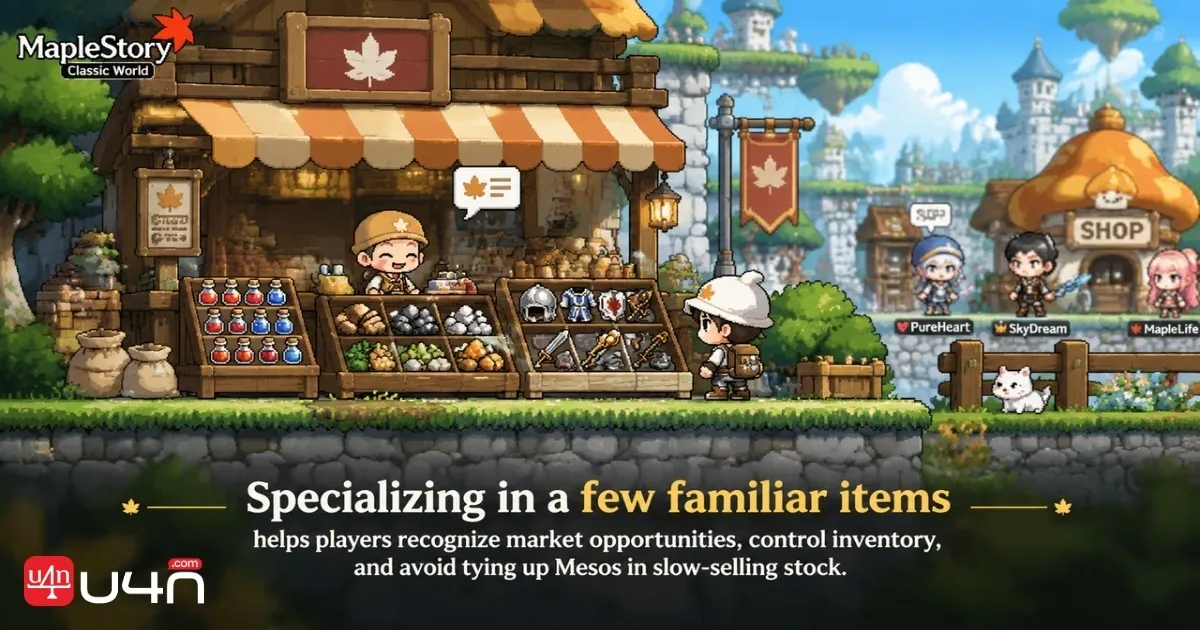
Trying to understand every item's price is an inefficient way to begin trading. Our team recommends specializing in a narrow category first: common ores, crafting components, frequently used consumables, or a particular type of equipment.
Repeated exposure helps us recognize normal price ranges, identify unusually cheap listings, and judge whether an item's asking price reflects real demand.
Learn the market before investing heavily. ily
For each item we follow, record a few basic details:
- Typical asking prices and the number of competing listings.
- Prices at which our own items actually sell.
- How long inventory usually takes to move.
- Whether demand appears tied to crafting, quests, leveling, or equipment upgrades.
Asking prices are only a starting point. Several sellers listing an item at the same price does not prove that buyers are willing to pay it. Our own completed sales provide more useful evidence.
Crafting: calculate the full cost
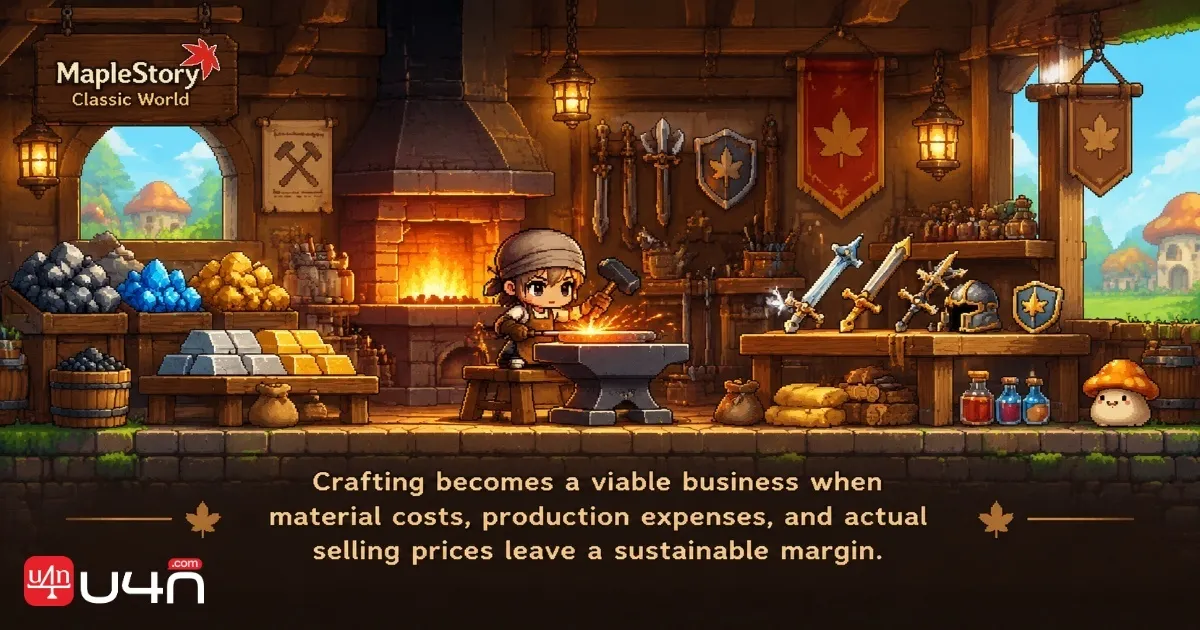
Crafting can create a profitable business when players value the finished product more than the effort required to gather materials and produce it. But a recipe is not automatically profitable simply because its output looks expensive.
Crafting profit = Realized sale price − Material cost − Crafting fees − Selling costs
We should assign a value to materials gathered ourselves, too. Gathering them still consumes time, and using them for one recipe means giving up the opportunity to sell them separately.
A practical way to test a recipe is to produce a small batch, list it at a competitive price, and track the actual selling speed. If the margin remains healthy and buyers return, we can increase production gradually.
Avoid crafting dozens of identical items before confirming demand. When several sellers follow the same opportunity, supply can grow faster than the number of buyers, pushing prices down and leaving everyone with unsold stock.
Look for convenience-based opportunities
Some players would rather buy a finished item than gather ingredients, find a crafting NPC, and complete the recipe themselves. This creates an opportunity for sellers who can supply useful products consistently.
The strongest opportunities are not necessarily rare or complicated. A straightforward product with recurring demand and manageable production costs may be more dependable than an expensive item that sells only occasionally.
The key is to verify the margin, not assume that other players' reluctance to craft guarantees easy profits.
Manage Inventory, Timing, and Market Risk
Once we understand a small part of the market, we can start making better purchasing decisions. Buying materials below their usual market range may improve our margins, especially when we already know what those materials are worth and how quickly they sell.
But cheap inventory is not automatically a bargain.
Buy when the price makes sense, not just because it is low
Before purchasing extra stock, we should check whether the price is genuinely attractive relative to recent sales, whether the material has recurring demand, and whether we can afford to hold it if the market moves against us.
A material that drops from 375 Mesos to 250 Mesos may look appealing, but only if the expected resale value leaves enough room for costs and risk. If the market price has fallen because demand is disappearing, buying more may simply increase our losses.
Avoid flooding our own market.
Producing or collecting too much of one item can work against us. Once our stock exceeds the number of buyers willing to purchase it, sales slow dow,n and we may have to lower prices to clear inventory.
We should monitor three signals:
- Sell-through rate: How much of our stock sells during a typical period?
- Margin: How much do we retain after all relevant costs?
- Capital tied up: How much money remains locked in unsold goods?
When these indicators deteriorate, reduce production or look for a different product rather than continuing to scale a weakening strategy.
Do not waste hours chasing perfect prices
Not every item deserves an extensive price check. For ordinary drops with little resale demand, a quick comparison against the NPC sale price may be enough to decide whether listing them is worth the effort.
Equipment deserves more attention when it has unusually strong stats, valuable upgrades, or a clear market. Common items with limited demand may not justify checking multiple sources and delaying the rest of our session.
The right level of research depends on the item's potential value. We should spend more time evaluating high-value decisions and less time optimizing transactions that barely affect our overall income.
Build a Repeatable Mesos Strategy
The most reliable way to improve our Mesos income is to combine efficient farming with informed selling and disciplined market management. We should choose routes based on net returns, treat rare drops as upside, and sell materials in ways that reduce unnecessary trading work.
For the Free Market, specialization is often more useful than trying to track every item. Learn a small category well, understand what buyers need, test crafting margins before scaling production, and avoid holding more stock than the market can reasonably absorb.
Trading can eventually become more profitable than active farming for players with enough market knowledge and capital. However, flipping is not free money: poor pricing, slow sales, and falling demand can erase a seemingly attractive margin. Players who want to compare their options should start with the methods they can measure and repeat, rather than assuming one approach is always superior.
Our rule of thumb is simple: measure the profit, account for the time, and repeat what the market proves it will support. Whether we are gathering materials, crafting useful products, or buying and reselling items, a disciplined approach gives us a clearer path to sustainable Mesos income.
FAQ
Is farming high-level monsters always the best way to make Mesos?
No. Stronger monsters may provide better EXP or valuable drops, but they can also increase potion expenses. Compare kill speed, ordinary drops, and total costs before deciding which map is more profitable.
Should I sell materials in bulk?
Bulk selling works best when buyers regularly need large quantities. It can reduce transaction friction and support a modest premium, but large listings may move slowly if demand is limited.
Is crafting a reliable way to earn Mesos?
It can be, provided the finished product sells for more than the full cost of its materials, production, and selling process. Test small batches and verify actual sales before committing substantial resources.
Should I spend time checking every item's market price?
No. Focus your research on items with meaningful resale value or strong demand. For ordinary drops, a quick check against the NPC sale price may be sufficient.
Is market flipping better than grinding?
Neither method is universally better. Grinding generates loot directly but requires active play and supplies. Flipping depends on pricing knowledge, available capital, and market liquidity. Compare the net return per hour and the risks you are comfortable taking.
For players who prefer active farming, start with a route that produces useful drops at a manageable cost. For players who enjoy trading, learn one category, track completed sales, and expand only when the numbers support it. The aim is to improve our own decision-making rather than blindly copy someone else's strategy.
Ultimately, players looking to buy MapleStory Global Mesos should keep that choice separate from evaluating in-game earning methods. Our focus here is on understanding the economy and making better use of the time and resources we already have.