

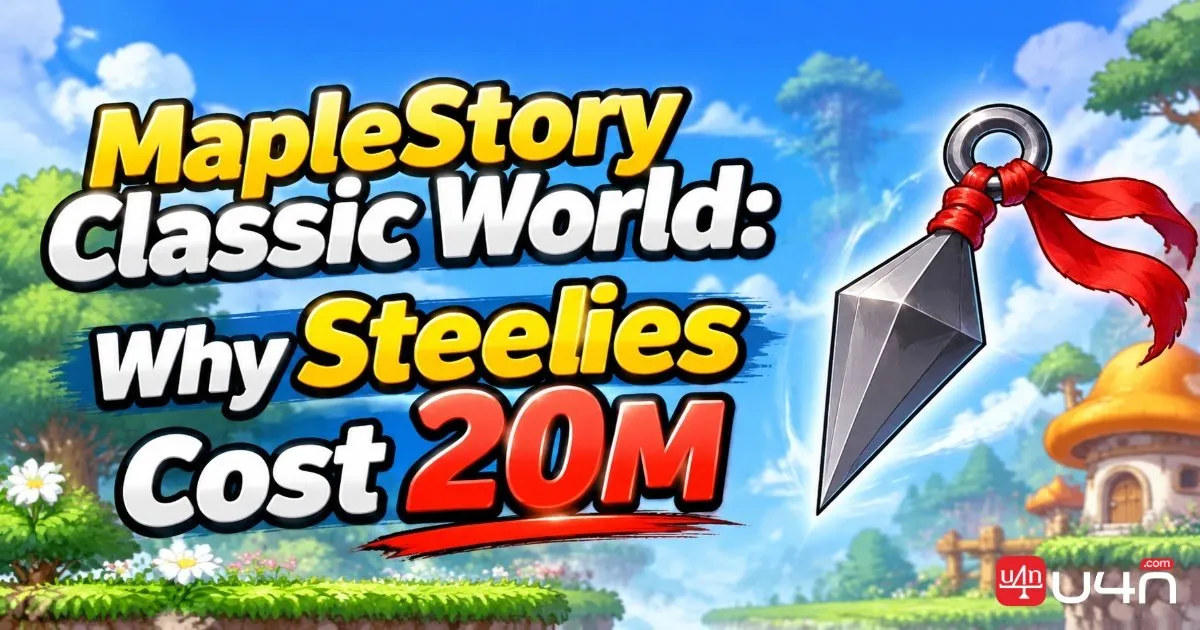
Steelies approaching 20 million mesos make one thing clear: keeping an Assassin supplied can cost far more than buying the weapon itself. Yet the market described is moving in several directions at once. Some weapons are getting cheaper, popular scrolls are rising, and valuable throwing stars are drawing players to specific hunting grounds.
Our team's reading is that MapleStory Classic World Mesos purchasing power needs to be judged item by item. A larger wallet does not necessarily mean an easier upgrade if everyone earning that money is chasing the same limited drops.
Three pressures drive the situation: new drops are changing equipment supply, popular classes are concentrating demand, and efficient farming is putting more spendable currency into circulation. Understanding those pressures makes it easier to decide what deserves an immediate purchase and what can wait.
Why Cheaper Weapons Can Make Scrolls More Expensive
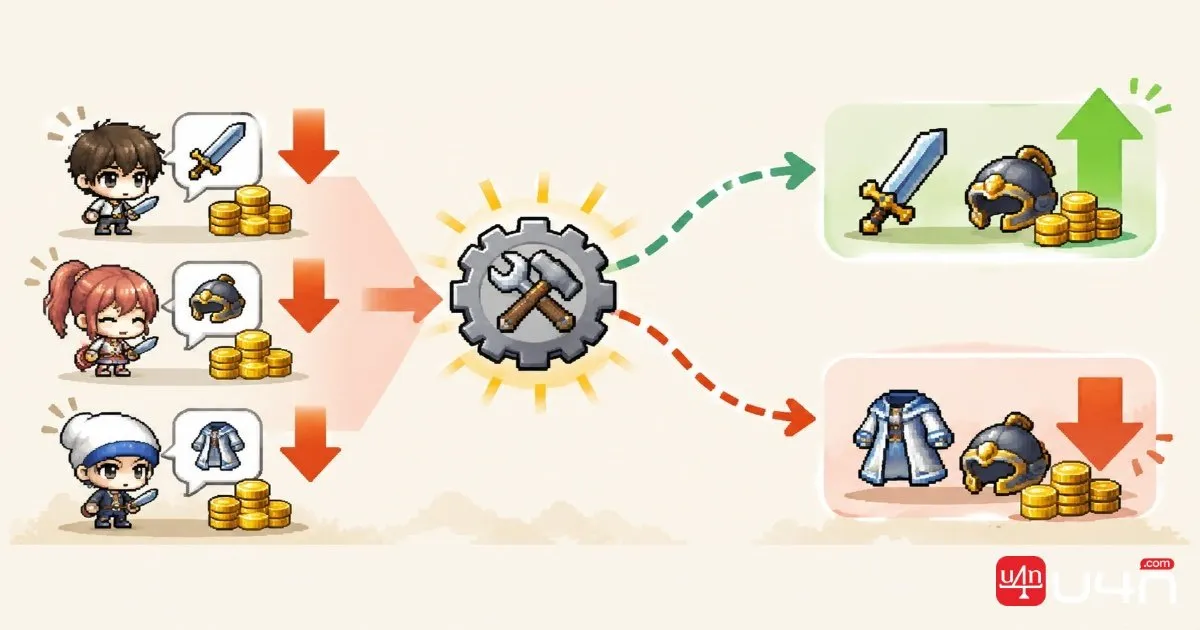
A new monster with a desirable weapon on its drop table can produce a seemingly strange result: the weapon falls in price while its upgrade scrolls become more expensive.
The explanation starts with access. Before the update, a weapon might have been too scarce or too expensive for much of the player base. Once a more practical source appears, additional players can obtain it. Those players then enter the scroll market, often within the same short period.
Weapon supply increases, but scroll supply may not increase at a matching rate.
Cromi and Slain illustrate this relationship. Easier access to those weapons creates more potential buyers for their respective scrolls. The purchase price of the base equipment becomes only one part of the upgrade budget.
Our team would evaluate that budget before buying. A cheap clean weapon can still lead to an expensive project if the scrolls needed to improve it are trading near a temporary peak.
| Market change | Immediate effect | What we would check |
|---|---|---|
| A practical weapon source appears | More clean weapons enter circulation | Whether actual weapon sales are falling |
| More players obtain an upgrade | Scroll demand increases | Total cost of the planned enhancement |
| Players replace failed projects | Additional weapons and scrolls are consumed | Whether repeated attempts remain affordable |
| The first upgrade wave slows | Demand may become less urgent | Whether listings are accumulating |
The duration of this cycle matters. A sharp rise after an update can reflect a concentrated wave of upgrades rather than a permanently higher price floor.
We would be cautious about buying an entire enhancement project during that first rush. If the existing weapon still clears the same monsters in the same number of attacks, waiting has a measurable benefit: it preserves currency without immediately reducing hunting efficiency.

Class Popularity Changes the Value of Similar Items
Two scroll categories can react very differently to the same update because they serve different groups of players.
A popular class creates a larger potential customer base. More characters need weapons, more players attempt upgrades, and more failed attempts can lead to replacement purchases. A less populated class may receive new equipment without producing comparable demand for its scrolls.
That helps explain why a broad statement such as "weapon scrolls are rising" can be misleading. Each category has its own buyers, alternatives, and supply conditions.
Weapon substitution adds another layer. If a newly accessible wand becomes an attractive upgrade for many magicians, some players may redirect their spending away from staffs. Wand scroll demand can strengthen while staff scroll demand weakens.
Our team would therefore track the equipment players are moving toward, rather than treating all magician weapons as one market.
The same logic applies to armor. A desirable set can remain expensive when many characters need it, while a comparable alternative attracts fewer buyers. Differences between male and female equipment prices may reflect the available population of buyers as much as the usefulness of the stats.
That creates an opportunity for budget planning, although the cheapest listing is not automatically a practical substitute. Equipment restrictions, required attributes, and the cost of changing an existing setup all belong in the comparison.
For a new character, we would examine those differences before committing to an equipment route. For an established character, we would compare the savings against the cost of switching.

Patch Expectations Can Move Prices Before Content Arrives
Markets respond to anticipated updates as well as released content.
A player holding an expensive weapon may worry that the next patch will introduce a stronger alternative, a crafting route, or a more productive farming location. Selling early feels safer than waiting for a possible price drop.
If enough owners make that decision together, listings increase before the patch changes anything.
That can produce a familiar sequence: selling pressure before maintenance, followed by renewed buying if the expected replacement does not appear. Players who sold equipment still need something to use, and the existing weapon may remain relevant.
We would treat that sequence as a possibility, not a scheduled trading opportunity. It requires several conditions to line up, and the cost of buying back can erase the benefit of selling early.
There are two separate questions to answer:
- Does the update materially increase the supply of this weapon?
- Does it reduce the reason to own this weapon?
A new farming source mainly affects availability. A stronger replacement affects desirability. A crafting system could influence both, depending on its materials, restrictions, and output.
Our team would keep those distinctions clear when reading patch speculation. A rumor that "weapons will crash" provides little help unless it identifies which weapons, what changes their supply, and why buyers would stop wanting them.
For equipment currently needed to farm effectively, selling also has an operating cost. Losing productive hunting time while waiting for a cheaper replacement can make an apparently successful trade less profitable than it looks.
Steelies Are Expensive Because One Set Does Not Finish the Build
Throwing stars create a different purchasing problem from ordinary equipment.
A weapon remains equipped throughout a hunting session. A supply of stars must support the duration of that session before the player returns to recharge. Owning one strong set therefore does not provide the same sustained benefit as owning enough strong sets for a normal farming trip.
This matters most near a damage threshold.
If stronger stars let an Assassin defeat a monster in two attacks, switching to weaker stars might push that target to three. The difference affects more than the damage shown on screen. It can reduce kills per hour, increase exposure to attacks, and change how comfortably the character clears a platform.
Our team would assess stars through that practical breakpoint.
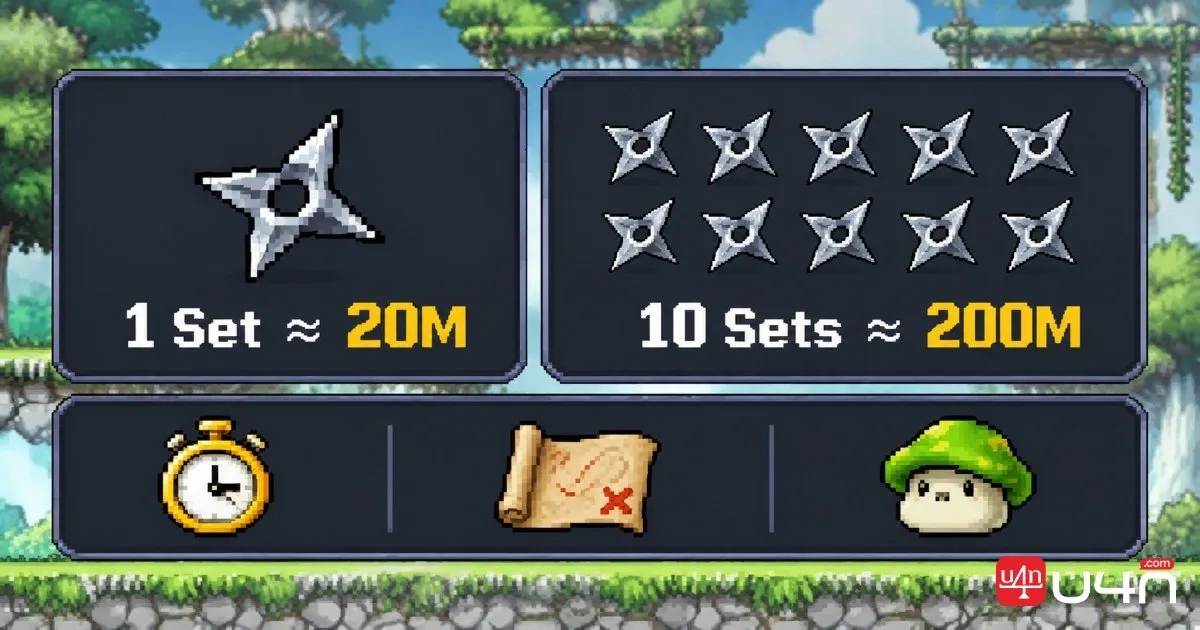
Using an approximate price of 20 million mesos per set, ten sets would cost about 200 million mesos. That arithmetic explains the scale of the expense, but ten sets should not be treated as a universal requirement.
The useful quantity varies with session length, star consumption, recharge access, and the performance of the backup stars already available.
| Purchase question | Why it matters |
|---|---|
| Do stronger stars reduce attacks per kill? | The upgrade may improve actual farming output |
| How long do current sets last? | This determines how often performance changes |
| How costly is a recharge trip? | Travel can reduce productive hunting time |
| Are backup stars still effective? | A cheaper reserve may preserve acceptable efficiency |
| Would another upgrade help more? | The next star set competes with every other use of mesos |
We would build toward a useful hunting duration rather than an arbitrary inventory target. A player taking short sessions near a recharge point faces a different problem from someone holding a difficult map for hours.
Demand can remain strong because established Assassins still have reasons to buy additional sets after obtaining their main weapon. That creates a continuing destination for accumulated mesos.
Expensive Drops Are Changing Where Players Hunt
A valuable rare drop can make an otherwise ordinary hunting location much more attractive.
Using a simple illustration, a 20 million meso drop equals twenty days of income for a player saving one million mesos per day. That comparison explains the appeal. It does not establish how profitable the map will be for the next player who arrives.
Rare drops need probability and time to become meaningful income estimates.
Our team would separate hunting returns into three parts: currency collected directly, ordinary items sold consistently, and rare drops whose contribution becomes clearer over longer periods.
A useful planning model is:
Expected net income = regular income + expected sale value of drops - operating costs
Operating costs include potions and travel, but they also include time lost finding a channel or competing for monsters. A location with an excellent drop table can perform poorly when the player cannot maintain a steady clearing rhythm.
Highlights hunting targets associated with valuable stars, including Red Drakes and Dark Stone Golems. Their appeal comes from combining routine income with a chance at a much larger payout.
We would still test each location using the character that will actually farm it.
A high-level Assassin's result cannot be transferred directly to a character that needs additional attacks per kill. Different movement options, attack coverage, potion consumption, and access to a stable channel can change the outcome substantially.
The practical approach is to record several sessions. Note the time spent hunting, ordinary proceeds, consumable costs, and interruptions. Keep exceptional drops visible as separate results before folding them into a longer record.
That avoids two common mistakes: abandoning a solid map after one unlucky evening, or declaring a map unbeatable after one unusually valuable drop.

Why Zenith Can Feel More Expensive Than Windia
A newer world does not automatically provide cheaper upgrades.
It may contain fewer established suppliers while still attracting players who already know which classes and equipment they want. Those players can move through familiar progression routes quickly, concentrating demand on a narrow selection of valuable items.
Zenith is heavily weighted toward thieves and magicians. Our team would read that as a potential demand imbalance, while treating the quoted population figures cautiously. Ranking entries do not establish the number of active traders, and a world's total character count does not reveal its daily item production.
The more useful question is how much supply reaches buyers.
A smaller economy can struggle when many advancing players want the same scrolls and stars, especially if productive hunting areas have limited capacity. More demand does not immediately create more drops.
Experienced players may also generate currency efficiently from an early stage. That gives buyers money to spend before the supply of desirable equipment has caught up.
Event consumables can add pressure from another direction. If players receive enough recovery items to reduce purchases from NPC shops, one recurring currency sink becomes weaker. More of their farming proceeds remain available for trading.
We would distinguish this from the scarcity of an individual item. Reduced currency removal can affect purchasing power broadly, while a shortage of popular stars can make that specific category rise faster than the wider market.
Both can happen together.
For players comparing worlds, familiar prices are a starting reference. Local completed sales, available stock, and replenishment speed provide a better basis for a purchase than assuming Zenith should match Windia.
How We Would Spend Through This Market
Our team would put productive upgrades ahead of speculative inventory.
The priority is a purchase that solves an observable problem: reaching a better kill threshold, surviving a profitable route more comfortably, or extending a hunting session without a costly interruption.
We would then compare the complete upgrade cost. A clean weapon, its scrolls, and the likely expense of unsuccessful attempts belong in the same calculation. Buying the inexpensive part first can make the remaining expense feel unavoidable, even when the full project was poor value from the start.
Limited cosmetics need a separate budget. Presents a familiar pattern of early supply, buying near rotation changes, and later resale attempts. That pattern is plausible, but scarcity alone cannot establish a profitable exit.
A desirable appearance can still have too many sellers at one price. Rereleases, changing preferences, and weak transaction volume can all affect resale value. We would check how readily an item sells, rather than judging its value from the highest visible listing.
For MapleStory Classic World Items, our purchasing rule is to connect each expense to a specific benefit. That could mean fewer attacks per monster, enough stars for a normal session, or a cosmetic we actually want to keep. An expectation that someone else will pay more later needs its own evidence.
We would also keep a working reserve for ordinary play. Spending every available meso on an anticipated price increase leaves little room for an unexpected equipment opportunity or a change in farming conditions. A useful reserve lets us make the next decision without being forced to sell something quickly.
Before buying another expensive star set or starting a scroll project, we would check recent sales, count the resources needed to finish, and test the current setup on the intended monsters. If the purchase changes a three-attack kill into two, we can measure its value during the next session. If it leaves performance unchanged, we can afford to keep watching the price.