

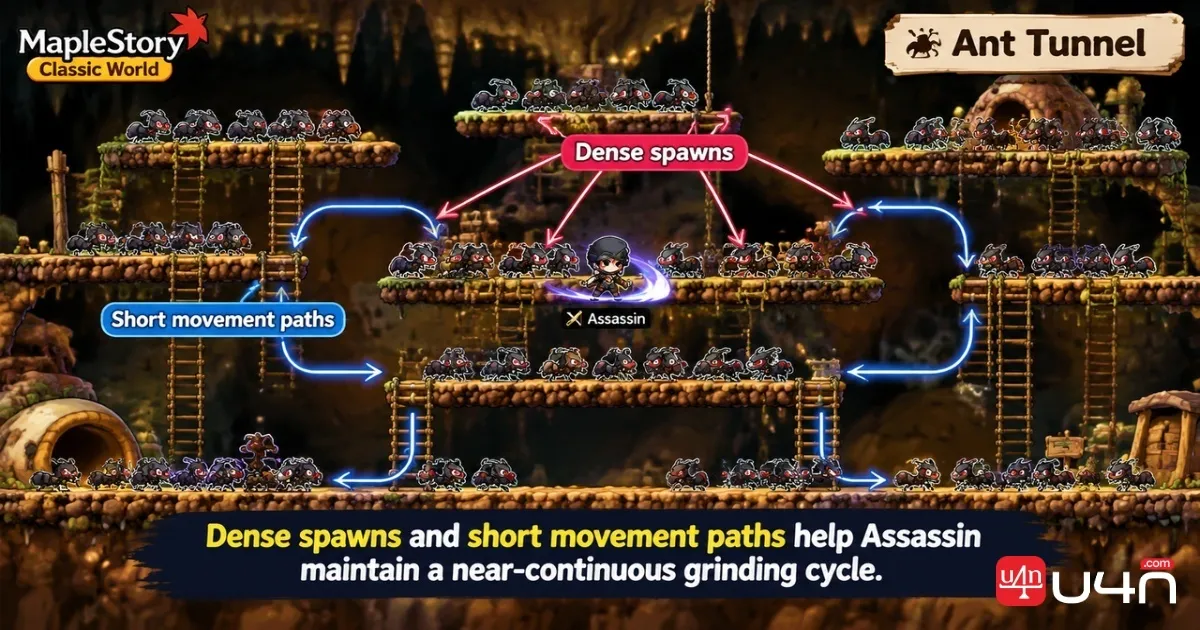
Assassin can look deceptively specialized when we judge the class by its early-game reputation. In practice, our leveling speed depends much more on how efficiently we turn range, movement, and spawn density into actual kills. That becomes especially obvious in Ant Tunnel, where a dense map can let an Assassin maintain pressure almost continuously.
For players planning their early progression, the important question is not simply whether Assassin has serious damage. It is whether our attacks can consistently reach the monsters we want, how many attacks each monster requires, and how much time we spend moving between targets. That is where MapleStory Classic World Mesos can also become relevant to our progression, since efficient grinding affects how quickly we build the resources needed for future upgrades.

Why Assassin's Early Mobbing Reputation Can Be Misleading
Assassin does not need to stand directly beside every monster to keep a grinding rotation moving. That changes how we should evaluate the class. Instead of measuring mobbing purely by how many targets an attack can hit at once, we need to look at how quickly we can move from one target to the next without interrupting our attack cycle.
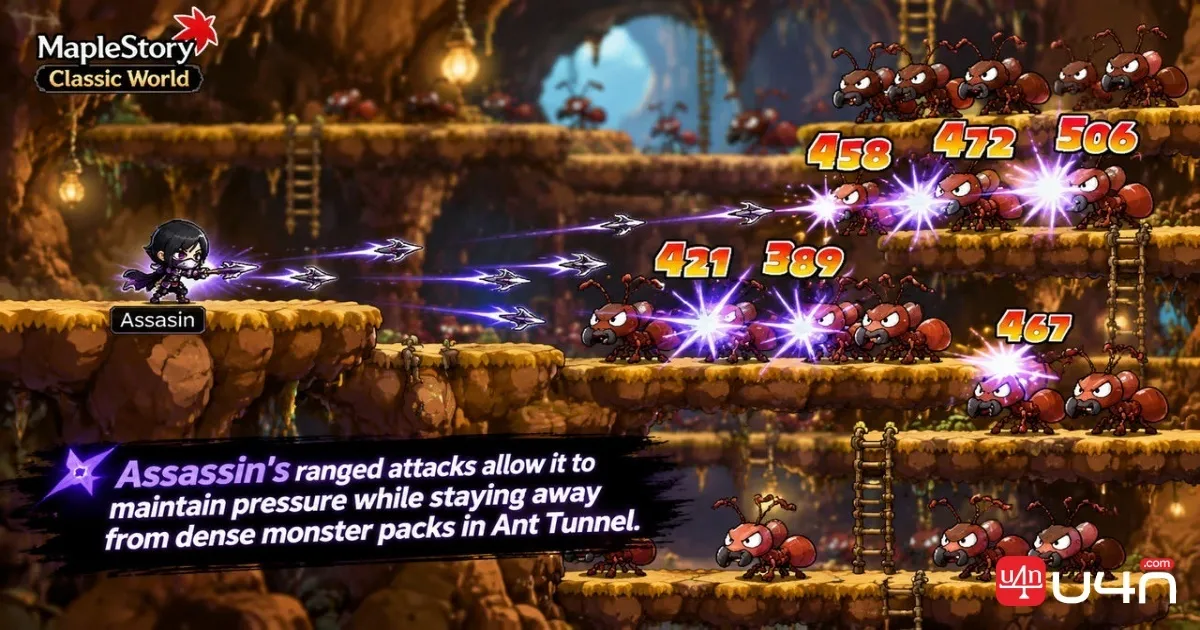
Our ranged attacks give us room to attack before monsters fully reach us, and jump attacks make it easier to maintain momentum across platforms. When the map is crowded with targets, that combination becomes much more valuable than it might appear from a simple skill comparison.
The real question is how many attacks it takes to finish the average monster on our chosen map.
That is why we should not judge Assassin's grinding performance by reputation alone. A class that looks weaker on paper can perform extremely well when the map allows it to attack continuously with minimal repositioning.
Ant Tunnel Turns Spawn Density Into a Major Advantage
Ant Tunnel is useful because the map can keep targets in front of us instead of forcing long periods of empty movement. When monsters are constantly appearing across nearby platforms, an Assassin can chain attacks together without wasting much time searching for the next target.
The goal is not to chase every monster on the map. We want to minimize empty movement.
What Makes a Good Grinding Map?
- High spawn density keeps targets available.
- Short movement paths reduce downtime between kills.
- A reliable kill threshold keeps the attack cycle consistent.
| Grinding Factor | Why It Matters | Assassin's Advantage |
|---|---|---|
| Spawn Density | More targets reduce downtime between attacks. | Ranged attacks can pressure nearby monsters quickly. |
| Movement Distance | Less travel means more time attacking. | Jump attacks help maintain movement between platforms. |
| Kill Threshold | Fewer attacks per monster create a smoother rotation. | Two-shot kills can keep the grinding cycle moving. |
This is the basic reason Ant Tunnel can feel much better than a less crowded map. We are not necessarily dealing more damage per hit. We are simply spending a larger percentage of our time actually attacking.
The Two-Shot Threshold Matters More Than Raw Damage
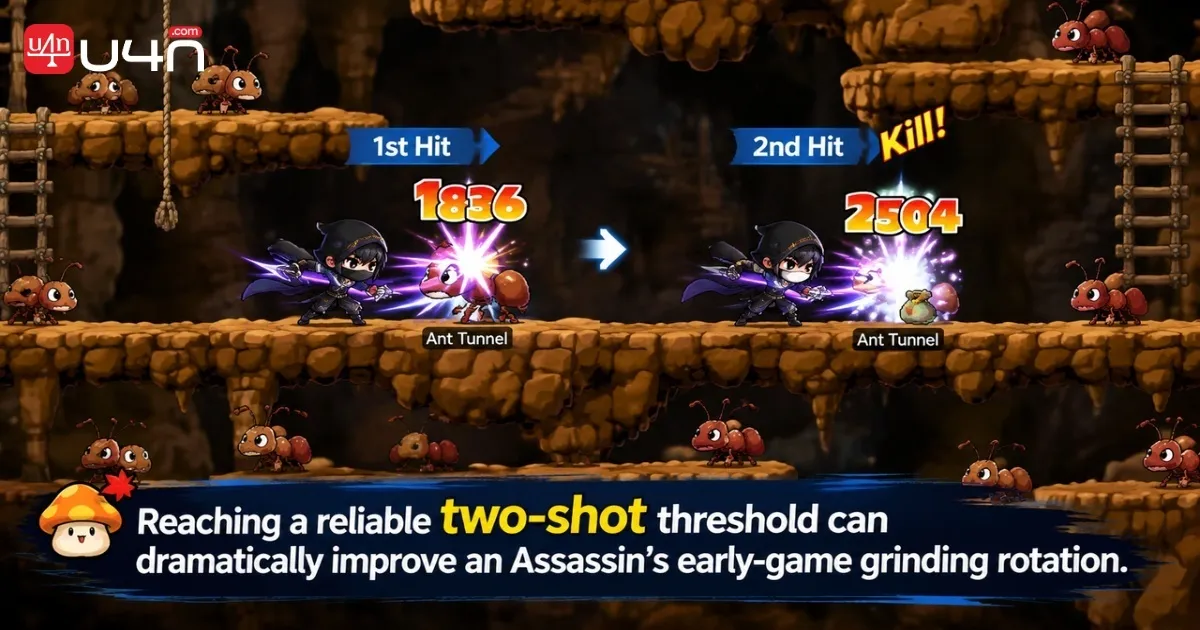
One of the biggest practical differences we notice while leveling is whether a monster dies in two attacks or requires three. This sounds like a small change, but it affects the entire rhythm of a grinding session.
If we need three attacks instead of two, every target stays alive longer. That means more time on each monster, more opportunities for incoming damage, and more interruptions to the movement pattern. When several monsters are spawning around us, those extra attacks quickly become a major source of downtime.
A reliable two-shot threshold can matter more to our real leveling speed than a small increase in theoretical damage.
Why the Kill Cycle Matters
We should evaluate our damage by looking at the complete kill cycle rather than a single damage number. If our Assassin can consistently eliminate monsters with fewer attacks, we can move to the next target sooner and make better use of dense spawn locations.
This also explains why gear upgrades should be judged by their effect on actual grinding. An upgrade becomes especially valuable when it changes a monster from a three-shot target into a two-shot target.
Solo Grinding vs Party Grinding
Solo and party grinding are not automatically better or worse than each other. The better option depends on how quickly the group can clear its assigned area and how much experience each player receives relative to the effort required.
When we are not consistently one- or two-shotting monsters, solo leveling can become noticeably slower because every kill takes longer and we have to cover the entire map ourselves. A coordinated party can divide the map and keep multiple areas active at the same time.
When Solo Grinding Makes Sense
Solo grinding becomes more attractive when our Assassin can clear targets quickly and maintain a strong movement loop. If the map is dense enough and we can kill monsters without constantly repositioning, keeping the entire rotation for ourselves can be very efficient.
When a Party Has the Advantage
Party grinding becomes more useful when the map has enough space for multiple players to cover separate sections efficiently. The important factor is not simply the number of party members. It is whether everyone can continue killing without interfering with each other's rotation.
| Approach | Main Strength | Main Limitation |
|---|---|---|
| Solo | Full control of the map and loot. | We must cover every relevant section ourselves. |
| Party | Multiple players can cover different areas. | Experience and map space must be shared. |
| Weak Kill Threshold | Can benefit from additional map coverage. | Longer kill cycles reduce overall efficiency. |
In practice, we should compare the two approaches by effective kills per minute rather than assuming that solo play is always faster.

Potions, Death Risk, and the Cost of Staying Too Long
Fast experience is only useful if we can afford to sustain the grind. Early-game Mesos can disappear quickly when we are repeatedly buying HP and MP potions, replacing equipment, or recovering from inefficient deaths.
This is particularly important when grinding for long periods. A map that produces good experience but forces us to consume too many resources can be less attractive than a slightly slower location with lower operating costs.
What We Need to Watch
- HP and MP potion consumption.
- Death risk and the potential cost of losing progress.
- Equipment upgrades and whether they actually improve the kill threshold.
A slightly slower rotation that runs continuously is usually better than a theoretically faster rotation that repeatedly sends us back to town.
When Should We Leave Ant Tunnel?
We should not stay in Ant Tunnel simply because it has a strong reputation. The correct time to leave is when the map stops giving us an efficient kill cycle.
If monsters begin taking too many attacks, if potion consumption becomes uncomfortable, or if competition makes it difficult to maintain a clean rotation, another map can become more efficient even if its raw spawn density looks lower.
Use the Kill Cycle as Our Benchmark
Instead of asking whether Ant Tunnel is still considered a good leveling spot, we should ask three practical questions:
- How many attacks does the average monster require?
- How much time are we spending moving instead of attacking?
- How much does the rotation cost in potions and other resources?
Once those answers become unfavorable, it is time to test another grinding location.
Summary
Assassin's early-game grinding strength comes from the interaction between ranged attacks, movement, spawn density, and kill thresholds. Ant Tunnel can bring those strengths together particularly well because dense spawns give us more opportunities to attack without long periods of empty movement.
The most important lesson is not that every Assassin should stay in Ant Tunnel for as long as possible. It is that we should evaluate grinding locations through actual combat efficiency. Two-shotting, minimizing travel time, controlling resource costs, and choosing between solo and party play all matter more than a simple class reputation. These factors also matter when deciding how efficiently we want to approach buying cheap MapleStory Global Mesos as part of our broader progression planning.
When we evaluate a grinding map this way, Assassin's early leveling performance becomes much easier to understand: good grinding is less about theoretical damage and more about how consistently we can convert each minute into completed kills.
FAQ
Is Assassin good at mobbing in MapleStory Classic?
Assassin can be very effective at early-game mobbing when its ranged attacks, movement, and map layout allow it to maintain a consistent attack cycle.
Why is two-shotting so important?
Two-shotting reduces the time spent on each monster and helps us move between targets more quickly. The improvement affects the entire grinding rotation rather than just individual damage numbers.
Is Ant Tunnel good for Assassin?
Ant Tunnel can be an efficient Assassin grinding location because its dense spawns and relatively short movement paths allow us to maintain pressure on nearby targets.
Is solo grinding faster than party grinding?
Not automatically. Solo grinding can be excellent when we clear monsters quickly, while a coordinated party can be more efficient when multiple players can cover separate sections of a dense map.
When should an Assassin leave Ant Tunnel?
We should consider leaving when monsters require too many attacks, movement downtime increases, potion costs become excessive, or map competition prevents us from maintaining a clean rotation.