
The Rogue is one of the more resource-sensitive classes in MapleStory Classic World, especially during the first job. Your early decisions affect more than damage: they determine how quickly you can clear monsters, how much MP you spend, and whether you can afford to keep attacking with throwing stars. Our team recommends building around Lucky Seven for a ranged-focused route while keeping equipment requirements and early-game costs under control. Efficient progression also means managing your MapleStory Classic World Mesos rather than spending everything on ammunition before your character has the tools to use it effectively.
This guide covers AP allocation, first-job SP priorities, weapon selection, and throwing-star management. We also explain why Dark Sight deserves consideration beyond its immediate combat value, and how a dagger-focused alternative compares with the recommended Lucky Seven build. The goal is to give players a practical progression plan without treating every skill point or equipment choice as a universal rule.

Rogue AP Build: Prioritize LUK Without Ignoring Equipment
Luck (LUK) is the primary offensive stat for the Rogue's claw-based and dagger-based damage progression. Dexterity (DEX), meanwhile, matters when you need to meet equipment requirements. The practical approach is to invest in LUK aggressively while planning DEX around the gear you actually intend to equip.
Recommended AP allocation
| Stage | AP priority | Reason |
|---|---|---|
| Early levels | Focus on LUK | Supports damage progression without investing prematurely in secondary stats |
| Around level 20 onward | Check DEX requirements before allocating points | Helps you prepare for equipment upgrades |
| Before changing weapons or armor | Meet the relevant equipment requirements | Prevents investing in gear you cannot equip |
| Remaining AP | Return to LUK when additional DEX is unnecessary | Keeps your offensive stat progression on track |
A useful starting guideline is to keep DEX around your character level minus five once equipment requirements become relevant. However, we would treat this as a reference point, not a fixed formula. Your next weapon's requirements should determine whether you need additional DEX.
This distinction matters because unnecessary DEX investment can delay offensive growth, while insufficient DEX can prevent you from equipping a meaningful upgrade. Check the requirements of your intended equipment before committing AP.
Best First Job SP Build: Lucky Seven and Dark Sight
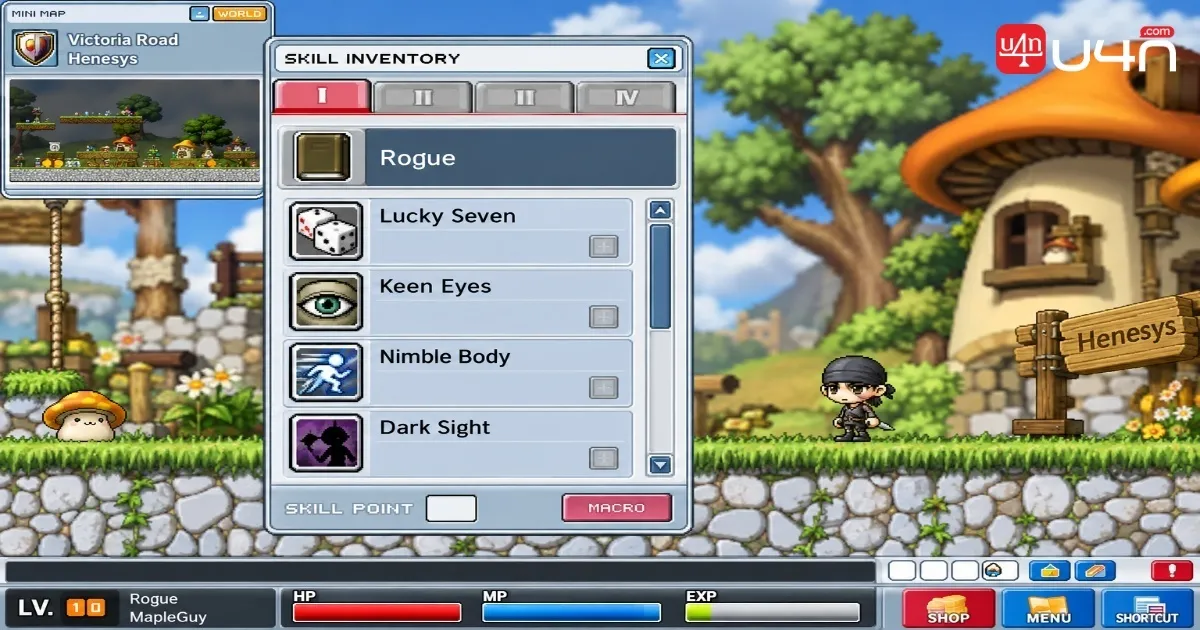
For players planning to use claws and pursue the Assassin path, Lucky Seven is the core attack skill. The recommended route prioritizes access to ranged combat, improves throwing-star range, and then invests in utility that remains useful as the character progresses.
Recommended skill priorities
| Skill | Priority | Purpose |
|---|---|---|
| Lucky Seven | Max | Main ranged attack |
| Nimble Body | 3 points initially, remaining points later | Provides accuracy and avoidability; also unlocks Keen Eyes |
| Keen Eyes | Max | Extends throwing-weapon range |
| Disorder | 3 points | Prerequisite for Dark Sight |
| Dark Sight | Max | Provides stealth utility for movement and positioning |
Suggested SP order
- At level 10, put the free SP into Lucky Seven.
- Raise Nimble Body to level 3 to unlock Keen Eyes.
- Max Keen Eyes to improve your throwing range.
- Max Lucky Seven to strengthen your main ranged attack.
- Put 3 points into Disorder to unlock Dark Sight.
- Max Dark Sight, then invest remaining points into Nimble Body.
The order reflects a deliberate trade-off: establish a useful ranged attack and its supporting range first, then invest in a utility skill that becomes more valuable when traveling through dangerous areas.
Players who want stronger early passive benefits may choose to invest more heavily in Nimble Body before maxing Dark Sight. The recommended route instead gives greater weight to stealth utility later in progression.
Lucky Seven vs. Double Stab: Choose Your Leveling Route
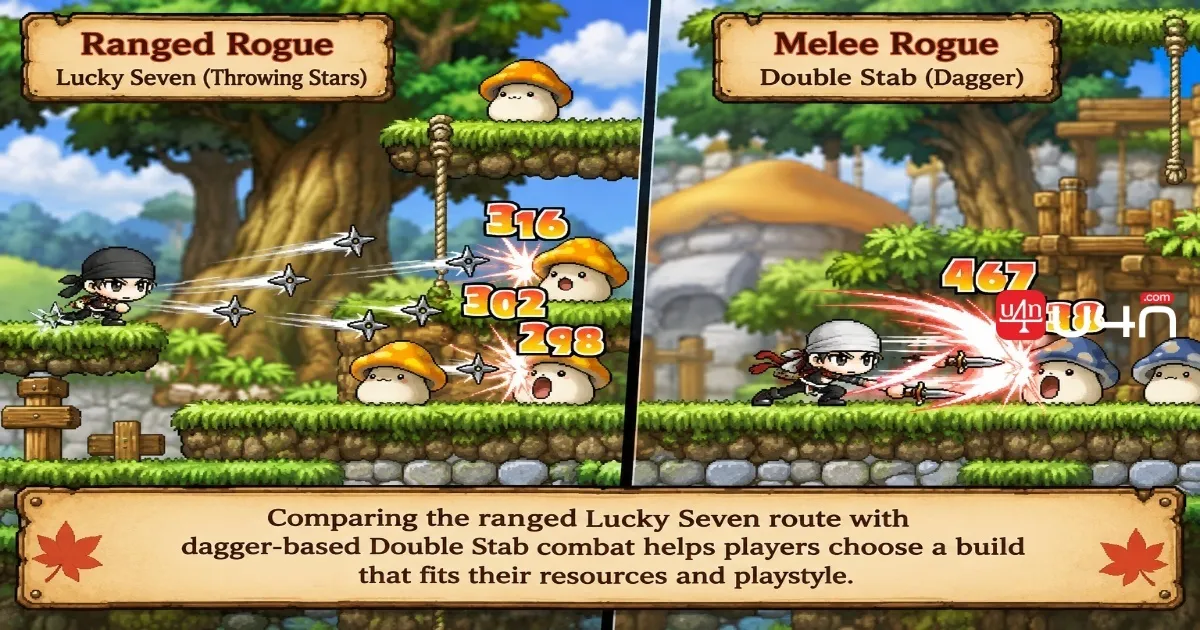
The first major decision for a Rogue is whether to build around Lucky Seven or Double Stab. Both have a place in the class's progression, but they support different combat styles.
| Consideration | Lucky Seven | Double Stab |
|---|---|---|
| Weapon style | Claw and throwing stars | Dagger |
| Combat range | Ranged | Melee |
| Main advantage | Attacks from a safer distance and benefits from Keen Eyes | Avoids throwing-star consumption |
| Main drawback | Requires ammunition and can be expensive to sustain | Requires close-range positioning |
| Best fit | Players targeting a claw-based Assassin route | Players committed to dagger-based combat |
The original guide favors Lucky Seven even for players considering Bandit. Its reasoning centers on the skill's damage behavior and the practical benefit of ranged attacks. That is a useful perspective, but it should not be interpreted as proof that every dagger-focused player must follow the same build.
For a claw user, Lucky Seven is the natural foundation. Keen Eyes increases the effective range of throwing weapons, making it easier to engage monsters without constantly moving into melee distance.
For a dagger user, Double Stab offers a direct alternative. You can avoid throwing-star expenses, but you give up the range advantage and must account for the time spent approaching monsters.
The right choice depends on your intended second job, available funds, weapon quality, and tolerance for consumable costs. We would not recommend investing in both attack skills without a clear reason, because doing so can delay the skill progression that defines your chosen route.
Early-Game Weapons and Throwing-Star Management
One of the easiest mistakes to make is switching to ranged combat before your character can sustain it comfortably. Lucky Seven may be the long-term priority, but ammunition costs, MP consumption, and limited range during early progression can make constant throwing inefficient.
Use a dagger when it makes economic sense.
If you obtained the Fruit Knife from the Maple Island quest, the original guide recommends using it during the early Rogue levels. Players who already have a Razor can also consider the beginner's triangular Zam Zamodor as a temporary alternative.
The objective is straightforward: use an available dagger to handle easy early monsters while conserving throwing stars and MP. Once your ranged setup becomes more practical, transition toward regular Lucky Seven use.
This is a temporary efficiency measure, not a reason to abandon your planned build. Compare the time required to defeat monsters in melee with the cost of using ranged attacks. If close-range combat becomes slower or more dangerous, the savings may no longer justify the switch.
Recharge throwing stars instead of repeatedly buying replacements
The original guide recommends keeping four to six sets of throwing stars available. That is a practical starting point for players who rely heavily on Lucky Seven, although the ideal quantity depends on your training location and consumption rate.
When your throwing stars run low, check the shop's Sell tab for the Recharge option instead of automatically purchasing another set. Recharging existing ammunition can be more economical, leaving more funds available for potions and equipment.
Our recommendation is to maintain a small operating reserve rather than spend all your available currency on ammunition. A build that deals serious damage but cannot afford to keep attacking is not an efficient leveling build.
Why Dark Sight Matters Beyond the Early Game
Dark Sight is easy to undervalue because it does not directly improve your attack damage. However, the skill offers utility that becomes more relevant as your character spends more time moving through monster-filled areas.
The original guide highlights two practical uses: navigating to and from training locations, and moving through dangerous areas without engaging every monster along the way. This becomes particularly useful when traveling between distant regions.
Disorder is a prerequisite for Dark Sight, so the initial investment of 3 SP is part of the route rather than a recommendation to maximize Disorder itself. Its direct combat utility is limited for a player whose main attack is ranged, but the prerequisite unlocks a more useful tool.

Dark Sight and Haste
The original guide also warns that Dark Sight's skill level can affect the handling of Haste's movement-speed benefit. According to the author's experience, entering Dark Sight before maxing it can remove the speed effect, requiring Haste to be cast again afterward.
This interaction is worth checking in the active game build before committing to a skill order. If it works as described, investing in Dark Sight can reduce friction during travel and make the skill more convenient to use.
The broader lesson is that skill value should not be measured by damage alone. A skill that improves movement, positioning, or safe traversal can save time across an entire leveling session, even if it contributes nothing to a monster's health bar.
Summary
Our recommended Rogue approach is to prioritize LUK while meeting the DEX requirements of your intended equipment, build around Lucky Seven if you are pursuing a claw-based route, and invest in Keen Eyes before completing the main attack skill. Dark Sight is a strong utility priority once its prerequisite is available, while Nimble Body receives the remaining points in the recommended route.
The key is to balance offensive growth against the cost of sustaining it. Use a dagger when it makes early progression more economical, recharge throwing stars when possible, and avoid spending AP on DEX without a clear equipment goal.
A good build is not simply a list of maxed skills. It is a progression plan that keeps your damage, mobility, equipment access, and spending aligned. Before making major purchases, compare your available MapleStory Classic World Items against your actual equipment requirements and intended leveling route.
FAQ
Should I use Lucky Seven or Double Stab for my first Rogue?
We recommend Lucky Seven for a claw-focused build targeting Assassin. Double Stab remains a reasonable choice for players committed to dagger combat, particularly when ammunition costs are a concern.
How should I allocate AP as a Rogue?
Prioritize LUK while monitoring the DEX requirements of your intended equipment. The level-minus-five guideline can serve as a rough reference, but equipment requirements should determine your actual allocation.
Why should I max Keen Eyes?
Keen Eyes increases throwing-weapon range, helping you engage enemies from farther away. For a Lucky Seven build, this supports safer positioning and more consistent ranged combat.
Is Dark Sight worth maxing during the first job?
The recommended route prioritizes Dark Sight after Lucky Seven and Disorder. Its value comes from stealth and travel utility rather than direct damage. Players who prefer passive combat benefits may adjust the timing of their investment.
Should I buy new throwing stars whenever I run out?
Not automatically. Check whether the shop offers a Recharge option for your current throwing stars. Keeping several sets available and replenishing them economically helps preserve funds for potions and equipment.
When should I switch from Lucky Seven to daggers?
There is no universal switching level. The original guide suggests that some players transition around levels 37–40, but that is a personal recommendation rather than a mandatory breakpoint. Consider your weapon upgrades, second-job direction, skill investment, and the ongoing cost of ammunition before changing routes.