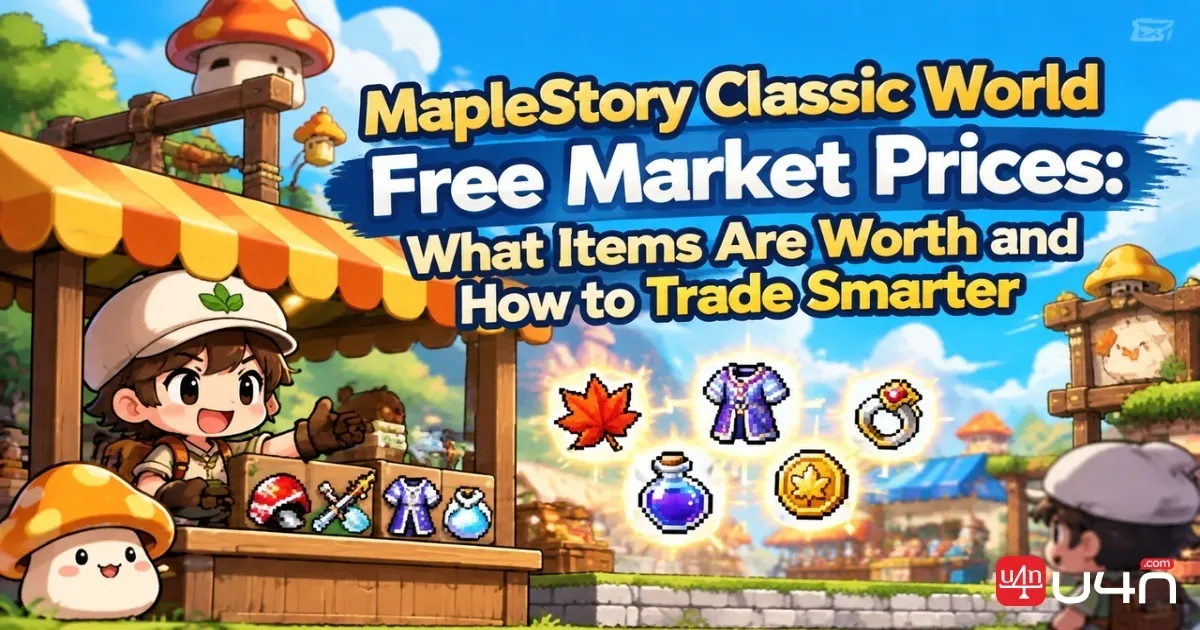
The Free Market in MapleStory Classic World is more than a place to buy equipment and sell spare drops. During Founder's Access, prices can shift quickly as players level up, demand for upgrades grows, and the Mesos supply changes. For anyone building wealth before the October 21, 2026 Grand Launch, understanding the market matters just as much as knowing where to farm. Tracking MapleStory Classic World Mesos alongside actual item sales can help us separate realistic prices from optimistic listings. Nexon lists October 21, 2026, as the official launch date in its Founder's Package announcement.
Our team approaches the Free Market from a practical trading perspective: a listed price is only a seller's expectation, not proof that someone will pay it. The figures below provide a starting point for comparing common goods, equipment, and scrolls. Because community estimates can quickly become outdated quickly, treat them as indicative prices rather than guaranteed current values, and check recent listings and completed trades before committing to a purchase.

Current MapleStory Classic World Free Market Prices
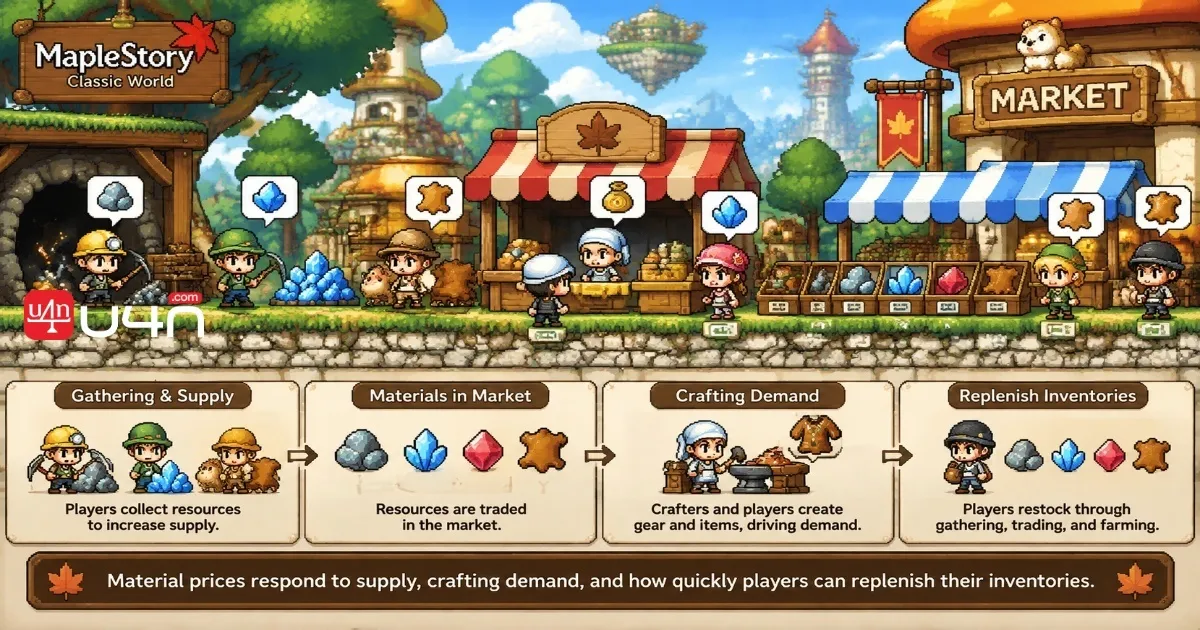
The market covers everything from basic crafting materials to equipment and upgrade scrolls. Their prices depend on different factors, so comparing every item against one general market average can be misleading.
The following table reproduces the estimates provided in the original market report. These figures have not been independently verified as current completed-sale prices.
| Item | Estimated Price (Mesos) | Market Consideration |
|---|---|---|
| Wooden Top | 150,000+ | Compare demand and availability before accepting a premium listing |
| M-Star | 150,000+ | Check comparable offers and item-specific demand |
| Claw Attack Scroll | 80,000+ | Scroll prices can change with upgrade demand |
| Red Viper | 50,000+ | Compare equivalent equipment and available listings |
| Arwin's Glass Shoes | 40,000–50,000 | Check item details and competing offers |
| Weighted Earrings | Around 8,000 | Compare similar accessories before buying |
| Iron Ore | Around 4,600 | Check recent material trades and stack sizes |
| Garnet | Around 1,600 | Consider crafting demand and current supply |
| Pure Water | Around 1,000 | Compare the cost of individual and bulk purchases |
| Leather | Around 250 | Small unit-price differences matter when trading in volume |
Price note: These are estimates from the supplied report, not a live price feed. Actual values may differ by trading date, item condition, supply, and demand.

Why Item Categories Matter
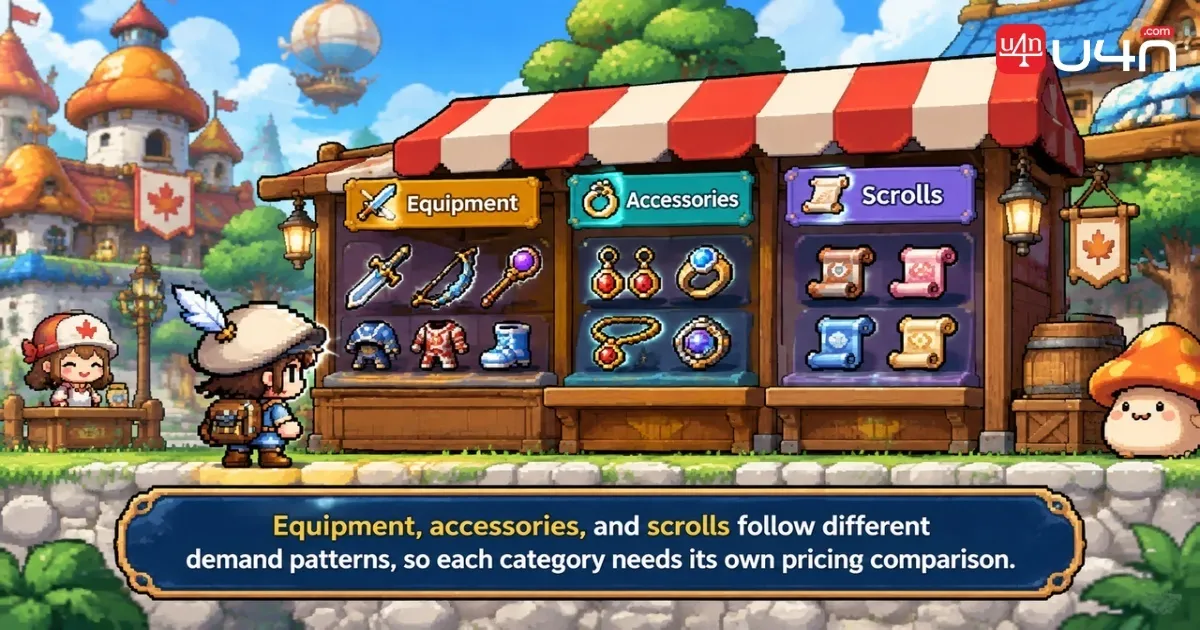
Equipment, scrolls, and crafting materials do not behave identically in the market.
Equipment prices depend on the number of available alternatives, the usefulness of the item, and how many players are looking for an upgrade. Scrolls can attract stronger demand when more players begin investing in equipment progression. Basic materials, meanwhile, are often more sensitive to supply and the number of players gathering or crafting.
We recommend comparing like with like. A rare equipment listing should not be judged using the same logic as a stack of common materials. For equipment, inspect the exact item and its relevant attributes. For materials, compare the unit price and total quantity. For scrolls, check that the scroll type and upgrade percentage match.
How Mesos Supply Can Affect Free Market Prices
A market can become unstable when the amount of currency circulating among players changes faster than the supply of goods.
The original report attributes recent volatility partly to a Steal skill exploit that allegedly allowed Bandit characters to generate large amounts of unearned Mesos. Community discussion also reported concerns about unusually profitable use of the skill. However, claims about the exploit's exact economic impact and a market-wide 20% increase in high-end item prices should not be treated as established measurements without reliable before-and-after data.
The underlying economic mechanism is straightforward. If more Mesos enter circulation while the supply of desirable equipment remains limited, some buyers may become willing to pay more. Sellers may then raise their asking prices, particularly for items that are difficult to replace.
But additional currency does not automatically increase every price. If material supply grows faster than demand, prices can fall instead. A temporary rush to sell can also push prices down even when the broader economy is experiencing inflation.
What Players Should Watch
When evaluating a sudden price change, our team looks at three signals:
- Supply: Are more copies of the item appearing in the market, or has availability tightened?
- Demand: Are players actively buying the item, or are sellers repeatedly relisting it without a sale?
- Transaction history: Are completed trades confirming the new price, or are only asking prices moving upward?
These checks help distinguish a genuine shift in market value from a short-lived pricing spike. A hotfix or exploit correction may change player behavior, but prices do not necessarily return to their previous levels immediately.
Listing Prices vs. Actual Sale Prices
One of the most important habits in Free Market trading is separating what sellers ask for from what buyers actually pay.
The original report claims that 93% of items sell below their median asking price and that sellers typically list around 40% above the prices buyers accept. Those figures would indicate a substantial gap between seller expectations and completed transactions, but the report does not provide enough detail about the sample or calculation method to establish them as universal market statistics.
An expensive listing does not establish an item's market value.
How Buyers Can Avoid Overpaying
Before purchasing an item, compare several equivalent listings instead of choosing the first available offer. Pay attention to the quantity, attributes, and condition of the item, and check recent sales where reliable records are available.
If a seller asks substantially more than comparable offers, consider whether scarcity or immediate demand justifies the premium. If neither does, waiting or negotiating may be the better option.
How Sellers Can Price Items More Effectively
Sellers should start with comparable listings, then use completed sales to judge whether those asking prices are realistic. A high listing that remains unsold for days is not necessarily a useful benchmark.
The right price also depends on how quickly an item needs to sell. A player who wants Mesos immediately may reasonably accept a lower offer, while someone selling a scarce item may prefer to wait for a suitable buyer. Neither approach guarantees the best outcome, but both are more deliberate than copying the highest visible price.
Free Market Shop Costs and Trading Overhead
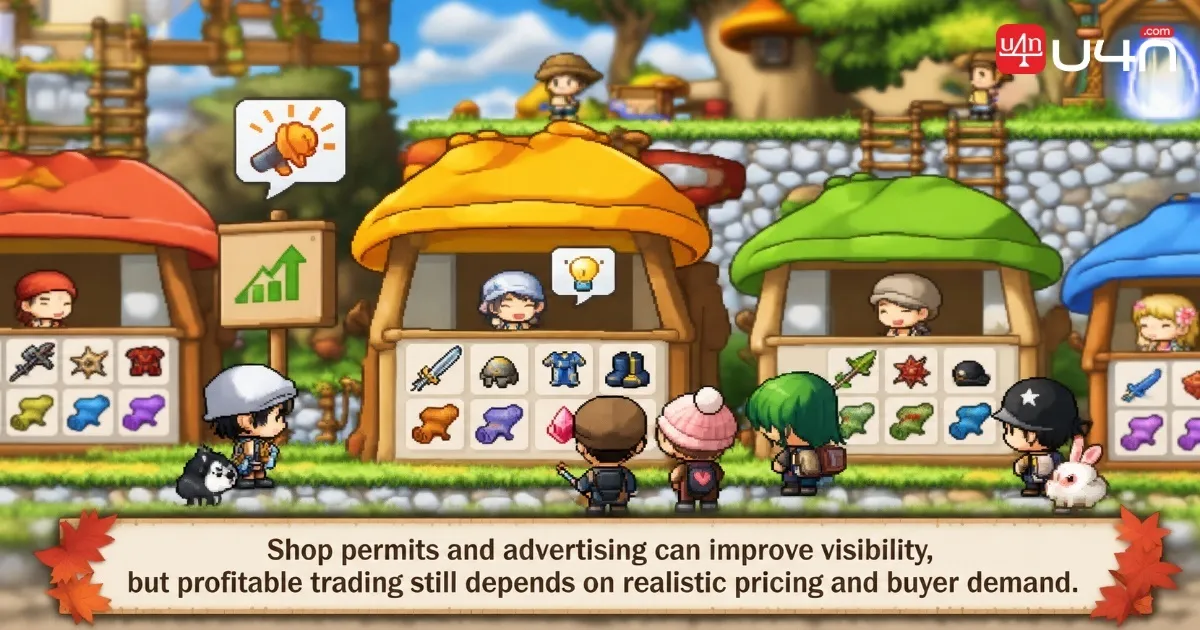
Running a shop involves more than choosing a price. Depending on the available shop system and the player's trading approach, permits and advertising can add costs that should be considered before setting a target profit.
The supplied report lists the following Cash Shop prices. Check the current in-game store and item descriptions before purchasing, as availability and terms may change. The Classic World Cash Shop price reference also lists the Founder's Mystery Fashion Crate and Fall Store Permit details.
| Item | Reported Cost | Reported Details |
|---|---|---|
| Fall Store Permit | 3,000 NX | Reportedly lasts 90 days and supports up to 18 listed items |
| Founder's Mystery Fashion Crate | 3,500 NX per crate | Contains random permanent cosmetic covers that may be traded if the applicable rules allow it |
| Super Megaphones | Not specified | Used to advertise shop locations or trading offers |
Does a Shop Permit Make Trading More Profitable?
A permit can make it easier to display several items in one place, but access to a shop does not guarantee sales. Before spending NX, consider how often you trade, the value of your inventory, and whether your items are likely to attract buyers.
Advertising can improve visibility, but its value depends on demand and competition. For inexpensive materials, the extra expense may not be worthwhile. For a sought-after item, reaching more potential buyers may be more useful.
Cosmetic crates require a different calculation. Even if an item can be traded for Mesos, the value of a random reward depends on what drops, how many similar items are available, and whether buyers want that cosmetic. Buying a crate is therefore a speculative purchase, not a reliable method of generating profit.
We recommend treating NX expenditure and Mesos earnings as separate parts of the trading decision. Do not assume that spending real money will produce a predictable in-game return.
Summary
The MapleStory Classic World Free Market rewards players who compare prices, pay attention to supply, and distinguish seller expectations from completed transactions. Equipment, scrolls, and materials each follow different demand patterns, so a single market-wide estimate cannot reliably value every item.
For buyers, the priority is to compare equivalent offers and avoid paying a premium without a clear reason. For sellers, recent sales and realistic pricing are more useful than copying the highest listing. Players considering permits, advertising, or cosmetic crates should also account for those expenses before estimating potential returns.
As the market develops toward Grand Launch, use MapleStory Classic World Items price references as a starting point, not a promise of what any item will sell for. Regularly checking current listings and transaction records will provide a stronger basis for trading decisions than relying on a single snapshot of the economy.
FAQ
Where can I check MapleStory Classic World Free Market prices?
Use community price-check tools and trading hubs to compare listings and reported sales. Check the date and methodology of each source, since some trackers display asking prices while others report completed trades or player-submitted estimates.
Are the prices in this guide guaranteed to be current?
No. They reproduce the estimates supplied in the original report. Prices can change as supply, demand, player progression, and market conditions evolve, so verify the current value before buying or selling.
Why might an item sell for less than its listed price?
A seller may have priced the item too aggressively, competing listings may offer better value, or demand may have weakened. Some sellers also accept lower offers when they want to convert inventory into Mesos quickly.
Did the Steal skill exploit cause all Free Market prices to rise?
That conclusion cannot be established from the supplied figures alone. Increased currency supply can put upward pressure on some prices, but the effect varies by item and depends on supply, demand, and player behavior. Reliable transaction data before and after the reported fix would be needed to measure the actual impact.
Should I buy a Fall Store Permit or a Founder's Mystery Fashion Crate to make Mesos?
Neither purchase guarantees a profit. A shop permit is an operating expense whose value depends on how much you sell. A random cosmetic crate has uncertain outcomes and resale demand. Check the current terms and evaluate the potential cost before spending NX.