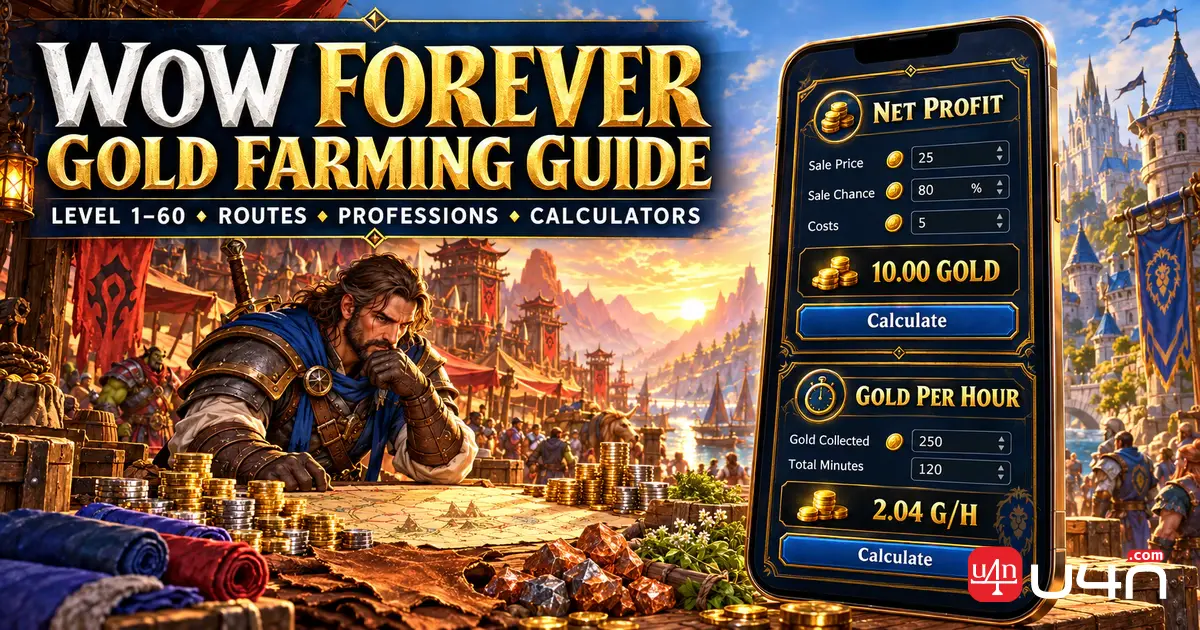
WoW Forever Gold Farm: The Short Answer
Last fact-checked: October 16, 2026. WoW: Forever is still in beta, and Blizzard can change profession recipes, vendor values, drop rates, riding costs, and Auction House behavior before the global launch on November 4, 2026.
The strongest WoW Forever gold farm is not one secret camp. It is a progression system: keep leveling, collect materials that are already on your route, convert only when the margin is proven, and leave a farm as soon as competition or travel time destroys its gold per hour. That conclusion reconciles the two loudest launch-week arguments. Greedsy demonstrated that a Tailoring/Enchanting loop can generate substantial early seed capital, while experienced Classic players on Reddit correctly point out that higher levels unlock less-contested materials, richer vendor trash, better dungeons, and more valuable buyers.
Player rule: farm on the way, not instead of the way. A method is good only when its realized gold plus character progress beats the value of continuing to level.
This guide uses beta observations, the supplied Greedsy transcript, community debate, Blizzard's published system descriptions, and current Wowhead profession data. It does not pretend a beta price is a launch-day guarantee. Use every threshold below as a decision rule, then replace the example prices with the numbers on your own ruleset.
| Character Stage | Primary Gold Plan | What You Are Really Building | Leave or Pivot When... |
|---|---|---|---|
| Levels 1–10 | Quest, vendor, skin nearby corpses, collect cloth | 10–20 silver of liquid seed money | Gathering sends you off-route or bags fill with low-value stock |
| Levels 10–25 | Gather while leveling; test one small craft/disenchant batch | Bags, training, profession skill, working capital | Crafted output sells below material opportunity cost |
| Levels 25–39 | Mid-tier ore, herbs, leather, cloth, dungeon stacks | A protected riding reserve | You are spending the reserve on gear or speculative flips |
| Levels 40–49 | Mounted routes, dense beasts/humanoids, Mithril-era materials | Faster movement and access advantage | A famous spot is crowded enough to lower kills or nodes per hour |
| Levels 50–60 | High-tier materials, recipes, dungeons, raid-prep consumables | Endgame inventory and a second riding reserve | Listings do not sell or repair/travel costs erase the margin |
| Level 60 | Specialize: gathering, crafting, dungeons, or market making | Repeatable net gold per hour | Your seven-day sale data says another market is stronger |
Can You Really Make 10 Gold on Your First Day?
Yes, a beta test produced more than that—but the method is a case study, not a promise. In the supplied transcript for Greedsy's video, the character finished with 13 gold 25 silver after about 6.5 hours, including proceeds still moving through the Auction House. The run also lost time to server downtime and an unnecessary trip to Orgrimmar. However, beta cloth prices, inexperienced sellers, temporary population patterns, and launch competition can all move the result sharply in either direction.
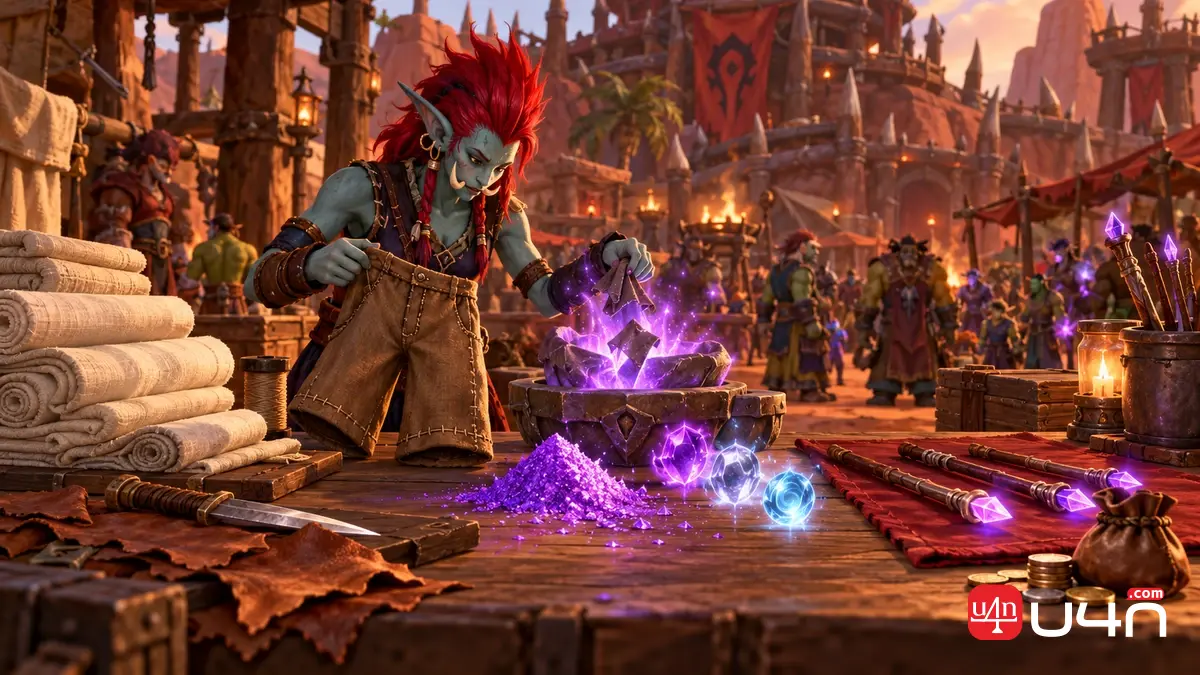
The Greedsy Tailoring/Enchanting Loop, Rebuilt
Step 1: Reach a Small Seed-Capital Threshold
Complete the fast starter quests, loot everything, train only abilities that materially improve kill speed, and take the early gathering manual that best fits your route. On the Horde test route, Skinning was especially efficient because other players left fully looted beast corpses behind. Wowhead's current WoW Forever Skinning guide confirms that starter-zone manuals can teach Apprentice Skinning and that other players' fully looted kills can be skinned.
The observed run reached roughly 11 silver through questing and gathering, then sold three Linen Bags to reach around 17 silver. Your exact opening balance matters less than the rule: do not start a conversion loop so early that thread, wood, deposits, or one bad batch leaves you unable to train or travel.
Step 2: Turn Linen into Disenchantable Gear
Train Tailoring and Enchanting. Convert Linen Cloth into Bolts of Linen Cloth, craft Brown Linen Pants, and disenchant the pants. In the beta observation, each pair yielded one of four outcomes: one or two Strange Dust, or one or two Lesser Magic Essence. The essences supported wand crafting; Strange Dust was listed for other enchanters.
Before crafting, write down this formula:
Craft cost per pair = (4 × Linen Cloth price) + thread cost
Then compare three exits for every green item:
- Vendor value: instant, certain cash.
- Auction value: expected sale price minus deposit risk and market costs.
- Disenchant value: expected material value, adjusted for the chance of each result and the time needed to sell it.
Step 3: Use Vendor Wands as the Cash-Flow Engine
The beta route used Lesser Magic Wands with a reported 5-silver vendor value, then Greater Magic Wands at roughly 70 Enchanting with a reported 15-silver vendor value. Vendor wands matter because they turn part of a volatile material pile into immediate liquidity. Strange Dust can finance profit later, but only sold dust is gold; an unsold listing is inventory.
Greedsy's early example moved from 17 silver to about 24 silver in vendor cash, with six Strange Dust listed for roughly another 12 silver. Repeating the cycle with larger batches eventually produced the reported 13g 25s total. The clever part is not “craft pants forever.” It is the split between fast guaranteed liquidity and slower Auction House upside.
| Observed Beta Checkpoint | Reported Result | What the Number Teaches |
|---|---|---|
| Opening quests, skinning, and early bags | About 17 silver available | Build enough cash to survive one conversion cycle |
| First wand/dust pass | About 24 silver cash plus six Strange Dust listed near 12 silver | Separate liquid gold from listed inventory |
| Maximum Linen Cloth buy price used in the run | 50 copper per cloth | A personal ceiling prevents emotional overbuying |
| Enchanting around skill 70 | Greater Magic Wand reported at 15 silver vendor value | Profession breakpoints can improve cash conversion |
| End of recorded session | 13 gold 25 silver in about 6.5 hours | Promising beta evidence, not a guaranteed launch yield |
When the “10 Gold” Method Is Actually Bad
- Linen is above your ceiling. Greedsy refused cloth above 50 copper each; your ceiling may be lower after deposits and thread.
- Dust is listed but not selling. Count it at a conservative liquidation price, not the cheapest optimistic listing.
- You are first in the leveling pack. Stopping for two hours may cost access to higher-tier nodes, cloth, recipes, and customers.
- The market is saturated. A realmless ruleset creates a larger player ecosystem, which can mean more buyers and much more supply.
- You dislike market play. Skinning plus normal leveling is less fragile and requires far fewer price checks.
The Best WoW Forever Gold Farming Route from Level 1 to 60

Levels 1–12: Liquidity Beats Optimization
Your job is to avoid being poor, not to become rich. Take the gathering manual from the new early profession quest, vendor grey items, sell or use the first bags, and keep a small cash buffer. Blizzard's profession changes make the starter decision unusually valuable: current Wowhead data says the early quest can teach Mining, Herbalism, or Skinning, while Blizzard has described professions as a meaningful part of Forever's long-term systems.
- Best low-friction choice: Skinning on beast-heavy routes.
- Best future crafting supply: Mining where Copper Veins line up with quests.
- Best light-inventory route: Herbalism when herbs are directly on the road.
- Best combat drop: Linen from dense humanoids, but do not camp them if tags are contested.
Levels 12–25: Let the Leveling Route Pay You Twice
Keep one profession that monetizes movement. Run dungeons when they also complete quests, unlock flight paths, or replace weak gear. A dungeon is a strong gold activity when one run combines experience, quest rewards, cloth, green items, recipes, vendor trash, and profession materials. It is weak when group formation, travel, deaths, and resets consume most of the hour.
This is also the right stage to test—not blindly scale—Tailoring/Enchanting. Craft five to ten items, record the output, and stop if the material opportunity cost is higher than the finished value.
Levels 25–39: Protect the Riding Fund
Blizzard has confirmed a Burning Crusade-style model in which more of the mount expense sits in riding training and a mount is granted when the skill is learned. The exact launch prices were not published on Blizzard's main announcement at the time of this review. Community and beta guides commonly use 100 gold at level 40 as a planning target. Treat that as a working reserve, not a final official price.
At this stage, mid-tier ore, herbs, leather, Silk Cloth, and useful BoE greens can be more important than a famous single drop. Keep training and bag expenses outside the reserve. A 5-gold “upgrade” that saves only a few minutes before replacement is often a 5-gold delay to your mount.
Levels 40–49: Use the Mount to Expand the Route
Once mounted, compare loops by sellable value per full circuit, not by the value of the rarest node. Stranglethorn Vale is attractive because beasts, humanoids, herbs, mining nodes, quests, and vendor trash overlap. The Reddit discussion behind the current search trend also highlights gorillas and other beasts with worthwhile grey drops near the mount-level range. Treat that as a route candidate, not a guaranteed monopoly.
Levels 50–60: Sell Access, Scarcity, and Preparation
High-level players reach markets the leveling pack cannot efficiently supply: Thorium-era ore, high herbs, Rugged Leather, Runecloth, rare patterns, dungeon BoEs, and raid-preparation consumables. This is why “keep leveling” is more than generic advice. Access itself is an economic moat.
A second widely reported planning target is 1,000 gold around level 60 for the higher riding tier. Again, verify the final trainer price after launch. Do not liquidate irreplaceable profession stock at a discount solely to hit a number that may change.
| Level Band | Route Families to Test | Best Customers | Main Hidden Cost |
|---|---|---|---|
| 1–12 | Starter beasts, Copper, Peacebloom-tier herbs, Linen humanoids | New crafters and bag buyers | Detours and bag space |
| 12–25 | The Barrens, Westfall, Darkshore, Loch Modan, early dungeons | Players leveling first professions | Competition for tags and nodes |
| 25–39 | Wetlands, Ashenvale, Hillsbrad, Thousand Needles, Scarlet-era humanoids | Riding savers and mid-tier crafters | Travel and speculative gear buys |
| 40–49 | Stranglethorn Vale, Tanaris, Feralas, Hinterlands, dense dungeon routes | Fast levelers and profession power-levelers | Repair bills and overcrowded “best spots” |
| 50–60 | High-level zones, endgame dungeons, rare recipes, raid-prep supply | Guilds, raiders, PvP players, alt crafters | Unsold niche inventory |

Best Professions for a WoW Forever Gold Farm
Forever gives professions more economic weight than a straight Vanilla rerun. Wowhead reports more than 600 new recipes, profession objects for the Camping system, starter-zone gathering manuals, and Legacy interactions. Blizzard's official Legacy overview says non-gathering primary professions grant Legacy Points at skill 150, 225, and 300. It also lists profession perks such as Bountiful Harvest, Bartering, Working Overtime, and Performance Bonus.
| Profession | Best Use | Why It Can Win | Failure Mode |
|---|---|---|---|
| Skinning | Fast leveling and beast quests | Turns kills—including eligible corpses left by others—into extra materials | Leather supply can overwhelm demand |
| Mining | Route farming and Blacksmithing/Engineering demand | Ore and bars feed multiple crafts; Scarce materials add upside | Node detours and raw-vs-smelted mispricing |
| Herbalism | Consumable markets | Potions create repeat demand; lower herbs can become bottlenecks | The highest-level herb is not always the best gold per hour |
| Tailoring + Enchanting | Cloth conversion, bags, disenchanting, wands | Multiple exits: finished goods, dust/essence, or vendor liquidity | Destroys value when cloth is expensive or dust does not sell |
| Alchemy | Repeat consumables and raid preparation | Demand is consumed rather than permanently equipped | Margins collapse when everyone crafts the same potion |
| Blacksmithing / Leatherworking | New leveling gear and specialty recipes | Forever's expanded recipe pool may create meaningful niches | Self-gathered materials are incorrectly treated as free |
| Fishing + Cooking | Low-competition consumable supply | Food and specialist fish can serve repeat buyers | Low activity if the recipe is not currently relevant |
How the Legacy System Changes the Long Game
Legacy Points are account-wide, but each character spends them independently. Blizzard says the launch spending cap is 16 points per character. For economy-focused characters, that makes specialization more interesting: a dedicated gatherer can lean toward extra Scarce resources, while a crafting character values skill-up efficiency and vendor-cost reductions. The important restraint is that the system rewards broad play; it does not make a weak market profitable by itself.
- Bountiful Harvest: improves the amount of Scarce resources found through Mining, Herbalism, and Skinning.
- Working Overtime: improves the chance to gain tradeskill points.
- Bartering: reduces vendor purchase costs, useful for material-heavy crafts.
- Performance Bonus: can increase Merchant's Favor from profession supply activity.
Auction House Strategy: Calculate Realized Profit

Use the two calculators below to test a craft, flip, or farming session with your own Auction House data. Enter every value in gold; for example, 50 silver equals 0.50 gold.
This prevents the most common Classic economy error: calling a bag full of unsold auctions “profit.” Keep a seven-day ledger with quantity posted, quantity sold, average realized price, deposits, and time invested. Scale only after two or three profitable small batches.
Vendor, Auction, Disenchant, or Hold?
| Item Type | Default Decision | Override the Default When... |
|---|---|---|
| Grey item | Vendor | It has a known quest or collectible use |
| White profession material | Check Auction House | The vendor value beats the realistic net sale value |
| Green BoE | Compare vendor, sale, and disenchant | A desirable stat/slot combination has real buyer demand |
| Rare recipe | Research before listing | You can craft a higher-margin niche yourself |
| New Forever reagent | Hold a small sample and identify uses | Demand is already proven and the price is attractive |
| Scarce material | Price separately from common output | A specific craft creates higher conversion value |
The Three Launch Markets Worth Watching
- Bags: every new character needs space, and first suppliers can charge for convenience—but supply catches up quickly.
- Profession bottlenecks: low- or mid-tier materials may outperform endgame materials when thousands of players hit the same skill range.
- Raid and dungeon preparation: consumables, resistance tools, enchants, ammunition, food, and repair-adjacent supplies create repeat demand when organized groups mature.
Buying or Selling WoW Forever Gold Through U4N
Farming should remain the core of this guide because it is the only route fully inside normal gameplay. Some players also compare third-party marketplaces when time is scarce, while dedicated farmers may investigate selling excess inventory. U4N brings buyer listings, seller tools, escrow-style platform handling, support, and localized access into one marketplace. Players can review current listings to buy WoW Forever gold, while eligible sellers can use the same market to sell WoW Forever gold.

U4N Seller Transaction Fees
U4N uses a tiered seller fee based on cumulative transaction volume. The first $1,300 is charged at 0.1%; only the portion above $1,300 is charged at 5%. Check the live seller dashboard for the applicable accounting period and current terms before listing.
| Cumulative Transaction Amount | Fee Formula | Example | Effective Rate in Example |
|---|---|---|---|
| ≤ $1,300 | Amount × 0.1% | $1,000 × 0.1% = $1.00 | 0.1% |
| > $1,300 | ($1,300 × 0.1%) + ((Amount − $1,300) × 5%) | At $1,500: $1.30 + ($200 × 5%) = $11.30 | About 0.753% |
Sellers should also read the U4N Seller Protection Policy. Current requirements include accurate listings and direct upload of valid delivery evidence; higher-value orders may require video proof.
U4N Affiliate Program: A Second Monetization Layer
Gold is not the only way a guide creator, guild community, or marketplace seller can monetize useful knowledge. Under the current U4N Affiliate Program:
- 20% recurring commission: the current program page calculates commission from U4N's platform net revenue on completed referred orders; terms apply.
- Up to two years: purchases made by a user who registered through your referral code can continue generating commission for two years.
- Flexible withdrawals: the program supports multiple global payout methods.
- No commission expiry: available earnings can be withdrawn or used later rather than expiring on a timer.
Localized Access for International Buyers and Sellers
U4N's localized marketplace experience is designed for an international audience across ten language options: English, French, German, Spanish, Brazilian Portuguese, Polish, Japanese, Chinese, Simplified Chinese, and Traditional Chinese. Localized navigation reduces avoidable mistakes when buyers compare region, ruleset, faction, delivery method, and quantity, and it helps sellers describe stock to the correct audience.
A Seven-Day Gold-Farming Test Plan
If you want a method that survives launch volatility, run a controlled test instead of copying a headline.
- Day 1: level normally, take a gathering profession, and record vendor gold plus materials collected.
- Day 2: price ten common materials at two different times; record actual sales, not just listings.
- Day 3: test one five-to-ten-item crafting or disenchant batch.
- Day 4: run one dungeon with quests and one open-world route for equal time.
- Day 5: test a profession bottleneck rather than the highest-level material you can reach.
- Day 6: calculate realized gold per hour after travel, deposits, vendor reagents, and repairs.
- Day 7: scale the winner, liquidate slow stock, and protect the riding reserve.
Repeat the test whenever a major content release, profession adjustment, raid opening, or population shift changes demand. Blizzard has positioned Forever as a long-lived version of Azeroth; a durable process will outlast a one-week farm.
Common WoW Forever Gold Farming Mistakes
- Copying a beta threshold forever: 50 copper Linen was one player's ceiling, not a universal law.
- Counting listed stock as cash: unsold Strange Dust cannot pay a trainer.
- Stopping progression too early: access to the next material tier may be worth more than another hour of Linen.
- Ignoring opportunity cost: ore you mined still has a market value when used in your own craft.
- Buying every skill and gear upgrade: train for kill speed, survival, or group utility; postpone luxuries.
- Farming a famous spot through heavy competition: empty routes with slightly weaker loot often win on realized hourly value.
- Overlooking ruleset differences: PvP deaths, travel danger, population, and faction balance can change route efficiency.
- Ignoring publisher rules: third-party transactions can create account risk regardless of marketplace safeguards.
WoW Forever Gold Farm FAQ
What is the best WoW Forever gold farm at launch?
For most players, it is gathering—especially Skinning—while continuing to level. Tailoring/Enchanting can outperform it when Linen and cheap green items sit below a tested buy ceiling, but only if dust and essences actually sell or can be converted into profitable vendor items.
Is 10 gold on the first day realistic?
It happened in the reviewed beta run: 13g 25s was reported after about 6.5 hours. Treat it as evidence that the loop can work, not a guaranteed launch result. Live cloth prices, competition, recipe values, and server stability will decide the outcome.
Should I stop leveling to farm Linen or Wool?
Usually not for long. Test a short batch, then compare its realized gold per hour with the value of reaching higher-tier zones. If you are ahead of the pack, protecting that access advantage is often more valuable than farming low-tier cloth.
Which profession makes the most gold in WoW Forever?
Skinning is the lowest-friction leveling choice; Mining and Herbalism benefit route farmers; Tailoring/Enchanting offers a strong early conversion loop; Alchemy can win on repeat consumables. The best choice is the one supported by your route and current buyers.
How much should I save for riding?
Use 100g near level 40 and 1,000g near level 60 as conservative beta-era planning reserves, but verify the final trainer prices after launch. Blizzard has confirmed the riding-cost model, not every final price in the main published overview.
Sources and Editorial Method
This guide distinguishes confirmed systems from beta observations and community strategy. It was built from the following source types:
- Official launch facts: Blizzard's WoW: Forever overview and Forever Found panel recap.
- Ruleset structure: Blizzard's Choose Your Ruleset article.
- Legacy and profession systems: Blizzard's Legacy System guide and Wowhead's profession changes overview.
- Profession route data: Wowhead's current Mining and Skinning guides.
- First-day field test: Greedsy's How to Get 10 Gold in Your First Day of WoW Forever, checked against the supplied transcript.
- Community counterpoint: the ClassicWoW discussion about leveling instead of pausing to farm.
- U4N marketplace facts: current Seller Protection and Affiliate Program pages, plus the business information supplied for this article.
Editorial note: World of Warcraft, WoW, and Blizzard Entertainment are trademarks of Blizzard Entertainment. U4N is an independent marketplace and is not affiliated with or endorsed by Blizzard Entertainment.