The latest Topps programs in MLB The Show 26 offer new player cards, packs, and plenty of reasons to spend time in Diamond Dynasty. But before we start grinding, our team recommends looking beyond the headline rewards. A good plan for earning MLB Stubs and progressing through multiple programs can save more time than simply chasing every mission on the list.
Black and Gold, Heavy Lumber, and Autumn Ascensions each offer different cards and objectives. Some rewards look more exciting than others, but the real opportunity lies in combining missions, choosing the right players, and making every game count. Here is how we would approach the programs while balancing card value, roster flexibility, and efficient PXP progression.
Topps Programs Overview: What Should You Prioritize?
The three programs offer a mix of player cards, packs, and program XP. However, not every reward deserves the same level of attention, especially when your lineup already has several competitive options.
| Program | Main focus | Our approach |
|---|---|---|
| Black and Gold | Kevin McGonigle, Chase Burns, Samuel Basallo, Paul Skenes, and related missions | Prioritize overlapping PXP objectives and use cards already available in your collection. |
| Heavy Lumber | Retro-styled cards featuring players. Such as Honus Wagner and Tony Gwynn | Evaluate hitting potential, defensive flexibility, and upgrade opportunities |
| Autumn Ascensions | Cards including Connor Griffin, J.J. Wetherholt, and Julio Rodríguez | Compare each card with your current roster before committing a lineup spot |
We would start by checking the program requirements rather than immediately building a team around the featured cards. A reward can be worth collecting without being an immediate upgrade to your starting lineup.
Packs and XP also matter. Even if a featured card does not fit your team, completing a program may still provide useful collection progress and additional opportunities to earn rewards. The key is to understand what you are working toward before deciding how much time to invest.
How to Complete Multiple Programs Efficiently
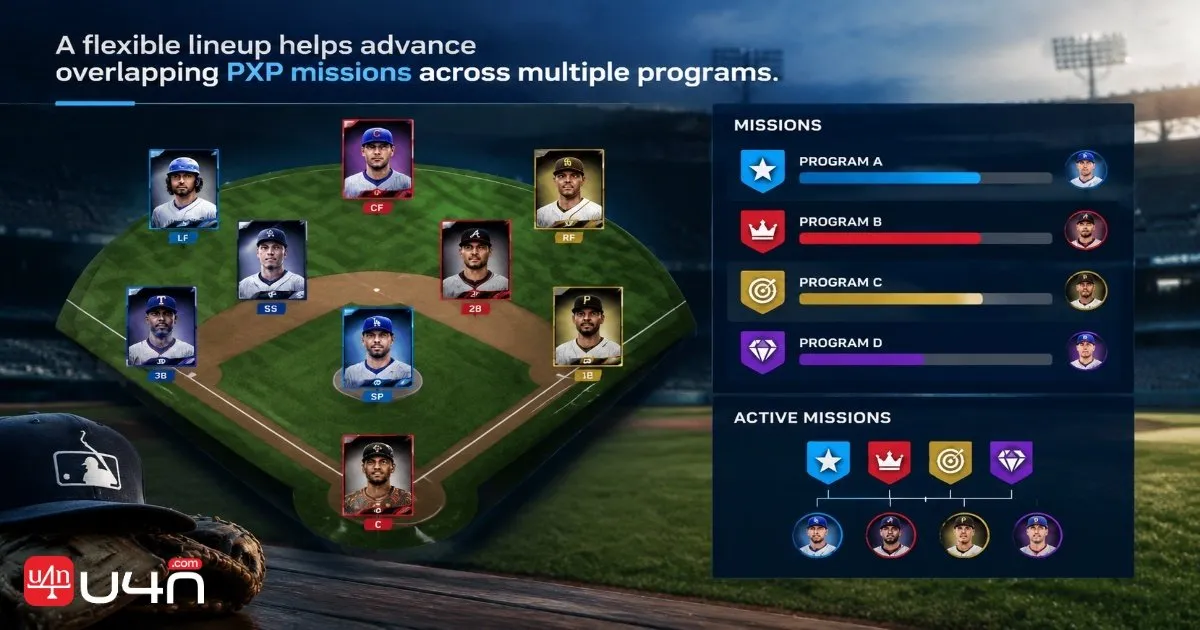
The biggest efficiency gain comes from completing compatible missions in the same games. Instead of treating each program as a separate grind, our team would build one roster around the objectives that overlap.
Understand the Program Point Threshold
In the programs described in the original review, each featured program has five missions worth 10 program points each, while only 40 points are required for completion. That means you can skip one mission without losing access to the program's completion reward. For a current breakdown of the Topps Update programs and their point thresholds, see the MLB The Show 26 Topps Update program guide.
This changes how we approach roster construction. If a mission requires a card you do not own, or a player who would contribute very little to your lineup, completing all five missions may not be necessary.
Before starting, check the current in-game requirements and confirm which missions count toward the program you want to finish.
Prioritize Missions That Overlap
The Bobby Witt Jr. PXP mission is especially important in the reviewed programs because it appears across all three. Using a suitable Bobby Witt Jr. card can advance several objectives while leaving room for other required players.
Pitching missions can also be convenient. If you have eligible versions of Paul Skenes and Chase Burns, consider using them where their missions apply. Pitchers can accumulate PXP through pitching appearances, allowing you to work toward those objectives without filling every position with a mission-specific hitter.
A practical priority list looks like this:
- Identify players who contribute to multiple active programs.
- Add required pitchers and other straightforward PXP targets.
- Fill remaining positions with players who satisfy team or position-based missions.
- Skip one low-value or inconvenient mission when the point threshold allows it.
- Replace players as soon as their required objectives are complete.
This approach prevents a common mistake: continuing to use a player after their mission is finished, even though another player could be earning progress toward an unfinished objective.
Black and Gold: Choose Missions Before Cards
Black and Gold features Kevin McGonigle, Chase Burns, Samuel Basallo, and Paul Skenes, alongside the recurring Bobby Witt Jr. objective. The original review highlights player-based missions requiring 500 PXP with the specified players, although the eligible card versions depend on the individual mission.
That distinction matters. Before adding a player to your roster, check whether the mission accepts any version of the player or requires a particular card series.
Which Missions Should You Prioritize?
We would generally favor the pitching objectives when the eligible cards are available and fit the planned game mode. Paul Skenes and Chase Burns are natural candidates for that approach.
Bobby Witt Jr. deserves special consideration because his mission can contribute to more than one active program. After those priorities are covered, choose between the remaining hitter objectives based on card availability and lineup fit.
Kevin McGonigle and Samuel Basallo may still be worth using if you need their progress, but neither should automatically take priority over a more useful overlapping objective.
Evaluate the Cards in Context
Paul Skenes has an appealing attribute profile, but the original review questions the lack of an outlier on his fastball. His pitch mix includes a sweeper, circle change, sinker, and splitter. Those options offer variety, yet velocity and individual pitch effectiveness still influence how threatening the arsenal feels in practice.
Chase Burns presents a similar consideration: strong attributes do not automatically make a pitcher dominant if his pitch mix lacks a standout weapon.
Samuel Basallo offers power against right-handed pitching and a strong throwing arm, making him an interesting catcher option. Kevin McGonigle has useful hitting traits, but his defensive limitations at shortstop make his best lineup role less obvious.
Our recommendation is to separate mission value from competitive value. A card can be useful for program progression without being the best long-term choice for your lineup.
Heavy Lumber: Hitting Potential and Upgrade Choices
Heavy Lumber is one of the more appealing parts of the update from a card-design and roster-building perspective. Honus Wagner and Tony Gwynn stand out in the original review because of their strong contact attributes, useful hitting quirks, and potential to benefit from power-focused upgrades.
Honus Wagner: A Strong Contact Foundation
Wagner's standout feature is his exceptional contact hitting, supported by strong speed and defensive attributes. His power is the main area the review identifies as a potential target for improvement.
A Power Mod may help address that limitation, particularly if you want to turn a contact-oriented card into a more complete offensive option. However, the best upgrade depends on the card's available customization and the resources you are willing to commit.
We would compare the expected improvement with other cards already in the lineup before investing heavily.
Tony Gwynn: Versatility With a Different Profile
Gwynn offers a similarly strong contact foundation, with differences in speed, arm strength, fielding, and power. His available secondary positions also provide more flexibility when building a roster.
A power-focused upgrade may be appealing here as well, but we would not assume that the same setup is automatically optimal for both players. Their defensive roles and existing attribute distributions should influence the final decision.
Heavy Lumber Mission Strategy
The program's missions include player-specific requirements and broader combinations involving positions or teams, as described in the review. Those broader objectives can help fill roster spots after the essential player missions are covered.
Rather than forcing every featured player into the lineup, use the mission rules to determine which cards are genuinely necessary. This leaves more room for productive hitters and pitchers who can continue advancing other objectives.
Autumn Ascensions: Find the Right Roster Fit
Autumn Ascensions offers another set of cards to evaluate, including J.J. Wetherholt, Connor Griffin, and Julio Rodríguez. The review suggests that their value varies considerably depending on the position, the attributes that matter most to your playstyle, and the alternatives already available.
J.J. Wetherholt: Watch the Defensive Details
Wetherholt has useful hitting quirks, including Dead Red, alongside respectable contact and power attributes. However, the review highlights a weakness in reaction to balls hit toward the left side of the infield.
That limitation matters when deciding whether to use him at shortstop or second base. Strong overall defensive attributes do not eliminate the risk of a slower reaction in a critical area.
We would consider his offensive traits alongside his defensive responsibilities rather than judging the card on a single standout attribute.
Connor Griffin: Speed and Contact Potential
Griffin offers strong contact attributes and excellent speed, with power against left-handed pitching identified as a potential weakness in the review. His defensive profile also has a reaction-related limitation that can matter at shortstop.
A power-focused upgrade may improve his offensive balance, but the choice should depend on whether you need another contact hitter, a speed option, or a more complete everyday player.
Julio Rodríguez: Balanced Does Not Always Mean Best
Rodríguez has a balanced hitting profile, good speed, useful defensive attributes, and hitting quirks. However, the original review questions whether he offers enough of a standout advantage to justify his place among the many strong outfield options available.
This is an important roster-building lesson. A card can perform well across several categories without being the best option in any one of them.
Before committing to Rodríguez, compare his role with the outfielders you already use. If his strengths do not address a weakness in your lineup, he may be more valuable as a collection piece or program objective than as a permanent starter.
Mini Seasons: Build a Lineup That Works for You
Mini Seasons provides a practical way to combine player missions, team-based requirements, and regular gameplay. The original review uses this mode to progress through the programs while earning additional rewards along the way. The game's official overview also highlights revamped Mini-Seasons campaigns and an upgraded PXP system in MLB The Show 26's Diamond Dynasty features.
Our team would approach each game with a clear plan rather than simply loading the lineup with every featured card.
A Simple Lineup-Building Workflow
Step 1: List the unfinished missions. Group them by player, team, position, and other eligibility requirements.
Step 2: Add the highest-priority overlapping players. Start with Bobby Witt Jr. where his mission applies, then include eligible pitchers and other required players.
Step 3: Fill the remaining positions. Use players who satisfy broader team or positional objectives without unnecessarily weakening the lineup.
Step 4: Track PXP after each game. Once a player completes the required objective, remove them if they no longer contribute to another active mission.
Step 5: Rebuild only when necessary. Avoid changing the entire lineup after every game. Replace completed objectives and preserve players who still contribute to multiple programs.
This method keeps your roster flexible while reducing the chance of earning progress that no longer helps you reach a program reward.
Which Difficulty Should You Play?
The original review contrasts lower-difficulty games with more challenging options. Lower difficulty may offer a more comfortable route for players who prefer consistent hitting, while greater difficulty can be worthwhile for experienced players who accumulate PXP efficiently.
There is no universal best choice. Your results depend on your hitting ability, pitching performance, and the specific objectives you need to complete.
We recommend choosing the difficulty at which you can make reliable progress without turning every game into a struggle. The goal is to finish the objectives efficiently, not to select the greatest difficulty simply because it is available.
Summary: Make Every Game Count
The smartest way to approach Black and Gold, Heavy Lumber, and Autumn Ascensions is to combine mission planning with selective card evaluation. Check the point threshold, prioritize overlapping objectives, use eligible pitchers where practical, and rotate completed players out of the lineup.
For card selection, focus on attributes that affect your actual lineup needs. Honus Wagner and Tony Gwynn offer interesting contact-oriented foundations, while the Black and Gold and Autumn Ascensions cards require more careful consideration of pitch mix, defense, power, and position fit.
Our team would rather complete a well-planned set of objectives than grind every mission without considering the reward. Keep your roster flexible, verify mission eligibility in-game, and use MLB The Show 26 Stubs and other resources thoughtfully when deciding whether a card is worth acquiring or upgrading.
FAQ
Do you need to complete all five missions in each program?
Not in the programs described in the original review. Each has five missions, and the 40-point completion threshold allows one 10-point mission to be skipped. Always confirm the current in-game requirements before relying on this structure.
Why should Bobby Witt Jr. be a priority?
The reviewed programs include a Bobby Witt Jr. PXP mission in each of the three programs. Using an eligible version can therefore contribute to multiple objectives. Check each mission's card eligibility before building your lineup around him.
Are Honus Wagner and Tony Gwynn worth upgrading?
Both offer strong contact-oriented foundations, and the review identifies power-focused upgrades as potential options. Whether those upgrades are worthwhile depends on the available customization, your resources, and the alternatives already in your lineup.
Is Mini Seasons the only way to complete the programs?
The original review uses Mini Seasons as its main approach, but it also discusses choosing other game modes. The best option depends on the mission requirements, your skill level, and the mode in which you can accumulate PXP consistently.
Should you use every featured card in your lineup?
No. Some cards are useful primarily for completing missions, while others may offer long-term roster value. Once a player's required objective is complete, consider replacing them with someone who can advance another mission or improve your team's performance.