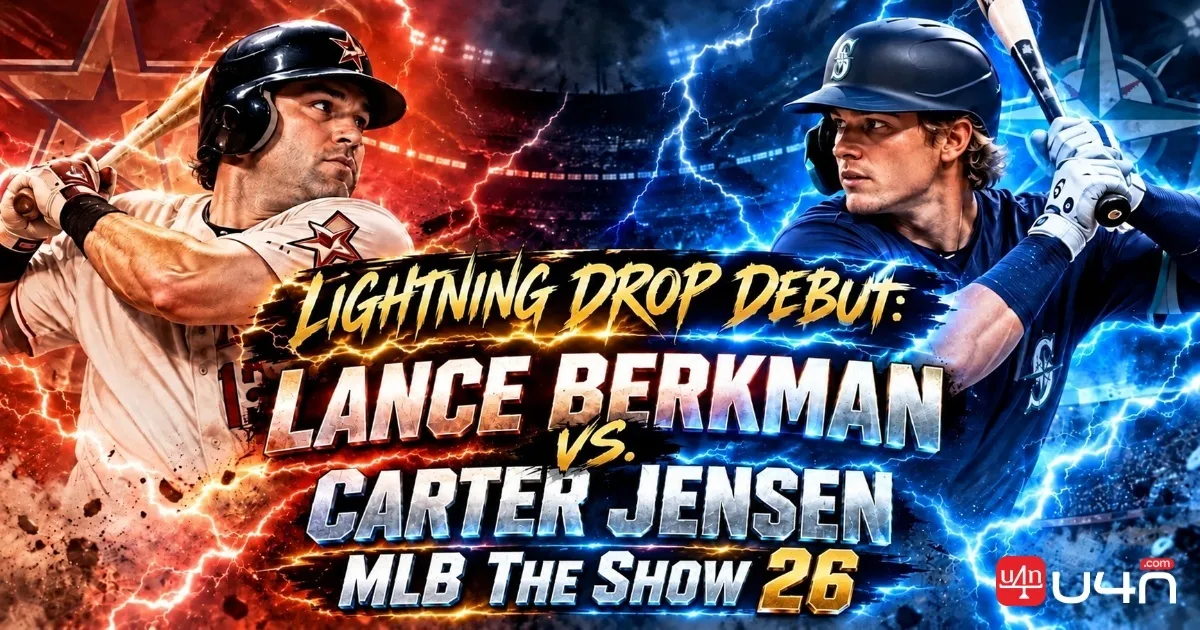
The final Lightning Drop of 2026 gives us two new cards to test in MLB The Show 26: Retro Lightning Lance Berkman and Carter Jensen. Berkman arrives with strong on-paper appeal, but Jensen ends up stealing much of the spotlight. After taking both players into online games, we found that a card's attributes only tell part of the story. Swing feel, timing, defensive utility, and how well a player fits our lineup can make a bigger difference than the initial hype suggests.
Our first impression of Berkman was positive, although the familiar switch-hitting profile felt a little predictable after seeing similar options throughout the year. Jensen, meanwhile, was more of an unknown. We wanted to see whether his swing would translate into consistent contact and whether his 91 Pop Time could make a meaningful difference behind the plate. For players managing their MLB Stubs, these are the kinds of practical details worth considering before committing to a new card.
Lance Berkman: A Strong Card That Still Needs Time
Berkman was the headline addition, and his switch-hitting profile gives us plenty of reasons to be interested. Our main reservation was not his overall quality, but the lack of variety in another high-profile switch hitter. After a year filled with strong options of this type, we would have preferred a more unexpected Retro Lightning choice.
The bigger question came once we started playing. Berkman did not immediately deliver the kind of consistent results we wanted. Some at-bats ended with weak contact, while others showed why the card deserves a longer look. We also had trouble finding our timing against certain pitches, so it would be unfair to blame every missed opportunity on the card itself.
By the end of the session, Berkman's results were respectable: three hits and two home runs in nine at-bats. That is enough to show his power potential, but not enough to establish how consistently he will perform over a longer stretch.
Our takeaway is straightforward: Berkman remains worth testing, but we would not make a final lineup decision based on this debut alone. A hitter can have excellent attributes and still require time to learn his swing.

Carter Jensen Steals the Spotlight
Carter entered the video with a much lower level of certainty. We had not used him before, and although his attributes looked promising, we were unsure whether his swing would feel comfortable. That uncertainty disappeared quickly once we started getting meaningful contact.
The most encouraging part was how naturally the swing felt to us. In Diamond Dynasty, that matters. A hitter's ratings can look excellent on paper, but if the swing timing does not match our habits, the results may not follow. Carter began to look like a player we could build an at-bat around rather than simply another high-rated card to try.
His final line was even more convincing than our early impressions. Carter finished the session with six hits and four home runs in ten at-bats, driving in five runs. He also homered against a left-handed pitcher, giving us another positive result to consider.
| Carter Jensen debut stat | Result | What it tells us |
|---|---|---|
| At-bats | 10 | A limited initial sample |
| Hits | 6 | Strong contact production during the debut |
| Home runs | 4 | Promising early power output |
| RBIs | 5 | Productive results with runners in scoring position |
These numbers are impressive, but the sample is small. We would not assume Carter will maintain that home-run rate over dozens of games. What matters more is that his swing felt good to us and his early results gave us a concrete reason to keep using him.
Carter's biggest achievement was changing our lineup discussion. Before the games, he was a card we wanted to test. Afterward, he was a legitimate candidate for a regular spot.

Pop Time Gives Carter Another Reason to Stay
Carter's offensive performance was the headline, but we also wanted to test his defensive value. His card lists a 91 Pop Time, and we were particularly interested in whether that rating would help us catch runners stealing.
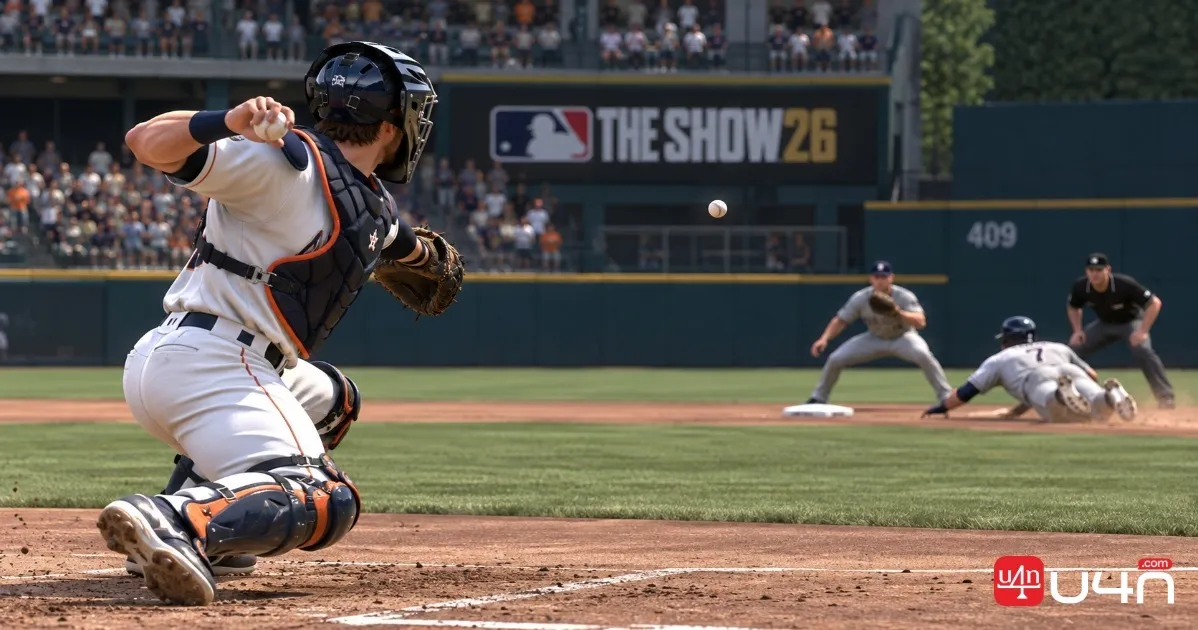
We had struggled to throw runners out consistently throughout the year, so this was a practical test rather than a box to tick. During the debut, Carter successfully threw out a runner. That gave us an encouraging early sign that he could contribute behind the plate instead of relying entirely on his bat.
Still, one successful throw does not establish his long-term defensive value. Pop Time is worth considering alongside the rest of a catcher's defensive profile, the runner's speed, the pitch received, and the timing of the throw.
For our lineup, Carter's appeal now comes from the combination of offense and defense. If his swing continues to work for us and his arm helps control the running game, he becomes much easier to justify over another catcher who offers less comfort at the plate.
Legend Difficulty and the Importance of Swing Feel
Returning to Legend difficulty changed the feel of our games. We had been playing on Hall of Fame, where we felt that offensive production could come more easily and getting outs became frustrating. On Legend, we were eager to see how our lineup would respond.
Babe Ruth was one of the players we watched closely. We had struggled to get the results we wanted from him on Hall of Fame, but his performance improved during the Legend games. That reinforced an important point from the session: our results with a card can depend heavily on the difficulty we play and how well our timing holds up in that environment.
The same principle applies to Berkman and Carter. Berkman's slow start does not automatically make him a poor card, just as Carter's explosive debut does not guarantee sustained production. Both players need to be evaluated in the context of our own timing, pitch recognition, and preferred difficulty.
For players deciding where to spend their MLB 26 Stubs, we recommend treating a card's first few games as an initial test. Give the swing enough opportunities to feel familiar, pay attention to the quality of contact rather than just the final box score, and avoid making expensive roster decisions based on one hot or cold session.
Summary
The final Lightning Drop gave us two cards worth testing, but Carter Jensen was the clear surprise of our debut. Berkman still showed his power, yet we did not find a consistent rhythm with his swing. Carter, by contrast, quickly felt comfortable and produced the kind of early results that make us want to keep him in the lineup.
| Card | What stood out | Our current verdict |
|---|---|---|
| Lance Berkman | Switch-hitting profile and two home runs in nine at-bats | Keep testing; the debut was promising but inconsistent |
| Carter Jensen | Comfortable swing, four home runs, and a successful caught-stealing attempt | Strong early candidate for a regular lineup spot |
We are not ready to call Carter a guaranteed long-term starter based on a short debut. But he has given us enough reason to continue testing him, and his combination of hitting potential and catching utility makes that decision easy.
Berkman deserves more time, too. We may find better results as we become more familiar with his swing. For now, Carter is the card that changed our expectations most—and the one we are most interested in taking into the next set of games.
FAQ
Is Lance Berkman worth using in MLB The Show 26?
Based on this debut, Berkman is worth testing. He showed home-run power, but our timing with his swing was inconsistent. We would give him more opportunities before deciding whether he deserves a permanent lineup spot.
Why did Carter Jensen stand out more than Berkman?
Carter's swing felt more natural to us, and he produced six hits and four home runs in ten at-bats. He also successfully threw out a runner. That combination of early offensive production and defensive utility made him the more exciting card in this session.
Does Carter Jensen's 91 Pop Time make him a must-use catcher?
Not by itself. The successful throw in this debut was encouraging, but a single play cannot establish consistent defensive performance. His hitting, overall defensive attributes, and fit with your roster should all factor into the decision.
Should we judge a card by its first few games?
No. A short debut is useful for identifying promising swings and obvious concerns, but it is not enough to establish long-term performance. Track how consistently you make quality contact, how the card performs against different pitchers, and whether it fits your usual difficulty and lineup.