

Choosing a Thief in MapleStory Classic World is about more than picking Assassin or Bandit at level 30. Weapon balance, skill investment, equipment costs, and map competition all affect how quickly we progress. The biggest decision is whether to stay with ranged claw attacks or build toward a dagger setup later. Managing MapleStory Classic World Mesos also matters, especially when consumables and equipment upgrades compete for the same early-game budget.
Our approach is to treat the first 50 levels as a series of decisions rather than follow a single rigid build. Assassins generally benefit from staying at range, pure Bandits face a more demanding early game, and Hybrid Thieves can use Lucky Seven before switching to daggers. Below, we break down the skill priorities, gear checkpoints, and training spots that make each route work.
Assassin, Bandit, or Hybrid Thief?
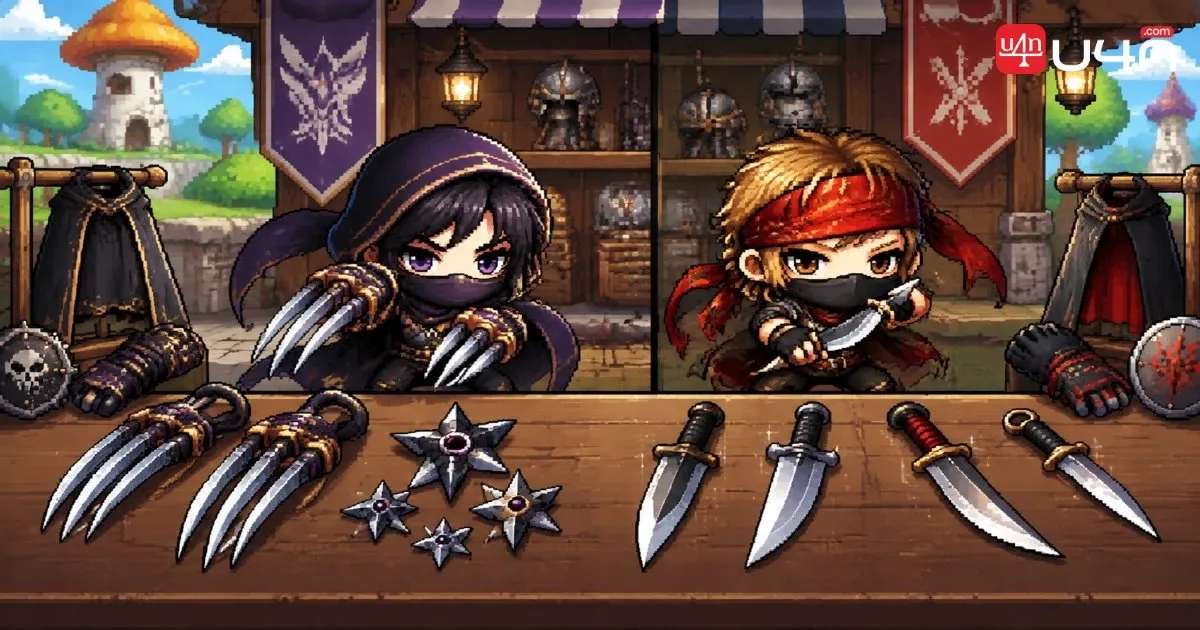
At level 30, Thieves choose between Assassin and Bandit. Assassins specialize in ranged claw attacks, while Bandits fight at close range with daggers. Hybrid Thief is a community term for a leveling strategy, not a separate job: the character chooses Bandit but continues using claws and Lucky Seven before resetting skills and moving to daggers.

This distinction matters because the weapon balance changes described in the current guide make early dagger progression less attractive than it might appear on paper. Lucky Seven retains a fixed damage multiplier, while dagger attacks are more dependent on the weapon and skill setup available at each stage.
| Route | Main Strength | Main Trade-Off | Best Fit |
|---|---|---|---|
| Assassin | Ranged attacks and strong access to crowded maps | Star and MP costs can add up | Players who value safer, more consistent leveling |
| Pure Bandit | Close-range dagger combat and strong later single-target potential | Early melee leveling can mean more incoming damage and potion use | Players with a clear dagger and equipment plan |
| Hybrid Thief | Ranged leveling early, followed by a dagger transition | Requires a skill reset and careful timing | Players willing to plan around a mid-progression respec |
Our default recommendation is to level with claws first if the goal is efficient early progression. A Hybrid Thief can reconsider daggers around level 40, when stronger weapon options become available. That is a checkpoint, not a rule: a good level 35 dagger may justify switching earlier, while weak or expensive options can make waiting the smarter move.
Stats and First Job Skills: Levels 10–30
After reaching level 10, visit the Dark Lord in Kerning City to become a Thief. The route outlined here prioritizes LUK, with DEX added to meet weapon requirements. The reference progression uses 15 DEX at level 15, 20 at level 20, 25 at level 25, and 30 at level 30. From there, the suggested pattern is 2 DEX and 4 LUK per level, subject to the requirements of the weapon you plan to use.
Do not treat these numbers as a substitute for checking your next weapon. Equipment requirements and the version's stat rules should take priority over blindly following a fixed allocation.
First Job Skill Priorities
| Skill | Suggested Investment | Purpose |
|---|---|---|
| Lucky Seven | Max first for claw users | Core ranged attack for Assassin and Hybrid routes |
| Keen Eyes | 15 points | Extends throwing range and helps maintain distance |
| Nimble Body | 15 points | Improves accuracy and avoidability |
| Disorder | 3 points | Part of the remaining utility allocation |
| Dark Sight | 8 points | Useful for movement and avoiding selected encounters |
| Double Stab | Max instead of Lucky Seven for pure Bandit | Provides the early dagger-focused attack route |
Claw users should pay attention to positioning. When a monster gets too close, the character may use a weaker close-range claw attack instead of throwing stars. Maintaining distance is therefore part of the damage rotation, not merely a defensive habit.
Early Gear and Consumables
Basic shop claws such as the Garnier and Steel Titans can cover early progression, while better stars should be treated as upgrades rather than mandatory purchases. Subi and Wolbi stars are practical starting options in the reference route. The level 25 Magical Mitten can also remain useful if replacing it would consume money better spent elsewhere.
Early on, speed and affordability usually matter more than building a perfect set. Buy what you need to keep leveling, then compare player-market prices when you have time. A personal shop can help sell spare items while you are offline, but the resale value of equipment varies by level and demand.
Best Training Spots from Level 10 to 40
The most effective map is not always the one with the highest-level monsters. We should consider how many hits a monster takes, whether the character can land attacks reliably, how much travel a map requires, and whether other players are competing for the same spawn.
Levels 10–20
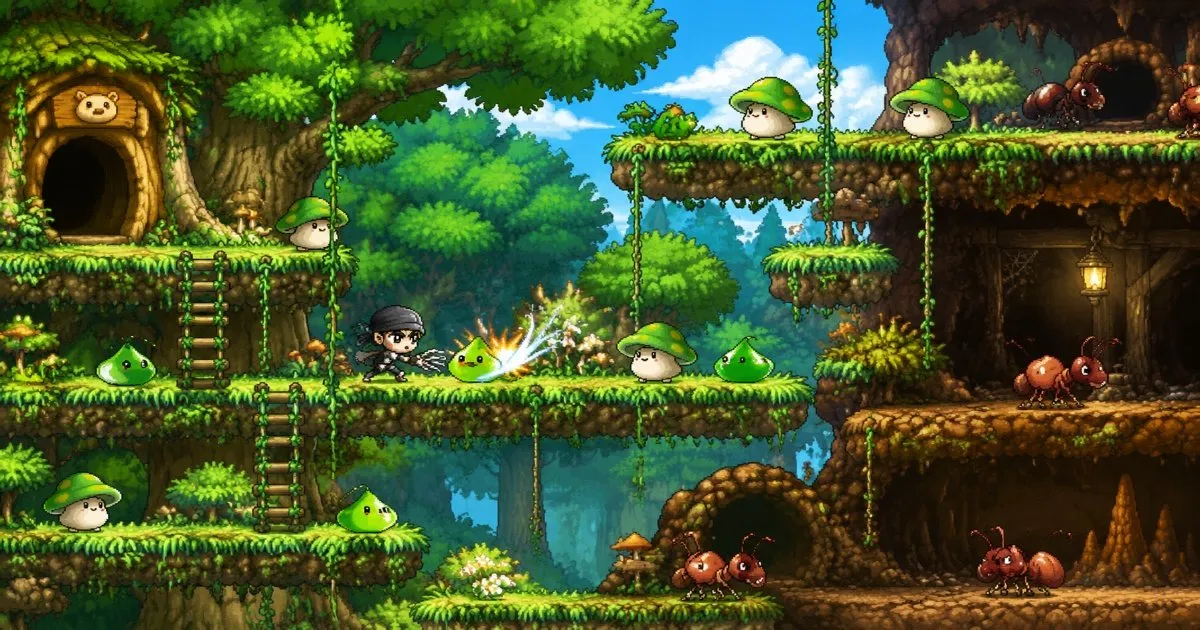
Maps around Henesys, Ellinia, and Lith Harbor provide straightforward early options. Ellinia's forest areas are particularly convenient for fighting Slimes and Green Mushrooms while completing nearby quests. Take free-potion quests when they fit naturally into the route, but avoid spending too much time on detours with little progression value.
Levels 20–30
| Priority | Training Spot | Why It Works | Watch Out For |
|---|---|---|---|
| Tier 1 | Kerning Subway transfer area | Stirges can be efficient targets for ranged Lucky Seven attacks and may provide useful drops. | Close-range characters may struggle to hit flying enemies |
| Tier 1 | Kerning Party Quest (KPQ) | A party-based alternative with experience and reward potential | Requires a suitable group and may be less convenient when crowded |
| Tier 2 | Sleepywood's damp swamp | Octopus and Jr. Necki offer an alternative to busy primary maps | Check accuracy and damage before committing |
| Tier 2 | Perion Rocky Road 3 | Dark Axe Stumps and Wild Boars provide another route through the level range. | Efficiency depends on your ability to kill them quickly |
| Tier 3 | Ellinia Tree Dungeons | Green and Horny Mushrooms are accessible alternatives | Move on if kills become slow or competition rises |
| Tier 4 | Roads between Lith Harbor, Henesys, and Ellinia | Pigs, Ribbon Pigs, and Orange Mushrooms can be useful when popular maps are full. | Lower priority when a better map is available |
KPQ is worth considering from level 21 when you have a reliable group. It offers a different pace from solo grinding and may provide useful equipment or scroll rewards. If the top maps are crowded, dropping to a lower tier can be more efficient than waiting for a free channel or fighting over spawns.

Levels 30–40: Keep Using Claws
For a Hybrid Thief, the second job does not automatically mean an immediate switch to daggers. Haste improves movement and jumping, while claw skills continue to support ranged leveling. In the route described here, Assassins invest in Haste, Claw Mastery, and Booster before completing Mastery. Hybrid characters can prioritize Haste while continuing to use Lucky Seven.
| Level Range | Primary Option | Alternatives |
|---|---|---|
| 30–35 | Stirges or KPQ | Wild Boar Land when the map is quiet |
| 34–35 onward | Ant Tunnel | Wild Boar Land if Ant Tunnel is crowded |
| 35–40 | Ant Tunnel and deeper sections | Lorangs around levels 39–40 if the damage and costs make sense |
Jr. Wraiths can look attractive because of their experience, but low accuracy in the early 30s may turn the route into a money sink. Before switching maps, check whether you can hit consistently and kill the target without excessive potion use. A map that looks strong in a ranking is not necessarily strong for your current build.
Assassin Build and Gear: Levels 40–50
Assassins continue to build around claw attacks and Critical Throw. The main goal is to improve damage consistency while preserving the mobility that makes ranged training effective. In the progression described here, Critical Throw is the priority through the late 30s and into the 40s, followed by supporting investments in Haste, Booster, and other utility skills.
Equipment Checkpoints
- Claws: Use a suitable level 40 claw when available. Dark Slain is the level 50 target in the reference route, although early market supply may be limited.
- Hat and armor: Consider drops from Drakes and Copper Drakes, alongside quest rewards such as the sauna robe.
- Cape: The black Adventurer's Cape with LUK and accuracy bonuses is a useful target if the cost is reasonable.
- Stars: Subi and Wolbi are budget options. More expensive stars are upgrades, not a requirement for every player.
Assassin Training Route
| Level Range | Recommended Map | Reason to Move There |
|---|---|---|
| 40–43 | Perion Burnt Land | Dark Axe Stumps and Fire Boars can provide a workable transition |
| 43–47 | Monkey Forest or Monkey Swamp | Zombie Lupins offer a relevant target and may drop a useful cape |
| 47–50 | Florina Beach, hunting Lorangs | Can become more attractive as damage improves |
| Situational | Subway Wraith maps or Curse Eye areas | Consider these when accuracy and damage allow efficient kills |
Do not move to a new map simply because you have reached its recommended level. The practical checkpoint is how many attacks you need to kill the target and how much time you spend repositioning. If Lorangs remain expensive to kill, stay with a more efficient target until your gear catches up.
Bandit and Hybrid Builds: Levels 40–50
The main decision for a Hybrid Thief is when to reset first- and second-job skills. Around level 40 is the standard checkpoint in this route, but a strong level 35 dagger may justify an earlier switch. Before paying for a reset, compare the weapon you can actually obtain with the damage and cost of continuing to use Lucky Seven.
Skill Transition
After moving to daggers, the suggested progression invests in Dagger Mastery, a small amount of Booster, and Savage Blow. Double Stab can carry the earliest part of the transition, with Savage Blow taking over as its skill level and damage improve. Haste remains valuable for movement, while remaining points can support utility skills such as Nimble Body, Recovery, and Steal.
One important detail is that Savage Blow's full multi-hit behavior develops with skill investment. Do not assume that a newly switched Hybrid will immediately perform like a fully developed Bandit. The dagger's attack speed, weapon attack, and the character's current skill levels all affect the result.
Choosing a Dagger
| Weapon | Why Consider It | Trade-Off |
|---|---|---|
| Korean Fan | Drops from Lorangs and has a very fast attack speed | Requires 70 LUK and may be expensive; its attack is lower than the Gephart described in the reference |
| Gephart | A fast dagger option that drops from Ligators | Compare its actual attack and price with available alternatives |
| Bazlud | A level 45 option dropped by Lupins | Requires 40 STR, so check your stat allocation before committing |
Bandits can also use a shield, making a Pan Lid a potential early defensive option. For armor, prioritize affordable pieces that meet your build's requirements. A strong weapon usually deserves more attention than small armor upgrades if the immediate goal is to improve kill speed, but melee characters should not ignore the extra potion costs caused by taking more hits.
Bandit Training Route
| Level Range | Primary Option | Condition |
|---|---|---|
| 40–45 | Evil Eye areas | Best when your dagger and buffs allow reliable one-hit kills |
| 40–45 | Ant Tunnel or Perion Burnt Land | Useful alternatives when the primary route is crowded |
| 45–50 | Monkey Forest or Monkey Swamp | Useful for hunting Lupins and pursuing dagger or star drops |
| Later in the range | Zombie Lupins, Drakes, or other stronger targets | Move when your equipment reaches the required kill threshold |
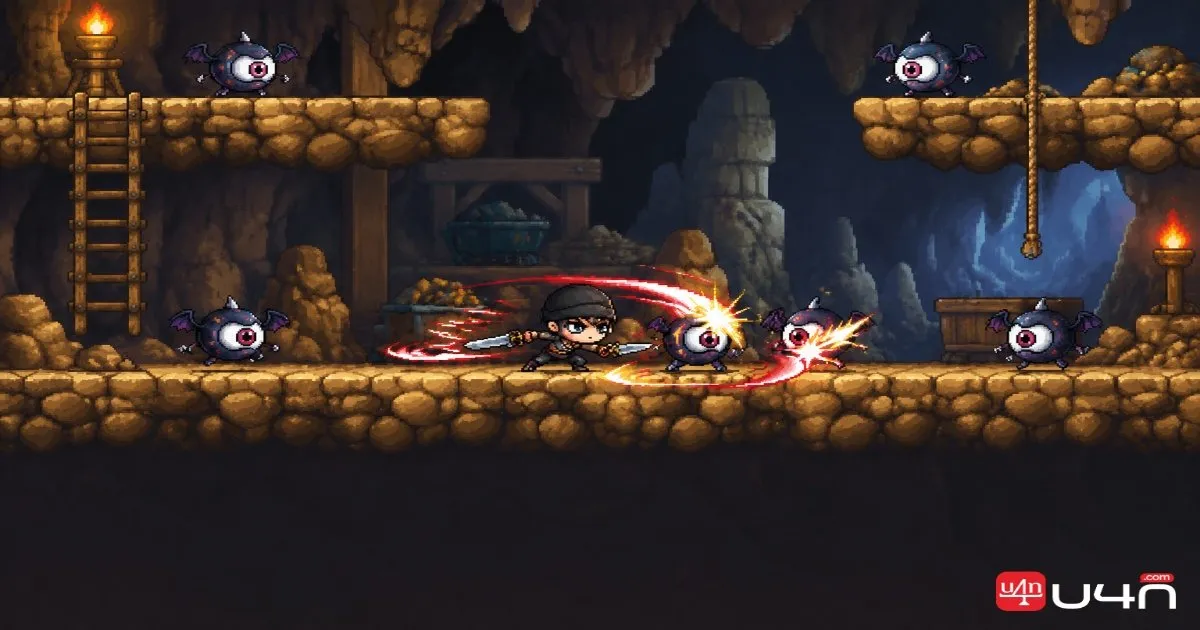
The most important rule is to match the map to your current weapon. If Evil Eyes are not dying quickly enough, a higher-tier map may cost more in time and potions than it returns in experience. Once a stronger dagger lets you clear targets consistently, reassess the route rather than staying on the same map out of habit.
Summary: The Most Practical Thief Route
For most players following this progression, claws are the safer early investment. Assassins can continue with ranged attacks, while Hybrid Thieves can delay the dagger transition until their equipment and skill setup support it. Pure Bandit remains an option, but its early melee costs make it less forgiving when funds and gear are limited.
- Levels 10–30: Build around your chosen first-job attack, meet weapon stat requirements, and prioritize efficient maps such as Stirge areas or KPQ when suitable.
- Levels 30–40: Use Haste and the relevant claw skills to keep leveling efficiently. Check accuracy before committing to higher-level monsters.
- Levels 40–50: Assassins continue with claws. Hybrid Thieves should compare the cost of a skill reset with the benefits of a dagger setup.
- When maps are crowded: Drop to a less contested map if it improves actual experience per hour.
- When upgrading gear: Compare damage, attack speed, requirements, and total cost rather than chasing the highest-level item available.
Keep a reserve for potions, stars, and essential upgrades instead of spending every meso on a single weapon. Players comparing MapleStory GMS Mesos resources should also remember that market conditions and progression systems can differ between versions, so prices and build assumptions need to match the world being played.
FAQ
Should a Bandit use claws before level 40?
For a Hybrid Thief, yes, if Lucky Seven provides better practical damage and leveling efficiency than the daggers currently available. A pure Bandit follows a different early skill route, so the choice depends on whether you intend to reset later.
Is level 40 always the best time to reset into daggers?
No. Level 40 is a useful checkpoint, not a universal rule. A strong level 35 dagger may make an earlier reset worthwhile, while a poor or expensive weapon may justify waiting. Compare the expected efficiency gain with the reset and equipment costs.
Which is easier to level, Assassin or Bandit?
Assassin is generally more forgiving when ranged attacks let you avoid incoming damage and compete for monsters more effectively. Bandit can offer serious close-range damage later, but it is more sensitive to weapon quality, positioning, and potion costs.
Why can a high-level training map be inefficient?
Monster level alone does not determine experience per hour. Low accuracy, too many attacks per kill, long movement routes, heavy competition, and high consumable costs can make a lower-tier map the better choice.
What should I prioritize when mesos are limited?
Keep your main weapon appropriate for your level, maintain enough consumables to train consistently, and avoid expensive upgrades that do not improve your kill threshold. For Hybrid Thieves, include the skill reset in the budget before committing to the dagger route.