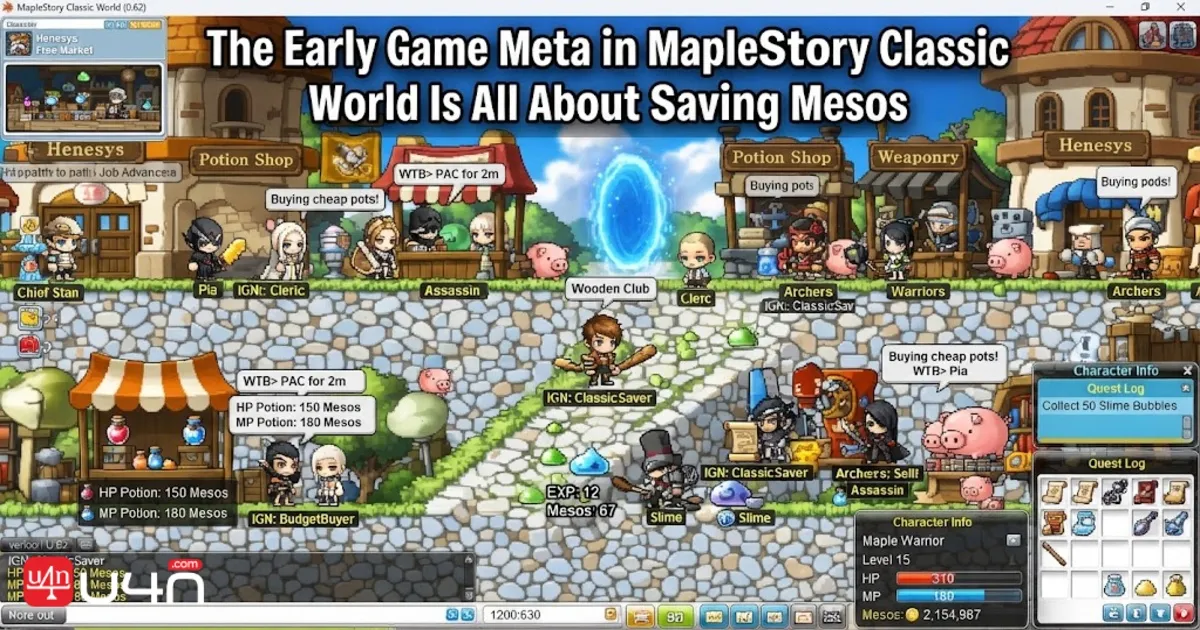
For new players, the early game in MapleStory Classic World is not simply a race to maximize experience per hour. MapleStory Classic World Mesos can disappear surprisingly quickly when potion costs, monster damage, equipment, and training efficiency all pull in different directions. Lessons from the closed tests point toward a simple rule: sometimes the player making slightly less EXP is actually progressing faster because they are keeping more money.
That matters even more with Founder's Access approaching. Nexon currently lists October 6, 2026, as the start of Founder's Access for eligible Founder packages, with the full launch scheduled for October 21. The early economy will therefore be something players need to think about from their first few levels rather than after reaching a high-level farming spot.
Potion Efficiency Could Matter More Than EXP Rates
One of the clearest lessons from the previous tests was how expensive it could be to simply keep fighting.
Larger HP and MP potions may look more convenient because they restore more resources at once, but that does not automatically make them the most economical choice. The better question is how much HP or MP you recover for each meso spent.
During the tests, smaller recovery items such as Meat for HP and Lemons for MP were noted as particularly efficient options. Exact shop prices can still change before launch, so players should check the live economy rather than assuming the test values will remain unchanged.
| Early-game habit | Why it matters |
|---|---|
| Compare recovery per meso | A cheaper potion can be more economical over a long session |
| Sit in a chair when safe | Recovering naturally can save consumables |
| Use regular attacks when practical | You do not always need to spend MP to keep progressing |
| Watch your remaining mesos | Fast EXP is less valuable if your income immediately disappears into potions |
The important shift in mindset is that EXP per hour is not the only efficiency metric. If a training session gives excellent EXP but consumes almost everything you earned, the character may be stronger while the player's wallet is weaker.
A Slightly Worse Training Map Can Be the Better Map
Bubblings are a good example of why monster EXP should not be considered in isolation. They can be attractive for ranged characters, but their speed and damage can make the same monsters considerably more expensive for classes that have to chase them around.
The closed-test experience described warriors spending a long time fighting Green Mushrooms around Ellinia instead because the slower, safer option was much easier to sustain.
That is probably one of the most useful lessons to carry into launch.
The best training map is not necessarily the map with the best EXP. It is the map where your class can maintain a strong balance between EXP, damage taken, potion consumption, and monster availability.
Classic World also changes enough of the old MapleStory experience that blindly following routes remembered from 20 years ago is risky. The game's official Closed Online Test #2 was a distinct test environment, and Nexon has continued developing the project toward launch.
Crowded Maps Change the Math
Launch-day population could make the usual “best map” recommendations even less useful.
A theoretically excellent map becomes much less attractive when a large number of players are competing for the same monsters. A quieter map with slightly lower EXP can provide a smoother rotation, fewer interruptions, and potentially lower potion costs.
This is where Classic World's party system can also become more useful. If several players are already competing for the same monsters, dividing the map with a party can make more sense than repeatedly fighting over individual spawns. The previous test experience suggested that party training could be a practical way to turn crowded maps into workable ones.
For launch, I would treat map popularity as a variable rather than a ranking. If a recommended map is packed, move. Your character does not gain anything from standing around waiting for a monster to appear.
Defensive Gear Can Save More Than It Looks
For classes that can use one, a shield is another piece of early equipment worth considering.
The reason is straightforward: avoiding damage means avoiding potion consumption. The exact block values mentioned during testing should not be treated as final launch numbers, but the underlying idea is more important than any single stat.
In an economy where every small expense matters, defensive equipment can effectively become an economic investment. If a shield allows you to take fewer hits during thousands of attacks, the savings can accumulate over a long leveling session.
This is also why class choice matters during the early game. A class that looks slower on paper may be cheaper to maintain, while another class can gain EXP quickly but spend more on HP and MP recovery.
Do Not NPC Every ETC Drop
Inventory management becomes another part of the early economy.
Classic World changes quests and adds systems that make some items more useful than they were in the original game. That means an ETC item that looks worthless at first glance may have value to another player.
The closed tests highlighted Garnet Ore as one example of an item that became desirable because of quest requirements.
The same principle applies to equipment and scrolls. Without the same assumptions players might have about older MapleStory economies, it is worth checking an unusual drop before immediately selling it to an NPC.
A useful early rule is simple:
Common junk can be sold. Unfamiliar, rare, or unusually large stacks should be checked first.
That does not mean keeping every ETC item you find. Inventory space still matters. The goal is to recognize when something may have player value instead of automatically treating everything as NPC trash.
Small Sources of Mesos Add Up
Selling Fame is another minor income option. According to the previous test experience, Fame could be sold once per day starting at level 10. It will not replace regular grinding as an income source, but it can provide a quick bit of extra money when the early economy is tight.
Quests are also worth checking rather than ignoring simply because they do not offer the best EXP.
The previous tests included quests that could provide mesos and potions alongside EXP, giving players another reason to break up long grinding sessions. The Citizenship system was another example of daily and weekly activities providing additional rewards.
This creates a healthier early-game routine: grind when your character is efficient, but take advantage of quests and other rewards when they can reduce the amount of money you need to earn elsewhere.
Launch Players Should Expect the Economy to Change
The most important caveat is that closed-test lessons are not guarantees of the final economy.
Potion prices, item values, quest rewards, monster behavior, and other systems can change before launch. Nexon's current Founder information confirms that Founder's Access begins October 6, while the broader launch follows on October 21, giving players a relatively short window to see how the live economy actually develops.
That means players should treat test-era strategies as principles rather than rigid formulas.
Don't memorize a potion list and never check prices again. Don't assume the same monster will always be the most profitable. Don't automatically sell an item because you remember it being worthless in old MapleStory.
The Early Meta Is Being Cheap on Purpose
If there is one idea worth carrying into MapleStory Classic World, it is that being cheap is not inefficient—it can be the meta.
Use efficient potions. Recover when you safely can. Consider regular attacks when MP is becoming expensive. Choose sustainable maps instead of chasing every last bit of EXP. Keep potentially valuable drops until you understand their purpose. Party up when a crowded map makes solo training inefficient. And consider defensive equipment when it can reduce the amount you spend on recovery.
The previous closed tests consistently pointed toward the same lesson: early progression is not only about how quickly you gain levels, but how much money you still have after gaining them.
For players preparing their launch budgets, that makes economic discipline just as important as choosing a training route. If you want to avoid being constantly broke while leveling, learning when to save, when to spend, and when to simply stop using a potion may matter more than squeezing another few percentage points out of your EXP rate. And for players who are looking at every possible way to build their starting budget, the option to buy MapleStory Classic World Mesos may also become part of the wider launch economy.