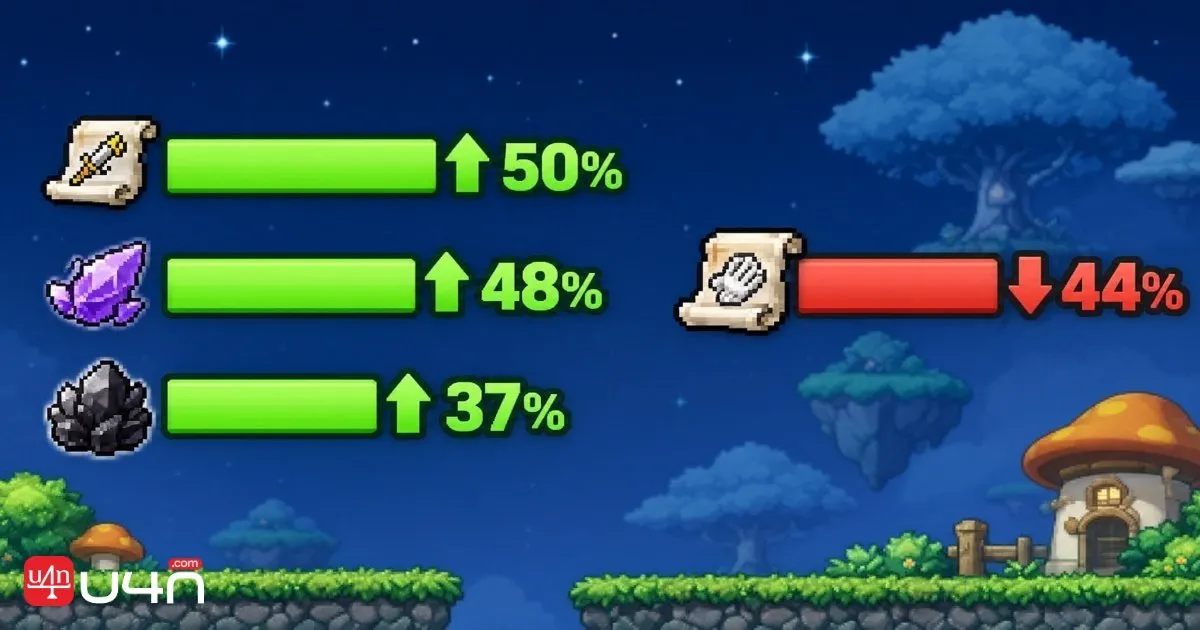
A quiet market can still produce some brutal price swings. In the Windia trading, most item categories barely moved, yet individual scrolls and crafting materials told a different story. One glove scroll lost roughly 44% of its value in a day. A two-handed sword scroll climbed about 50% over the week. Even ordinary snail shells briefly became expensive enough to attract attention.
Our team focuses on what those changes mean for players managing their MapleStory Classic World Mesos. A rising price matters much more when buyers keep showing up, and a sudden discount deserves closer inspection when a new crafting recipe has changed the item's competition.
The figures below describe the supplied market report surrounding the November 18 Forgotten Hollow update. They are historical observations from that reporting window, rather than live quotes. We separate the changes from our interpretation, especially where the connection between a patch feature and a price movement remains uncertain.
A Stable Market with a Few Sharp Exceptions
We examined 1,076 traded items on Windia, but the category overview used a narrower basket: the 15 most-traded items in each category over the preceding seven days. That distinction matters. A category indicator can look steady while less common items experience substantial price changes.
Weapons declined by less than 1%, scrolls fell around 2%, and ammunition dropped roughly 6%. Cash items were the obvious exception, gaining approximately 47%.
The practical message is straightforward: this was a selective repricing. Players were responding to specific changes in equipment, crafting, availability, and possibly event demand.
| Item | Earlier price | Later price | Approximate change |
|---|---|---|---|
| Basic throwing stars, listed as Wool Bee | 1,700 mesos | 1,500 mesos | -12% |
| Claw attack scroll | 100,000 mesos | 80,000 mesos | -20% |
| Shield accuracy scroll, 60% | 115,000 mesos | 85,000 mesos | -26% |
| Glove attack scroll, 60% | 1.9 million mesos | 1.6 million mesos | -16% |
| Staff magic attack scroll, 60% | 180,000 mesos | 235,000 mesos | +31% |
| Black crystal ore | 2,700 mesos | 3,700 mesos | +37% |
| Magic fragments | 135 mesos | 200 mesos | +48% |
| Two-handed sword attack scroll, 60% | 140,000 mesos | 210,000 mesos | +50% |
| Glove critical-rate scroll, 60% | 420,000 mesos | 235,000 mesos | -44% |
The comparison periods vary. Most entries use roughly a week; the glove attack scroll uses its November 13 peak, and the critical-rate scroll compares its previous stable level with the selloff. We would use this table to locate changes worth investigating, then check the individual price histories before buying.
How the November 18 Update Changed Trading
Forgotten Hollow ly introduced 34 quests, a level-60 boss, crafting level nine, and 15 weapons. It also started the Thanksgiving event, ended Halloween activities, and temporarily reduced the shop permit price from 1,500 NX to 100 NX through December 9.
Those changes affected different parts of the economy. New weapons could create demand for compatible upgrade scrolls. New recipes could increase material consumption while introducing alternatives to existing drops. Events could redirect demand toward otherwise ordinary items.
Cheaper shop permits created another possible pressure: more players could afford to list their stored loot.
We have seen this pattern across game economies. An item sitting in storage has little immediate effect on the visible market. Once its owner opens a shop, that same item competes with every other listing buyers can find. If several sellers want a quick sale, prices can slide without any change to the item's combat value.
The patch also created competing effects. Easier selling could push prices down, while new crafting demand pulled selected materials upward. Treating the whole update as either inflationary or deflationary would miss the useful detail.

Falling Scroll Prices Need Different Explanations
The cheaper throwing stars declined from about 1,700 to 1,500 mesos per set, alongside more than 800 sales that day. The loss per set was modest, but activity at that level makes the movement more relevant than an isolated bargain.
The claw attack scroll also weakened, moving from approximately 100,000 to 80,000 mesos with more than 200 sales. For players holding several copies, a 20% decline would be noticeable even if the item remained useful.
Our team would read these as signs of active selling. The permit discount offers a plausible explanation for increased competition, although changes in drops, buyer progression, and existing stock could also matter.
The 60% shield accuracy scroll showed a sharper late-session decline. Its price moved from around 115,000 to 85,000 mesos, while some recent sales were closer to 60,000-70,000. Recorded 106 sales, its busiest day in the observed history.
Those figures should stay separate. An 85,000-meso reference price and several cheaper recent transactions describe different parts of the market. Combining them into one dramatic percentage would hide whether the low prices represented a sustained move or a few urgent sales.
The 60% glove attack scroll fell from a November 13 high near 1.9 million to roughly 1.6 million mesos. Its daily traded value exceeded 160 million mesos, making this a meaningful market to watch.
Account transfers for a 100% glove attack scroll might have reduced some purchasing demand. We would treat that connection cautiously. The usefulness of the alternative, its supply, and the attributes each scroll provides determine how much substitution is realistic.
For a player upgrading equipment, the relevant question is the cost of the result. Compare the scroll's effect, success chance, and expected expenditure before deciding that a familiar item has become cheap enough.

Crafting Materials and Weapon Scrolls Gained Ground
Two-handed sword attack scrolls produced the strongest weekly rise among the highlighted items. The 60% version moved from about 140,000 to 210,000 mesos. Against its November 1 price near 70,000, it had roughly tripled in less than three weeks.
Around 180 sales per day. That supports a more substantial demand story than a high asking price with no buyers behind it.
Its proposed catalyst was Lion's Fang, a newly added level-52 weapon associated with two-handed sword demand.
Staff magic attack scrolls followed a similar upward path. The 60% version rose from approximately 180,000 to 235,000 mesos over the week and had traded much lower in late October. Fairy wings, described as a staff crafting material, also gained around 43%.
New staffs could explain demand for both the equipment material and its upgrades. Still, the scroll's rise ly accelerated on November 13, before the November 18 patch. That timing leaves room for anticipation, earlier changes, or other demand.
Crafting level nine provided a more direct explanation for material buying. Black crystal ore climbed from roughly 2,700 to 3,700 mesos, while magic fragments increased from about 135 to 200. More than 50,000 fragments changed hands daily.
Newly available glove scroll recipes consumed 45 magic fragments plus three units of the relevant gem or crystal material. Repeated crafting attempts could therefore create substantial consumption.
Our preference would be to watch both materials together. If fragment turnover remains strong while ore demand holds, the recipe explanation becomes more convincing. If one material suddenly loses buyers, it may signal that crafters have finished leveling or found a different route.
Why the Glove Critical-Rate Scroll Sold Off
The 60% glove critical-rate scroll supplied the largest highlighted decline. After remaining near 420,000 mesos for roughly 12 days, it fell to approximately 235,000 in one day. That is a drop of about 44%, with 93 sales during its busiest recorded session.
The proposed explanation was a newly craftable 100% critical-rate glove scroll.
That creates a sensible competitive pressure, but success chance alone does not establish value. Players also need to compare the amount of critical rate added, the number of upgrade slots available, crafting expenses, and any restrictions attached to the resulting item.
| Question | Why our team would check it |
|---|---|
| What does each successful scroll add? | A lower success rate may accompany a different attribute gain. |
| What does the recipe cost at current material prices? | Rising ingredients can make the crafted option less attractive. |
| How available is the crafted scroll? | Crafting access does not guarantee abundant supply. |
| What result does the player need? | A budget upgrade and an optimized item can justify different spending. |
| Are completed sales stabilizing? | A sharp decline can continue while sellers clear stock. |

This is a familiar trap for experienced traders: remembering the old price too strongly. An item that once sold for 420,000 is not automatically underpriced at 235,000 if buyers now have a better alternative.
For personal use, the lower price might still be helpful. Our team would compare the two upgrade routes and buy only the number needed. For resale, we would want evidence that demand can absorb the remaining supply before treating the decline as an opportunity.
Snail Shells and Cash Items Require Extra Care
Ordinary snail shells ly rose from around 20 to 49 mesos. Red and blue shells gained about 50%, while several other beginner materials also attracted attention.
The Thanksgiving event was suggested as a possible cause because some exchanges ly required extra materials that the notes did not name. That is a lead to investigate. Without an exchange list or direct confirmation, it cannot establish which materials the event actually consumes.
Trading activity made the shell price especially fragile. Only 29 sales that day, including a purchase of 13 shells at 199 mesos each. A few unusual transactions can move a thinly traded item's apparent price substantially.
We would check whether multiple buyers continued purchasing near the quoted level. A shell that appears valuable on a chart but takes hours to sell may offer a worse return than ordinary hunting with dependable drops.

Cash items showed a different pattern. The mystery fashion box increased from approximately 55,000 to 81,000 pesos, a rise of about 47%.
Connected demand to the box's scheduled December 2 removal. Limited availability can influence buying, but the size of that effect also rests on how many unopened boxes remain and how many players still want them.
Other cash items ly rose as well. Before interpreting the category's 47% gain as broad demand, we would inspect which products drove it and how the category indicator was calculated. A strong category reading does not mean every item offers the same trading opportunity.
What Our Team Would Do with This Snapshot
For players around levels 25-40, selling materials already collected is the most accessible way to respond to the changes. Magic fragments and black crystal ore had both higher prices and a plausible source of consumption. We would compare their actual sell-through with the travel and hunting time required, then choose a farming route that still provides useful experience or other saleable drops.
Players who buy MapleStory Classic World Items should compare recent completed trades, available supply, and the cost of alternatives before accepting a listing. The same check helps anyone spending saved mesos in the Free Market. A two-handed sword scroll near its high deserves different scrutiny from a critical-rate scroll facing new competition. Neither a large rise nor a large decline establishes fair value by itself.
For this reporting window, the dates to monitor were December 2 for the fashion box's stated removal, December 8 for Thanksgiving material expiration, and December 9 for the end of discounted shop permits. Each could change demand or selling activity, but their price effects remained uncertain. Our next check would be whether material purchases persisted, whether crafted scroll supply expanded, and whether buyers continued supporting the higher weapon-scroll prices.