


New monster drops can change a farming route faster than a level increase. A valuable scroll gives an ordinary enemy a reason to stay on our rotation, while a weapon drop can turn a training map into a source of our next upgrade. The Forgotten Hollow points toward both changes, with several monsters offering rewards that deserve a closer look.
For our team, the useful question is how those rewards affect the time and resources we spend getting stronger. A route that produces steady MapleStory Classic World Mesos while offering a relevant equipment drop can support progression even through a long stretch without a rare item. That makes its ordinary returns just as important as its headline prize.
This guide examines the monsters, scrolls, and equipment in the supply. The goal is to identify promising targets and explain what we would check before committing to a farming session.
Why These Drops Could Change Our Farming Routes
The most interesting change concerns glove scrolls. Junior Boogie is linked to a 60% Gloves for Attack scroll drop, while Rotting Mushrooms are presented as a source of the 100% version. Those two items would serve different purposes, but both could influence how players approach early damage upgrades.
A mixed monster map becomes more attractive when a secondary enemy gains a desirable reward. We describe farming Zombie Mushrooms near Mushroom Graveyard, with Junior Boogies appearing in the lower section. If the scroll belongs to that Junior Boogie drop table, clearing those encounters adds another potential return to a route players may already use.
We would still resist changing maps on that information alone. A rare drop improves a route's potential, but its everyday performance comes from spawn density, travel time, potion use, and how quickly we clear each pack. Chasing a low-frequency reward across awkward terrain can reduce our earnings before the scroll ever appears.
Roughly 60,000 mesos per hour on our preferred route. We treat that as a personal result. Without a clear breakdown of direct currency, sold equipment, consumables, and rare drops, it cannot serve as a reliable earnings target for another character.
Our approach would be to establish the route's ordinary income first. The scroll then becomes an extra reason to stay, rather than the item required to make the session worthwhile.
Forgotten Hollow Monsters With Useful Rewards
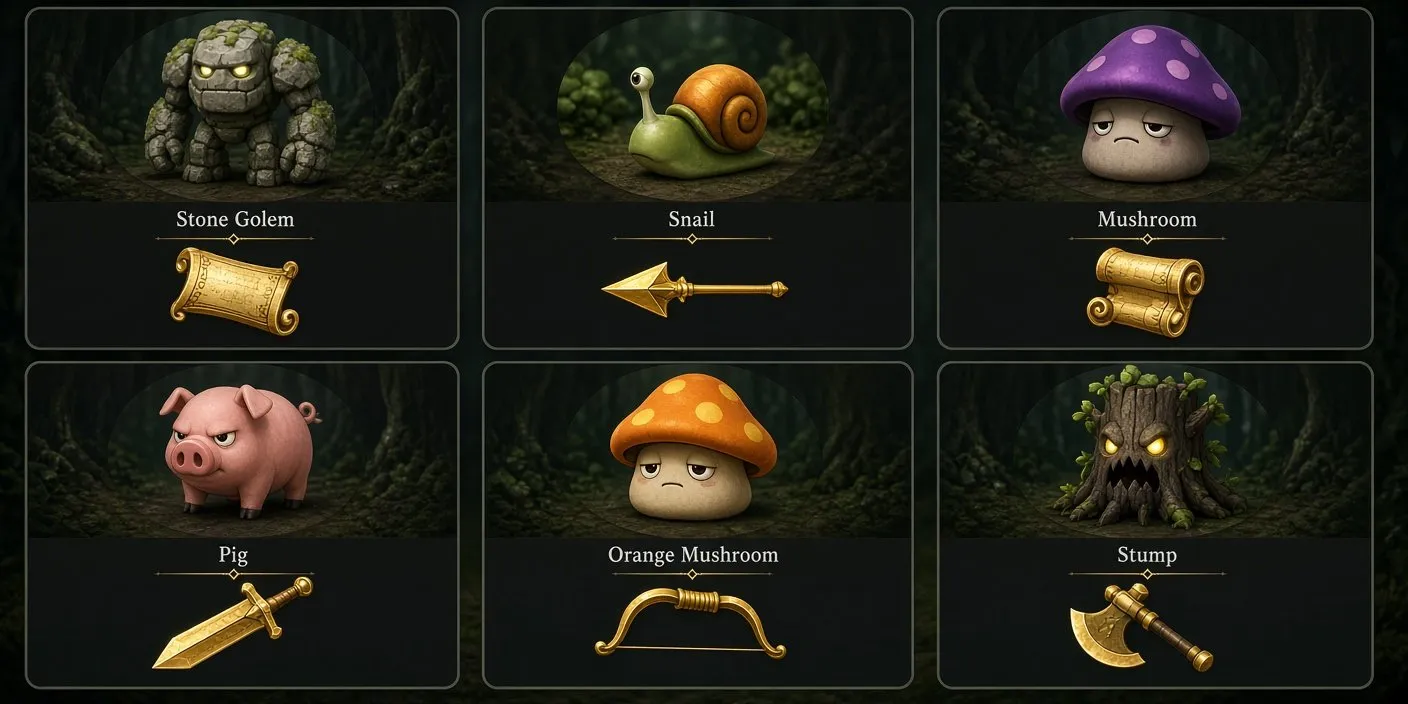
Forgotten Hollow draws attention because several enemies combine training value with equipment that players may still need. The following table organizes the main targets described.
| Monster | Details | Notable rewards | Main reason to investigate |
|---|---|---|---|
| Raffle | Level 40; weak to fire | 60% Gloves for Magic Attack scroll, Blood Avarice, Yellow Umbrella | A scroll target with additional equipment drops |
| Echo Pierce | Level 45; lightning weakness mentioned | Olympus bow | A possible self-farming target for Hunters |
| Rafflesia | Level 47; weak to fire | Jeweled Guitar, 60% Earring for LUK and Overall Armor for DEX scrolls | Several potentially useful rewards on one monster |
| Dusk Mander | Compared with Drake for experience and durability | Sai dagger, 60% Overall Armor for INT and STR scrolls | Training with a desirable dagger drop |
| Mywood | Level 54; 3,900 HP; weak to fire | Steel Slain, Cromi, 60% Earring for STR scroll | Weapon progression for more than one class |
| Sporewood | Fire and holy weaknesses discussed | Lion's Fang and another warrior weapon | A possible weapon target for warriors |
Raffle and Rafflesia: Scroll Value Matters
Raffle stands out because of the Gloves for Magic Attack scroll. For a player building magical damage, that reward is more relevant than a collection of equipment pieces with limited resale demand. Its fire weakness also gives Fire/Poison Wizards a reason to examine the matchup.
We would judge the map around the monster as carefully as the drop table. Can we attack several enemies from a useful position? Does collecting loot require repeated climbing? Are we spending more on healing than expected? Those details determine whether the scroll hunt remains comfortable over an hour.
Rafflesia offers a broader set of possible rewards, including LUK and DEX scrolls. That variety can make the target appealing, though it does not guarantee good returns. Local demand matters, and equipment that looks valuable in a database may sit unsold.
Echo Pierce: A Clear Equipment Goal
The Olympus bow gives Echo Pierce a straightforward purpose for Hunters. Farming a weapon we can immediately equip creates a clear stopping point: obtain a useful copy, compare its stats with our current bow, and decide whether further farming is justified.
We suggest that weapon crafting limitations increase the importance of monster drops. That condition needs checking on the version being played. If alternative sources are available, they change how much time an Olympus hunt deserves.
We would also avoid carrying a displayed price into a written guide. A listing captures one seller's expectation at one moment. A self-farmed bow still has value, but its market value requires current evidence.
Dusk Mander and the Cost of a Better Training Map
Dusk Mander receives one of the more useful comparisons. We describe it as awarding the same experience as Drake while having 270 less HP, lower physical defense, and slightly higher magic defense. That would create different advantages for physical and magical attackers.
For a physical class, lower HP and defense may reduce the attacks required per kill. The improvement becomes especially meaningful when it crosses a threshold. Saving damage without changing our attack count may feel modest; moving from three attacks to two can change the rhythm of the entire route.
We would verify that threshold over a normal sequence of kills. A critical hit screenshot tells us little about consistency. If the monster often survives with a small amount of health, we still spend time on another attack, take another possible hit, and delay movement toward the next pack.
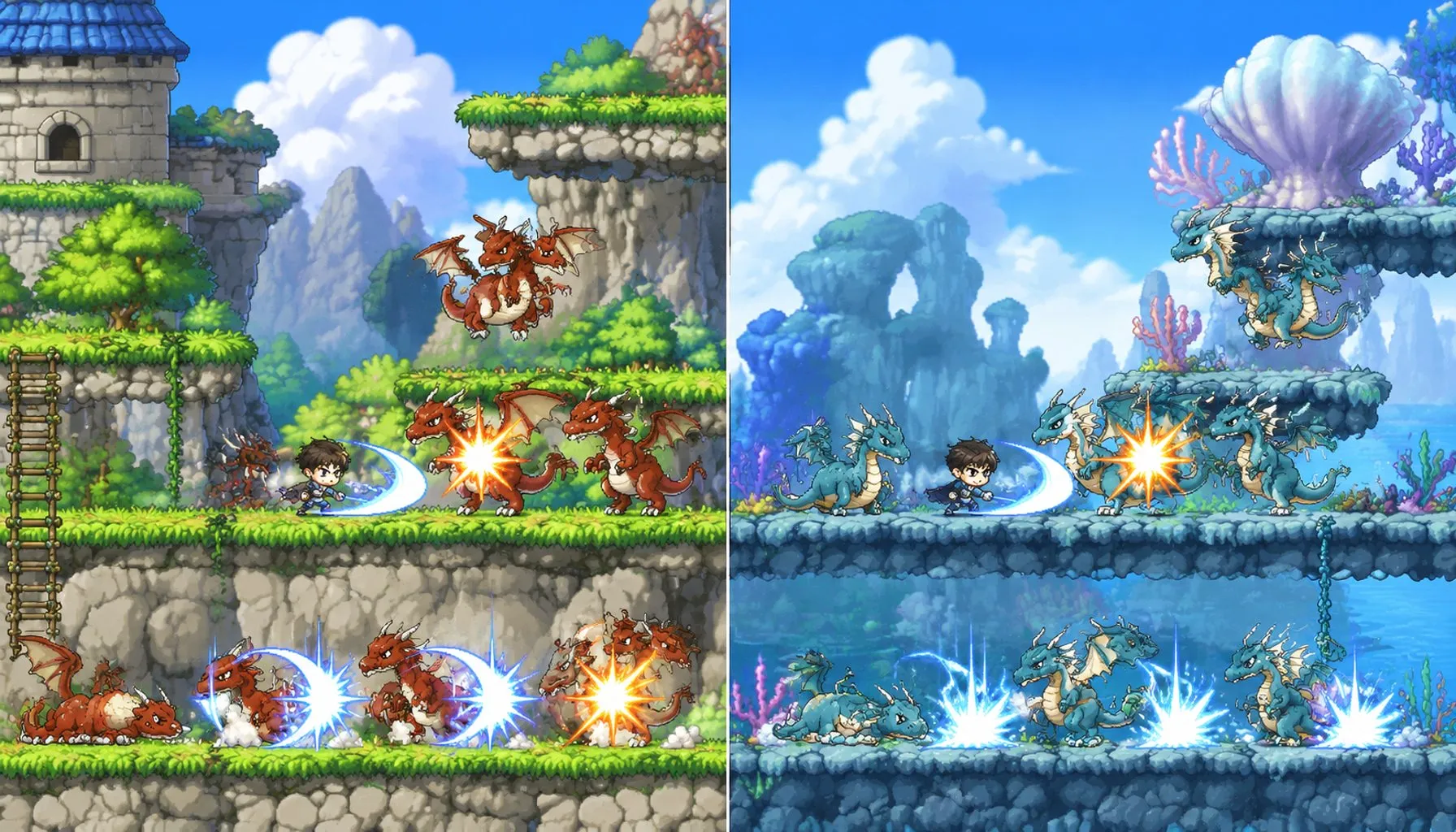
The Sai dagger gives Dusk Mander an additional attraction for Bandits. connects that reward with strong interest in the class, but its claim that Bandits are the strongest option is too broad to use as a settled ranking. Equipment investment, skill levels, enemy layout, and available alternatives all affect the comparison.
A narrower recommendation is more useful: Bandits looking for that dagger have a reason to investigate Dusk Mander, especially if the map also provides efficient experience.
Competition can erase part of the advantage. A busy map may leave us waiting for spawns or clearing fragments of a route. We would compare a contested session with an available alternative before assuming the more popular location produces better progress.
Mywood and Sporewood as Weapon Targets
Mywood attracts attention through its Steel Slain and Cromi drops. A monster with desirable weapons for multiple classes can draw both players seeking personal upgrades and players farming for resale. Its 3,900 HP, however, makes kill speed a serious consideration.
We guess that a substantially higher character level may be needed to farm it comfortably. We would replace that estimate with a practical check. Can our character hit reliably, survive the route without excessive healing, and kill at a pace that justifies the reward?
Level alone cannot answer those questions. Weapon quality, skill investment, accuracy, elemental interaction, and map layout all contribute. A character that technically kills Mywood may still progress faster elsewhere.
Fire weakness makes the target worth examining for Fire/Poison Wizards. It does not remove the need to measure the full encounter. Long casting sequences and frequent repositioning can make a promising matchup less efficient than expected.
Sporewood offers a similar equipment-focused decision for warriors. also discusses holy weakness, which gives Clerics a reason to check their actual damage against it. That detail should not be expanded into a claim that every Cleric skill works equally well there.
For both tree monsters, we would separate an equipment hunt from a leveling session. A player willing to accept slower experience for a specific weapon has a different objective from someone trying to reach the next level quickly. Giving the session a clear purpose makes it easier to decide when to leave.

Glove Scrolls and the Price of Reliable Attack
The glove discussion has the widest implications because it affects players outside Forgotten Hollow. If the 100% Gloves for Attack scroll is available and grants the expected attack increase, it gives players a way to plan a basic upgrade with less uncertainty.
| Detail to check | Why we need it |
|---|---|
| Scroll success rate | Determines the chance that an upgrade succeeds |
| Attack gained per success | Determines the value of each successful use |
| Remaining upgrade slots | Limits how many more scrolls the glove can accept |
| Existing glove attack | Establishes the starting point |
| Total purchase cost | Allows comparison with finished gloves |
Suppose a particular glove has five usable upgrade slots and the relevant 100% scroll adds one attack per successful use. Under those conditions, five scrolls provide five additional attacks without failed upgrade attempts. This is an illustrative calculation; the actual item descriptions must support both assumptions.
We would compare three routes before spending: buy finished gloves, use reliable scrolls, or attempt a higher-variance upgrade. The cheapest route can change as scroll supply, clean glove prices, and demand move.
Expects basic attack gloves to become cheaper as reliable scrolls become easier to obtain. That is a reasonable market hypothesis, but availability alone does not establish the final price. Supply may remain limited, and newly affordable upgrades can attract more buyers.
The same caution applies to the prediction that NPC access through a later progression system will reduce prices. We would check the unlock requirement and purchase conditions before using that future supply in a buying decision.
For our own progression planning, the strongest reason to buy is often immediate usefulness. An affordable glove upgrade that consistently reduces attack count may repay its cost through faster training. Buying several speculative upgrades because prices might rise requires a different level of confidence.
Mushroom Bosses: Compare the Whole Hunt
is less enthusiastic about Rune Mushroom's rewards than those of other mushroom bosses. It highlights only a few possible attractions and suggests the remaining equipment does not justify much dedicated farming time.
That assessment is incomplete without the cost of the hunt. Boss value includes time spent finding a spawn, competition, kill duration, healing, and the reliability of the reward information.
Zombie Mushmom may offer a practical opportunity when it appears near a route we already use. We describe encounters while farming Zombie Mushrooms with a friend. In that situation, checking for the boss adds relatively little travel time.
Camping a spawn is a larger commitment. We would want a stronger reason before giving up a productive training route for repeated waiting.
Throwing-star drops also need careful wording. We explicitly express uncertainty about some rewards. A written guide should preserve that distinction. An unverified star drop can be mentioned as requiring confirmation, but it should not carry a farming recommendation.
Build a Route Around the Upgrade We Need
Our team would start with one goal: steady currency, fast experience, a specific weapon, or money for a planned glove upgrade. Combining those goals is useful when the map supports it, but treating every possible reward as equally important makes route selection harder.
For steady returns, we would record starting mesos and consumables, run a consistent route, then separate ordinary loot from rare rewards. For experience, we would compare complete sessions at a similar level of attention. For equipment, we would set a time limit and a purchase price that makes continued farming unnecessary.
That time limit matters. A dry session does not make a rare drop more likely on the next kill. If buying the weapon lets us move to a substantially better training map, extending the hunt may cost more progress than the purchase saves.
We would also distinguish between landing a lucky two-attack kill and doing it reliably. Normal damage ranges, misses, critical hits, and leftover health all affect the route. A damage simulator can help establish a target, but actual combat shows how often that target produces the result we need.
Before spending, we compare the expected cost of self-farming with current listings for cheap MapleStory Classic World Items, checking usable stats and remaining upgrade slots rather than price alone. A modest purchase can be sensible when it removes a clear progression bottleneck, while a low-priced item that fails to improve our attack count may offer little immediate value.
The strongest targets each have a specific purpose: Raffle for a magic-attack scroll, Echo Pierce for an Olympus hunt, Dusk Mander for its experience comparison and dagger, and the larger tree monsters for weapon progression. We would confirm the relevant drop, test the route with our own character, and spend our farming time where the next useful upgrade is realistically within reach.