
Training at the nearest class trainer can quietly drain a leveling character's wallet. A single spell may not feel expensive, but several new ranks purchased across multiple visits can take a noticeable share of the gold reserved for repairs, equipment, consumables, and future upgrades. Our team found that the trainer's faction may matter just as much as the trainer's location, which gives players another practical way to manage WoW Forever Gold during the early game.
The central point is simple: two NPCs offering the same type of training may not always charge the same amount. Their prices can be affected by the reputation your character has with the faction they represent. A trainer standing in a familiar city is not automatically the cheapest option, and a trainer located outside your faction's main hub still offers better value if your reputation is higher there.
This is a small system detail, but it fits the way Classic-style progression works. Gold is earned slowly at lower levels, while training costs appear regularly and compete with nearly every other expense. Our team recommends checking the trainer's faction before opening the training window, then comparing the price with another trainer if one is available along your route. The habit takes a few seconds and can prevent unnecessary spending throughout the leveling process.
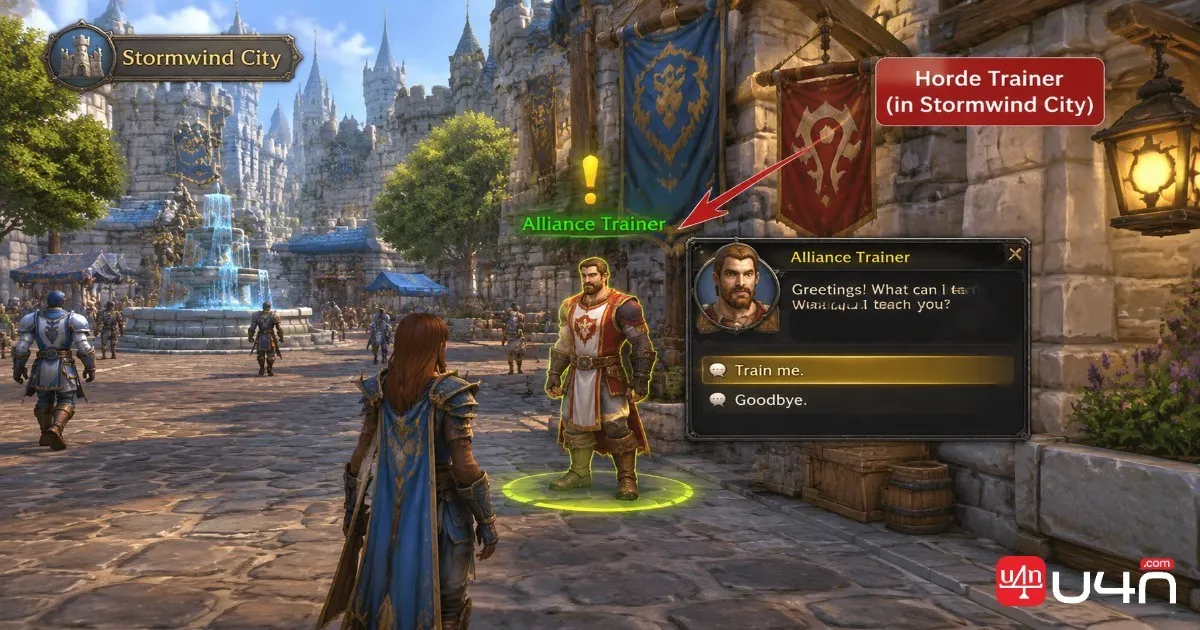
Trainer Location Is Not the Whole Story
Many players often choose a trainer based on convenience. If a character is already in Stormwind, the nearest class trainer seems like the obvious choice. The same logic applies in Darnassus, Moonglade, or any other hub where several services are concentrated.
That approach is efficient when the price is identical. The problem appears when reputation discounts are attached to the trainer's faction rather than the city itself. A trainer can stand inside one capital while representing a different faction. The building, zone, or city name may create one expectation, while the NPC's actual faction determines the price shown in the training window.
This distinction is especially useful for characters who move between racial capitals, class hubs, and questing zones. Druids, for instance, often pass through Moonglade for class-related activities. Alliance characters also visit both Stormwind and Darnassus during normal progression. If the same skill is available in more than one location, the relevant comparison is not simply "Which trainer is closer?" It is "Which trainer represents the faction where my reputation is strongest?"
The community observation behind this topic compared training costs across Moonglade, Stormwind, and Darnassus. It was based on player testing rather than a formal developer explanation, so we treat it as a mechanic worth checking in game rather than an absolute pricing rule for every trainer. That distinction matters because server versions, trainer availability, and individual skill costs can change.
The trainer's faction matters more than the city name alone. Check the NPC's faction, compare your reputation, and read the actual training price before making a long trip.
How Faction Reputation Changes Prices
Reputation in WoW Forever is not limited to quest rewards, faction vendors, or access to special items. It can also affect the cost of services connected to a faction. Training is one of the expenses that can become cheaper when your standing improves.
The relevant reputation belongs to the trainer's faction. It does not automatically follow your character's race, the city where the NPC is standing, or the faction you usually support. A Stormwind-based trainer and a Darnassus-based trainer can apply different prices even when they teach comparable abilities.
Players who have spent time questing in a particular region often have an advantage without realizing it. Reputation earned through quests, turn-ins, or other activities can make one trainer more affordable than another. The effect becomes easier to notice when several skills are purchased in one visit, especially at levels where new ranks become available close together.
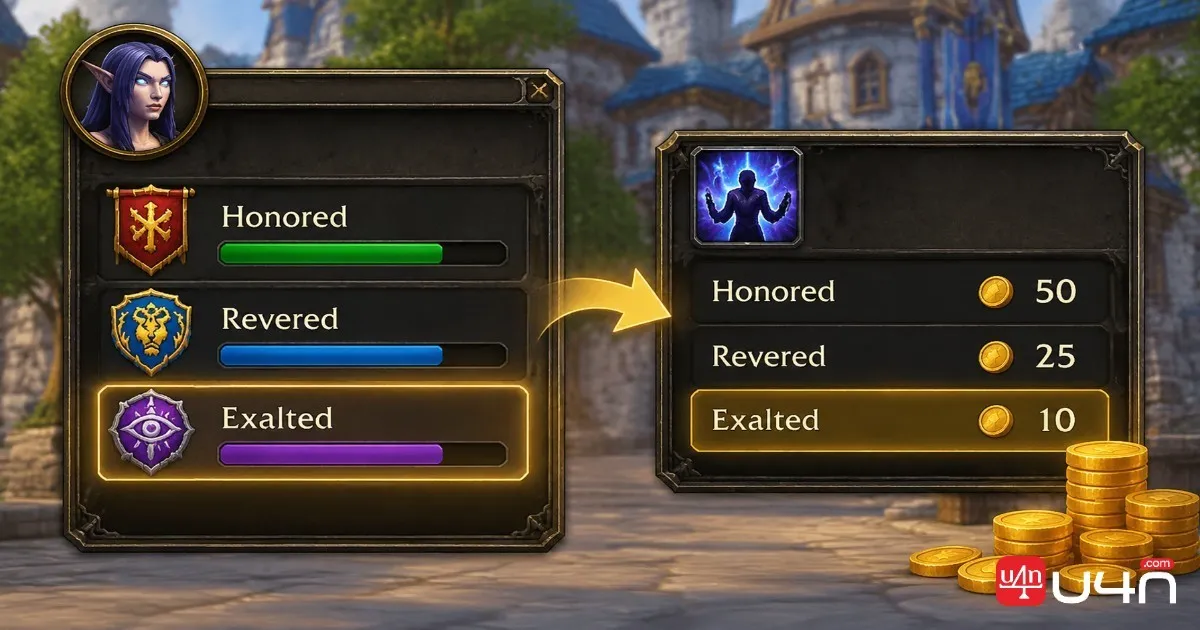
Classic reputation discounts are often used as a reference for this system. The commonly cited structure is 10% at Honored, 15% at Revered, and 20% at Exalted for eligible services. These percentages should not be treated as a guaranteed price table for every WoW Forever trainer. They provide a useful framework for understanding why reputation matters, while the actual amount should be confirmed from the in-game training window.
| Reputation standing | Classic reference discount | Practical meaning |
|---|---|---|
| Below Honored | No full discount reference | Training can cost more than at higher standing |
| Honored | 10% | A modest saving on eligible services |
| Revered | 15% | More valuable when buying several skills |
| Exalted | 20% | The strongest reference discount for eligible services |

A 10% reduction is easy to ignore on a cheap ability. It becomes more meaningful when several ranks are bought together or when the character is preparing for a new stage of leveling. Spending 20 gold on eligible training would represent a potential 2 gold difference at a 10% discount. That is not a fortune, but it can cover repairs, reagents, ammunition, food, or part of another training purchase.
The exact price shown to your character should always take priority over a general reputation chart. If the difference is only a few silver, travel may not be justified. If the gap grows across a full set of class abilities, the cheaper trainer deserves serious consideration.
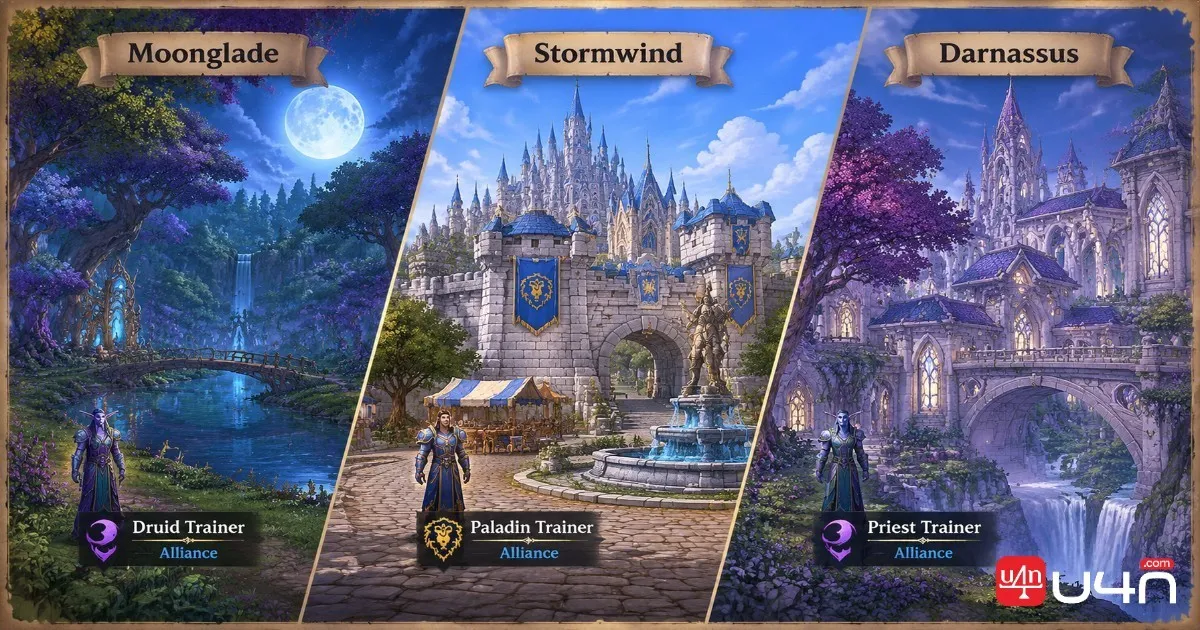
Moonglade, Stormwind, and Darnassus
The three locations most often discussed in this comparison are Moonglade, Stormwind, and Darnassus. They represent a useful example because players can visit all three for different reasons, yet the reputation attached to their trainers can vary.
| Training location | Faction to inspect | What our team recommends checking |
|---|---|---|
| Moonglade | Cenarion Circle | Confirm your current Cenarion Circle standing |
| Stormwind | Stormwind | Check if your reputation qualifies for a discount |
| Darnassus | Darnassus | Compare the price before choosing the trainer |
Moonglade deserves special attention because it feels like a class-specific destination rather than a standard capital. Players can assume that training there follows the same pricing logic as training in their racial city, but the trainer's faction remains the more useful clue.
Stormwind creates a different kind of confusion. The city contains NPCs from several backgrounds, and not every character inside its walls should be treated as a representative of Stormwind. The same principle applies to other major hubs. Location gives you a starting point, not the final answer.
Darnassus can provide a lower price for one character and no advantage for another. A player with stronger Darnassus reputation could see a better deal there, while a character with higher Stormwind standing can save more by remaining in Stormwind. This is why fixed statements like "Darnassus is always cheaper" are unreliable. The result depends on your character's reputation and the specific trainer being used.
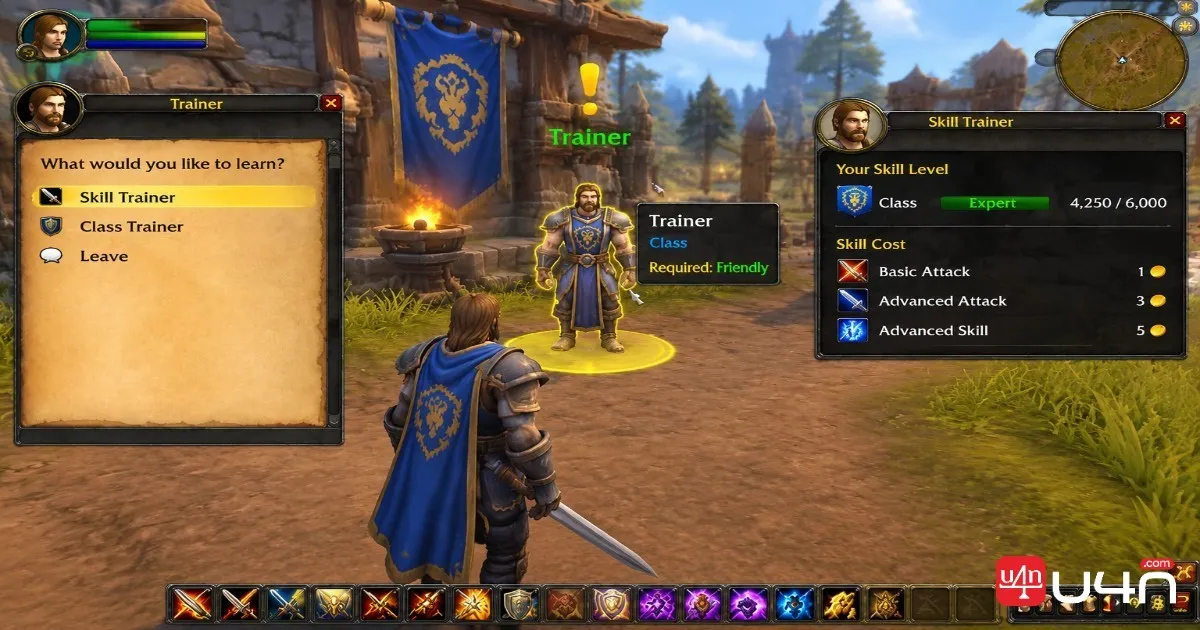
Players do not need to memorize every NPC's faction. In most cases, hovering over the trainer and reading the tooltip provides the information needed for a quick comparison. We recommend checking the tooltip before opening the training interface, especially when the character is about to purchase several abilities.
A Practical Trainer-Checking Routine
A repeatable routine makes this mechanic useful without turning every training visit into a research project. Our team uses the following sequence whenever a character reaches a new training milestone.
Locate the Available Trainer
Start with the trainer closest to your current route. There is no reason to make a detour before confirming that a price difference exists.
Inspect the NPC Tooltip
Check the faction listed on the trainer. Do not rely only on the trainer's race, appearance, or the city name displayed on the map.
Review Your Reputation
Open the reputation panel and find your standing with that faction. A character can have a favorable reputation with one related faction and a weaker reputation with another.
Open the Training Window
Record the price of the skill or rank you actually need. The displayed cost is more reliable than an old guide, a forum comment, or a general discount percentage.
Search for an Alternative Trainer
If another trainer offers the same class service, inspect that NPC's faction and compare the cost. This is especially useful when both locations are already part of your planned route.
Decide If the Savings Justify the Travel
Include flight costs, travel time, danger on the road, and the number of skills you intend to purchase. The cheapest price is not always the most efficient choice.
- Check the trainer's faction before opening the training window.
- Compare the displayed price instead of relying on a general discount estimate.
- Include travel time and transport costs when calculating the real saving.
This process also helps separate real savings from false savings. Suppose a trainer in another city offers a 10% discount, but reaching that city requires a long trip and an extra flight. If you are buying one inexpensive spell, the saving can disappear immediately. If you are returning there for quests, visiting a vendor, or turning in reputation items, training during the same trip becomes much more attractive.
The timing of the purchase matters as well. Many players return to a trainer the moment a new ability becomes available, even when they are not using that ability yet. That habit can create unnecessary expenses. If a spell does not support your current build, solo rotation, dungeon role, or profession routine, postponing the purchase can be more valuable than chasing a small discount.
When a Discount Is Worth the Trip
A discount should be evaluated as part of a route, not as an isolated number. Players who understand the rhythm of leveling recognize the pattern: travel costs money, downtime has a value, and every detour can interrupt a quest chain or group schedule.
The strongest case for visiting a cheaper trainer appears in four situations:
- You are buying several skills or multiple spell ranks at once.
- The cheaper trainer is already near your next quest objective.
- You have high reputation with one faction and weak reputation with the nearby alternative.
- You are returning to a major hub for other errands anyway.
The weaker case is a single low-cost purchase when the alternative trainer is far away. In that situation, paying the local price can be the better decision. Efficiency is not measured only by the number displayed in the training window. A saved trip can preserve quest momentum, reduce exposure to hostile zones, and keep you on schedule for a dungeon group.
We also recommend comparing training prices before a major spending session. This is especially useful near level brackets where several abilities become available together. Instead of purchasing each skill immediately, note what you need, check the alternative locations, and make one deliberate decision. A short pause can prevent a series of small purchases from becoming a large expense.
Spend Less Without Skipping Useful Skills
Reputation discounts work best when combined with selective training. Buying fewer unnecessary abilities is often more effective than traveling across the world for a minor reduction.
That does not mean players should ignore every skill outside their main rotation. Some abilities become valuable in specific dungeons, PvP encounters, solo farming routes, or emergency situations. The practical approach is to separate essential purchases from optional ones.
For a leveling character, essential skills usually include the abilities that define the current combat rotation, improve survivability, support the chosen dungeon role, or remove a major limitation from the class. Optional skills can include ranks that are rarely cast, utility abilities with a narrow use case, or upgrades that will soon be replaced by a stronger version.
Class knowledge makes the difference here. Experienced players often know which abilities can wait, while newer players can prefer to buy a wider selection and learn through practice. Our recommendation is to keep enough gold available for repairs and core upgrades before spending heavily on situational abilities.
The same resource discipline applies to WoW Forever Items. Equipment upgrades, consumables, profession materials, and other progression costs compete with trainer fees, so a small discount becomes more useful when it protects money needed for a specific upcoming purchase. The goal is not to avoid spending. It is to make each purchase support the character's next stage of progression.
A Small Check Before Every Training Visit
The trainer faction system rewards attention rather than complicated planning. Before buying a new skill, look at the NPC tooltip, confirm the associated reputation, check the displayed price, and consider whether another trainer fits your route better.
Moonglade, Stormwind, and Darnassus provide clear examples of why location alone cannot determine value. A trainer can be nearby but tied to a faction where your reputation is poor. Another can be farther away but offer a lower price because your standing is stronger. Neither option is automatically correct until the actual cost and travel requirements are compared.
Our team treats the current community discovery as a practical checkpoint rather than a rule to follow blindly. Trainer prices should be verified in game, especially when playing on a newly updated server or testing a character at a different level. If the displayed price confirms the discount, use it. If the difference is negligible, keep moving and protect your time.
A few seconds of checking can preserve enough gold for repairs, useful upgrades, and the next round of abilities. That is a small adjustment to the leveling routine, but it fits naturally into the way experienced players manage resources across Azeroth.