Cart Empty
Continue ShoppingSports gaming enters a fascinating head-to-head match this year. On one side stands MLB The Show 26, a highly polished, simulation-heavy baseball title focused on execution and deep management logic. On the other is EA Sports College Football 27, a high-octane, fast-paced gridiron simulator capturing the pageantry, chaotic energy, and strategy of the college ranks.
For players choosing where to invest their time and money, understanding how these two titans stack up in gameplay, career modes, and virtual economies is essential.
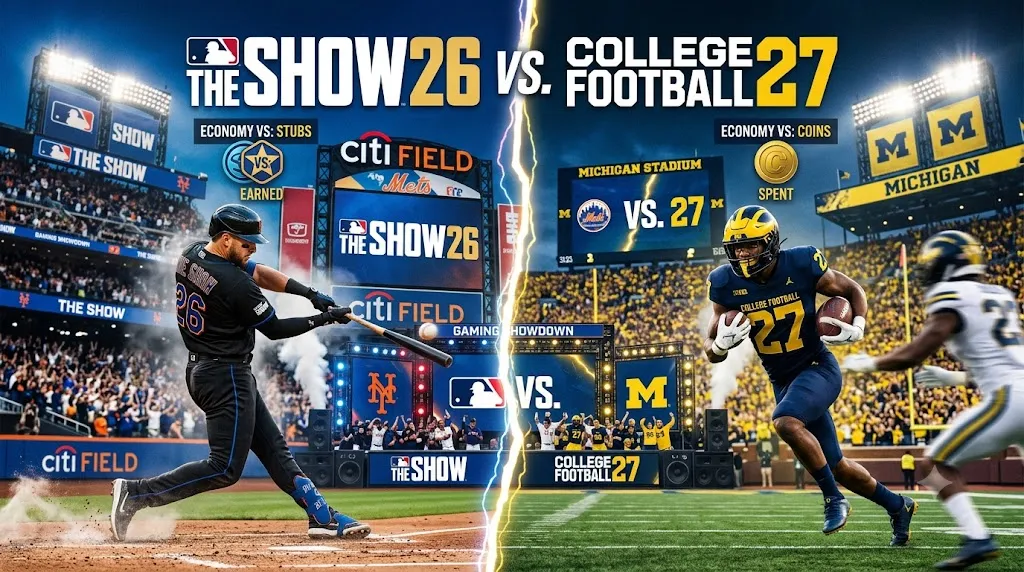
| Feature | MLB The Show 26 | College Football 27 |
|---|---|---|
| Primary Focus | Micro-precision, strategy, and roster logic | Explosive pacing, dynamic defense, and recruitment |
| New Gameplay Mechanics | Bear Down Pitching, Big Zone Hitting, ABS Challenge System | Smart Zones, Plaster Coverage, Timing-Based Catching |
| Flagship Career Mode | Road to the Show (Road to Cooperstown) | Road to Glory / Dynasty Mode |
| Team Building Mode | Diamond Dynasty | College Football Ultimate Team (CUT) |
| In-Game Currency | Stubs | Coins |
The choice between these two titles often comes down to their approach to live-service modes. Both games feature a centralized virtual currency used to purchase player packs, acquire specific cards on the community marketplace, and complete sets. However, the player experience in managing these economies is fundamentally different.
Diamond Dynasty remains widely regarded as one of the most consumer-friendly, "no-money-spent" fantasy modes in sports gaming.
EA Sports operates on an entirely different live-service philosophy for College Football Ultimate Team (CUT 27). The economy revolves around Coins, which are crucial for keeping pace with a rapidly shifting meta.
The Takeaway: If you prefer a steady, rewarding grind where a top-tier team can be built completely for free, the Stubs economy in MLB The Show 26 is superior. If you enjoy a highly volatile, high-stakes market where working the Auction House feels like a high-reward game of its own, College Football 27 Coins offer that aggressive style.
Both titles have introduced massive systemic upgrades to their respective engines this year.
Baseball is a game of millimeters, and the new mechanics emphasize pitch-to-pitch focus:
Football this year focuses heavily on countering mobile quarterbacks and adding skill gaps to standard play:
MLB The Show 26 delivers a masterclass in management realism. The franchise engine features completely rebuilt trade logic, increasing package slots to 8-player deals (4-for-4 trades). The AI accounts for "Buyer" and "Seller" market sentiment, and trades are no longer instant—the CPU takes time to evaluate, allowing rival teams to swoop in and attempt to steal or block deals.
College Football 27 leans into the unique chaos of collegiate sports. Roster management centers on the transfer portal, NIL deals, and spending Dynasty Points to upgrade school facilities to attract top-tier high school recruits. Roster turnover happens fast, forcing you to constantly rebuild rather than sustain a long-term veteran core.
The player journey is highly connected in both games, but the starting points differ:
Authored by elite gamers and industry insiders, the U4N Editorial Team delivers authoritative game updates, patch notes breakdowns, and expert strategies for trending titles including World of Warcraft, Path of Exile 2, MapleStory, Aion 2, and Arc Raiders.
From deep-dive guides to the latest meta shifts, our in-house veterans test every tactic firsthand to keep you ahead of the game.