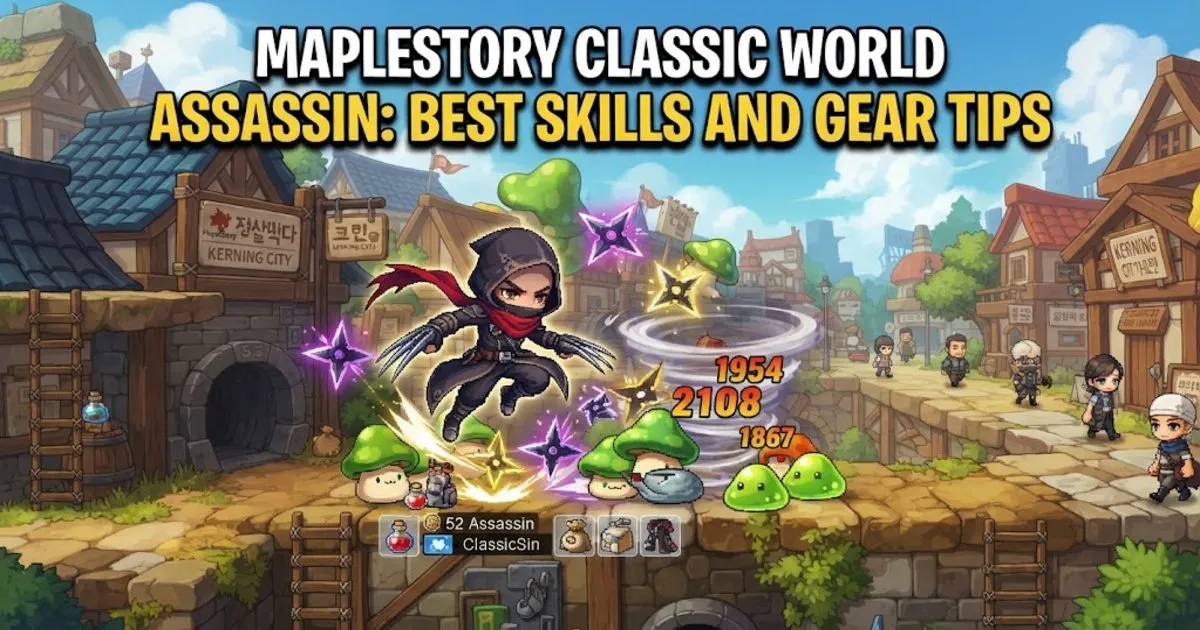
If you are thinking about playing an Assassin in MapleStory Classic World, one question probably comes up quickly: Do you need a lot of money to make the class work? MapleStory Classic World Mesos can certainly make it easier to chase stronger claws and throwing stars, but the Assassin is not necessarily locked behind expensive gear. Its skills, damage scaling, and star recovery tools give regular players several ways to control their costs.
This breakdown focuses on the first and second jobs, using data and damage calculations from the second Classic World test. The Assassin is unusual because it reaches second job without gaining a traditional mobbing attack. Instead, Lucky Seven remains the main attack, while the second-job skill set improves damage, mobility, sustain, and throwing-star efficiency.

Lucky Seven Is Strong From the Start
Lucky Seven throws two stars per cast and deals 140% damage with a 16 MP cost. Its formula is also different from the standard dagger attacks used by Bandits. The weapon multiplier is locked at three, while mastery stays at 50%.
That fixed mastery is especially useful during early leveling. When comparing an Assassin and a Bandit with similar stats, Double Stab has a small advantage immediately after the job advancement. However, Lucky Seven catches up quickly. By level 14, its average damage is ahead, and after upgrading to a stronger claw at level 15, the gap becomes much more noticeable.
At level 30, the comparison becomes more interesting. With every possible point invested into Luck, the Assassin can remain on a lower-level claw because of its Dexterity requirement. However, moving a few points into Dexterity to equip a stronger claw can push Lucky Seven's average damage significantly higher.
Claw Mastery Matters More Than It Looks
Claw Mastery is one of the most important second-job skills because it improves more than just mastery. At max level, it provides 20 attack power, raises claw mastery, and gives a 25% chance to recover the stars used by a throw.
The damage increase from the skill itself is useful, but weapon attack still has a much larger impact. In the level 70 test setup, adding 20 weapon attack produced a much bigger improvement than the attack power supplied by Claw Mastery.
That is one reason the Assassin can become expensive at the high end. Players who want maximum damage will eventually care a lot about the quality of both their claw and their stars.
Critical Throw Adds Consistent Damage
Critical Throw is another major damage skill. At maximum level, it raises critical chance from the basic 5% to 20% and increases critical damage from the normal 20% bonus to 55%.
For a simple 100-damage hit, a critical hit would therefore deal 155 damage. Once the increased critical chance is included, the average damage improvement is close to 10%.
This becomes even more useful when combined with Critical Recovery. Since Critical Recovery activates from critical hits, having more critical chances also means more opportunities to trigger its healing effect.
Haste and Jump Throwing Change the Class
Haste is one of the reasons Assassin gameplay feels much better once the second job begins. At maximum level, it provides 30 movement speed and 10 jump for five minutes. Its larger buff range at higher levels also makes it more convenient when playing in a party.
The bigger gameplay improvement comes from jump throwing. When an Assassin uses a throwing skill while airborne, the character does not automatically switch to a claw attack just because an enemy is close.
This makes areas with flying monsters particularly comfortable. In places such as the Kerning City Subway, an Assassin can jump and throw while the stars track targets within range. The combination of movement, range, and targeting makes the class feel very different from a character that has to stop and attack enemies directly.
Critical Recovery Can Reduce Potion Costs
Critical Recovery restores health and mana after a critical hit, with a cooldown. At maximum level, the next eligible critical hit can restore 10% of maximum HP and MP.
In the level 70 one-hour simulation, this passive triggered around 110 times under the tested conditions. Compared with grinding without it, the result represented a meaningful reduction in potion consumption.
The exact savings depend on how much damage you take and how often your critical hits occur, but the basic idea is important: Critical Recovery can save regular players money while they grind, not just provide extra convenience.
Drain Trades Damage for Sustain
Drain provides another way to recover health. At maximum level, it deals 240% damage and has a 12% chance to absorb 15% of the damage dealt as HP.
The tradeoff is its higher mana cost. In the one-hour simulation, Drain restored a large amount of health and reduced white-potion usage, but its additional MP consumption required more blue potions. It also dealt roughly 11% less total damage than the Lucky Seven route under the same test conditions.
For that reason, a balanced build can prioritize Lucky Seven, Claw Mastery, Critical Throw, Haste, and Critical Recovery, while leaving some points in Drain. Players who prefer self-healing and take frequent hits may instead invest heavily into Drain.
Are High-End Throwing Stars Really Necessary?
Throwing stars are another reason people associate Assassins with expensive characters. Higher-attack stars increase damage, but the ongoing recharge cost is not necessarily as frightening as it first appears.
Lower-tier stars are cheaper to recharge, while stronger stars naturally cost more. However, the recharge cost is relatively small compared with the broader cost of maintaining a character.
There is also a useful progression through the Kerning City citizen system. A 17-attack throwing star can be obtained through the citizen shop once the required rank is reached. This provides a practical option for players who do not want to immediately chase the most expensive stars.
Choosing Your Claw and Stats
When several claws share the same level and base attack, their smaller bonuses can help determine which one is preferable. For example, among the level 50 Slain claws, Dark Slain stands out because its critical-rate bonus can improve both damage and Critical Recovery activation.
For stat allocation, the general approach is simple: look at the next claw you want to equip, calculate how much Dexterity your equipment already provides, and put only the necessary amount into base Dexterity. The remaining points can go into Luck.
This approach lets your equipment cover more of the required Dexterity while preserving as much Luck as possible for damage.
First and Second Job Builds
For the first job, two practical approaches focus on either Dark Sight or Nimble Body. Maxing Nimble Body gives additional accuracy and avoidability, which can help when fighting monsters above your level. Dark Sight, meanwhile, becomes more convenient for movement and exploration when fully developed.
For a second job, a balanced build can max Claw Mastery, Critical Throw, Haste, Critical Recovery, and Claw Booster, with the remaining points going into Drain. Another option is to leave Claw Booster at one point and invest heavily into Drain.
The suggested leveling order begins with Claw Mastery, then adds basic points to Claw Booster, Haste, and Critical Recovery before heavily investing in Critical Throw and the main damage skills.
Is Assassin Still a Rich Player's Class?
The answer is yes and no. A top-end Assassin with an excellent claw and powerful throwing stars will obviously benefit from having plenty of money. Better weapon attack directly improves damage, so expensive equipment has a real effect.
But that does not mean a normal player needs a huge budget to enjoy the class. The citizen-shop stars provide a reasonable starting point, Claw Mastery reduces star consumption, and Critical Recovery can reduce potion spending. These tools help keep the running costs manageable.
For players who enjoy ranged attacks, fast movement, jump throwing, and the satisfying feeling of stars locking onto targets, Assassin remains an appealing second-job choice. You can spend heavily if you want to chase maximum damage, but the class is still perfectly playable without building the most expensive setup.
For players looking to improve their character efficiently, understanding where each upgrade actually matters is more valuable than simply spending everything available. Choosing sensible gear upgrades and managing your resources can make the Assassin much more affordable.
If you are also building a stronger character through equipment upgrades and other useful resources, MSCW Items can give you more options to consider as your progression continues.
The Assassin's strongest appeal is not simply its damage numbers. Its range, mobility, star management, and critical-based sustain give it a distinct playstyle. With the right build and reasonable gear choices, MSCW Items can complement your progression without requiring you to immediately chase every expensive upgrade.