



Chasing 100% completion should not mean spending an evening on something your achievement no longer needs. The supplied A Long Road checklist makes that distinction clear: some categories have a minimum target below the total amount of content available. Our team's approach is to separate required progress from optional cleanup before planning another collectible run, race session, or vehicle hunt.
That distinction also keeps resource planning sensible. We would treat GTA 6 money as a practical budget for the activities we still need, rather than a reason to buy every vehicle or collect every available item. A spending decision should follow an unfinished requirement, not the assumption that owning more automatically brings the achievement closer.
We are treating the supplied figures and published checklist as reported requirements, not presenting them as an independently tested official achievement specification. The useful question is still straightforward: what must we finish, what only needs a threshold, and where can we stop without turning an achievement run into an exhaustive clear?
What 100% Completion Actually Asks Us to Do
Our starting point is a simple distinction: completing the achievement checklist and exhausting the game's content are different goals.
A threshold requirement gives us a stopping point within a larger category. A full-completion requirement asks us to finish the specified category. A quality requirement adds another condition, such as earning a particular medal rather than merely participating.
We would label every checklist entry with one of those descriptions before working on it. That prevents a number from losing its meaning once it lands in a spreadsheet.
Consider the difference between these instructions:
- Finish an activity.
- Win a specified number of distinct events.
- Earn gold medals in a challenge category.
- Reach a stated value through a particular transaction.
Those are not interchangeable objectives. A completed race may not be a win. A repeated win may not represent another distinct event. Cash in our account may not tell us anything about a category that measures a specific kind of sale.
Our rule is to preserve the wording of each requirement. We can shorten a label for convenience, but we should never shorten away the condition that makes it count.
That is also why we would avoid a blanket claim that every category allows skipped content. The flexibility belongs to individual requirements, not automatically to the entire achievement.
The Three Thresholds That Change the Plan
The supplied material identifies three especially useful examples: 100 flamingos from 125, 30 race wins from 40 events, and 200 base vehicles from 277. The same figures appear in the associated community checklist post. We would use them as reported planning targets while checking the corresponding progress in our own save.
| Category | Reported target | Supplied total | Remaining beyond the target |
|---|---|---|---|
| Flamingos | 100 | 125 | 25 |
| Race wins | 30 | 40 | 10 |
| Base vehicles | 200 | 277 | 77 |
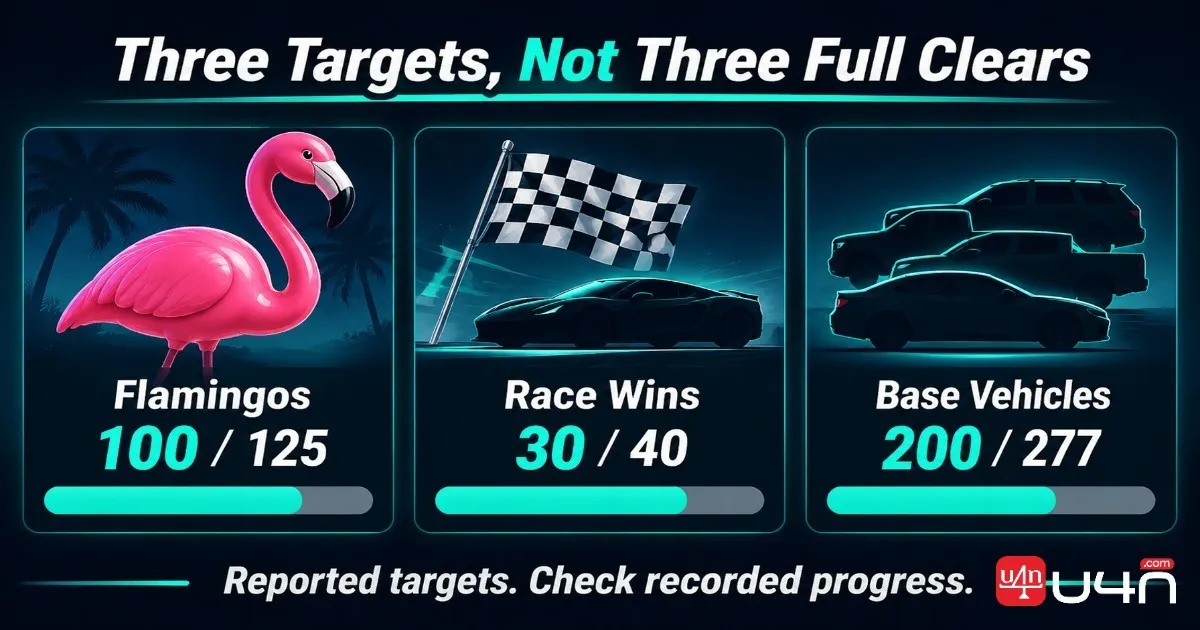
The practical benefit is flexibility, not permission to ignore how progress registers.
For flamingos, our suggested route would favor accessible clusters over isolated targets. A collectible beside an activity we already intend to complete is a better early choice than one requiring a separate cross-map journey. We would reserve awkward locations for later, then check whether we still need them.
For racing, we would maintain an event-by-event record. A general tally of successful finishes is too vague for a requirement described in terms of unique races. Our working note would include the event name, the result, and whether the relevant progress changed.
For vehicles, we would be particularly careful with the phrase "base model." We would not build a plan around paint jobs, cosmetic variants, or repeated encounters with a familiar car. Before investing heavily in that category, we would establish what action the game records and whether the model is genuinely new to our list.
The table also helps us avoid a familiar completionist trap: continuing a finished category because it is comfortable. Once its target is satisfied, the next session should address something unfinished.
The Reported 35-Requirement Checklist
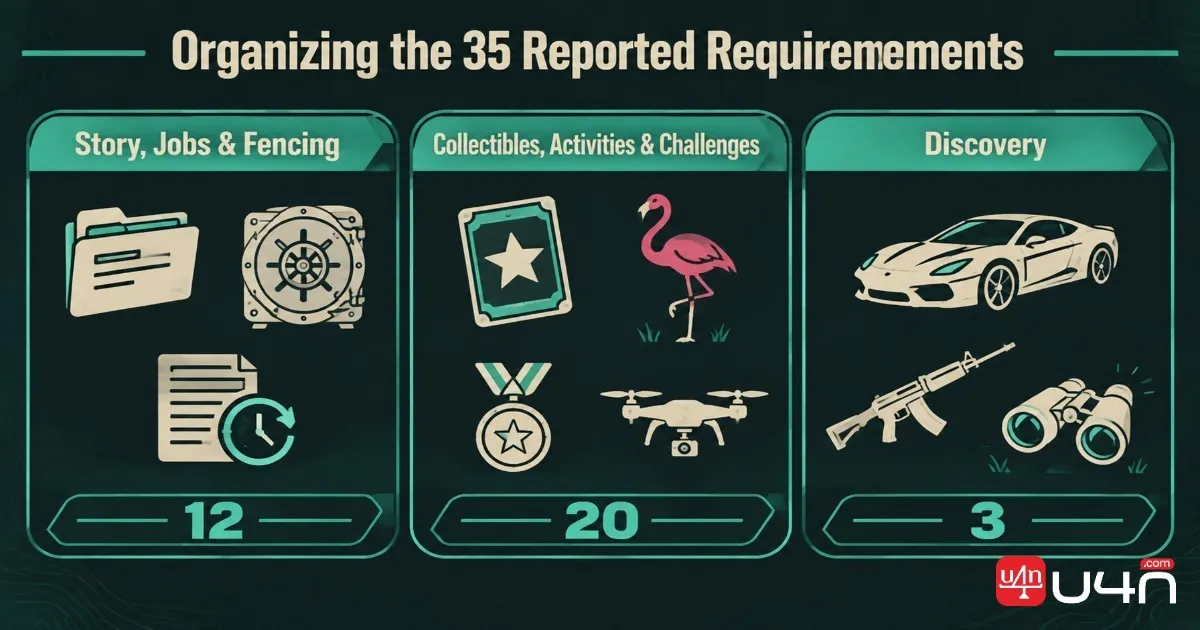
The list contains 35 requirements, which we have organized into compact planning tables for easier reference. We have retained the original names wherever their exact meaning is unclear, rather than making assumptions. Treat these as reported targets and verify unfamiliar labels in the game before relying on them as specific instructions.
Story, Jobs, and Fencing
| No. | Requirement | Target |
|---|---|---|
| 1 | Story | 100% |
| 2 | Optional tasks | 100 |
| 3 | Gang operations | 39 |
| 4 | Bank jobs | 22 |
| 5 | Payday loan jobs | 7 |
| 6 | Smash 'N' Grabs | 34 |
| 7 | Stick Ups | 50 |
| 8 | Narcotics fenced | $100,000 |
| 9 | Jewelry fenced | $100,000 |
| 10 | Marked bills fenced | $250,000 |
| 11 | Vaults | 8 |
| 12 | Vehicles fenced | $200,000 |
Our planning sheet would keep the four fencing totals separate. We would not combine them into a single earnings goal, and we would not substitute the current cash balance for a transaction-specific counter.
For jobs, we would record individual completions rather than rely on memory. A short list of names is easier to audit than a note that says "nearly finished." Where the original wording specifies fully completed jobs, we would retain that distinction in our notes.
Collectibles, Activities, and Challenges
| No. | Requirement | Target |
|---|---|---|
| 13 | Kenton sets | 5 |
| 14 | Card sets | 15 |
| 15 | WAiNK scans | 100 |
| 16 | Underwater discoveries | 33 |
| 17 | Magazines/books/comics | 30 |
| 18 | Meditation spots | 15 |
| 19 | Flamingos | 100 |
| 20 | Unique playlists | 2 |
| 21 | Styles | 70 |
| 22 | Unique race wins | 30 |
| 23 | Race golds | 10 |
| 24 | Shooting golds | 42 |
| 25 | Video games | 4 |
| 26 | Pool opponents | 5 |
| 27 | Mini-golf locations | 2 |
| 28 | Basketball hoops | 90 |
| 29 | Drone trials | 42 |
| 30 | Stunts | 300 |
| 31 | Challenges | 70 |
| 32 | Bret's decks | 15 |
We would split this group into location-based work and performance-based work.
Location-based tasks suit a regional route. Performance tasks deserve focused practice. Mixing them indiscriminately can turn a short cleanup session into several hours of driving, retries, and forgotten objectives.
Some labels also need care. "Sets" should not silently become individual objects. "Golds" should not become simple completions. "Opponents" should not become a total number of matches. Our notes would preserve those units even when the table itself stays compact.
Discovery
| No. | Requirement | Target |
|---|---|---|
| 33 | Base vehicles | 200 |
| 34 | Standard weapons | 50 |
| 35 | Animals | 100 |
For this group, we would add a registration note beside each category: what action did we perform, and what evidence showed that it counted?
That is more useful than assuming discovery means ownership, collection, use, or observation in every case. Until the game's wording establishes the rule, our team would leave that question open instead of recommending expensive purchases or unnecessary hunting.
A Cleaner Route Through the Required Work
We would organize the run around the next useful action, not the longest available list.
During story-focused sessions, our preference would be to preserve momentum. We would make brief notes about unfinished activities and convenient discoveries without trying to interrupt every mission with a checklist detour. A nearby opportunity is worth considering; a lengthy diversion needs a clearer reason.
For dedicated cleanup sessions, we would choose one area and identify several unfinished requirements within it. The aim would be a practical circuit with a clear end, rather than a zigzag across the whole map.
A sample planning session might look like this:
| Session type | Our intended focus | Stopping condition |
|---|---|---|
| Regional cleanup | Several nearby unfinished entries | Planned circuit complete |
| Race practice | One event or specific weakness | Verified result or planned retry limit |
| Discovery audit | Unrecorded models or categories | Progress checked and notes updated |
| Final cleanup | A small number of remaining gaps | Each gap individually resolved |
We would also put a time limit on repeated failures. After several attempts with the same mistake, another identical attempt is rarely our best plan. We would change one variable, practice a troublesome section, or leave that activity for a later session.
Our preference is to alternate demanding work with simpler cleanup. That gives a long completion run a better rhythm without losing sight of the remaining targets.
Before ending the session, we would update the record. Five minutes of bookkeeping is a reasonable trade for not wondering the next day whether a particular activity counted.

Track the Condition, Not Just the Number
A useful tracker needs more than a completed checkbox.
Our version would include the requirement, target, current recorded progress, remaining amount, and a brief note about the next action. For unusual entries, we would add the exact wording shown in the game.
The most valuable extra column is evidence. That might be a screenshot of the relevant counter, a recorded event result, or a dated note describing the change we observed.
We would use a simple verification routine:
- Check the relevant progress before the activity.
- Complete one clearly identified action.
- Check the same progress afterward.
- Record the result without guessing.
This is our recommended method for resolving ambiguity, not a claim that every category updates in an identical way.
If a counter does not move, we would pause the broader grind. Repeating an uncertain action twenty times only creates a larger uncertainty. We would check the requirement's unit, any result condition, and whether the action belongs to the correct category.
Our tracker would also distinguish three statuses: unfinished, verified complete, and needs checking. That third status matters. It prevents an uncertain recollection from becoming a confident checkmark.
We would keep platform achievement progress separate from our working checklist, too. One is the system's result; the other is a planning tool. If they disagree, the next step is an audit, not rewriting the checklist to make it look finished.

Where We Would Stop Spending Time
The easiest way to inflate a completion run is to keep working on categories that already satisfy their purpose.
Our stop rule would be strict: once the relevant target is verified, we move on unless another unfinished requirement shares the same activity.
That exception needs evidence. We would not assume that repeating a race, collecting another item, or acquiring another vehicle advances a different category simply because the activities feel related.
We would also keep personal goals on a separate list. Collecting everything can be enjoyable. Owning a favorite vehicle collection can be its own project. Neither needs to be disguised as achievement preparation.
Three habits would help keep our route lean:
- Check the remaining gap before starting another long session.
- Avoid purchases whose connection to an unfinished requirement is unclear.
- Retire completed categories from the active task list.
We would never promise a fixed completion time from these targets alone. A number does not reveal travel time, difficulty, access conditions, or how much progress a particular save already contains.
A better estimate starts with the actual remaining work. Ten unfamiliar activities may need more attention than dozens of routine entries. Our schedule would reflect that difference rather than treating every unchecked box as equal.
Check the Last Gaps Before Another Cleanup Run
Near the end, we would stop browsing the whole checklist and produce a short exception list. Only unfinished or uncertain requirements would remain visible. That keeps attention on the actual blockers instead of the hundreds of actions already completed.
We would resist collecting more GTA6 Items simply because the achievement has not appeared. Our audit would ask a narrower question: which stated condition remains unsatisfied, and what evidence would confirm it? An unrelated purchase or another familiar collectible is a distraction unless it answers that question.
For the next session, we would choose one remaining gap, record its starting state, perform the required action, and check the result. If the evidence still does not match the checklist, we would document the discrepancy before repeating the work.