Cart Empty
Continue ShoppingDiablo 4 Season 15 is built around getting players into the endgame faster, and the most efficient leveling route is less about fighting the strongest monsters and more about maximizing experience per minute.
The core strategy is straightforward: skip the campaign, begin on Normal difficulty, exploit high-density Strongholds during the early levels, then transition into Helltide and War Plans. Season 15’s new mechanics—particularly Soul Splinters and Challenge Dungeons—add further shortcuts to the traditional leveling process. Current Season 15 information is based largely on the Patch 3.2.0 PTR and pre-launch guides, so some values or mechanics can still change when the season goes live.
| Level Range | Primary Activity | Difficulty Strategy | Main Objective |
|---|---|---|---|
| 1–15 | Opening quests/setup | Normal | Unlock War Plans and start building momentum |
| 15–45/50 | Strongholds | Fastest clearable tier | Maximize kill density and XP/minute |
| 45/50–70 | Helltide + War Plans | Normal/Hard, then higher for turn-ins | Farm massive XP through Helltide activity |
| 70+ | The Pit + endgame activities | Torment | Unlock and begin the endgame progression loop |
The precise level breakpoints can vary according to class, gear drops, group size, and how quickly you clear content. The important principle is to change activities when their XP efficiency falls behind, rather than stubbornly following a fixed level requirement.
The first major mistake in a speed-leveling run is treating the opening hours like a normal playthrough.
If you’ve already completed the campaign, select Story Complete when creating your seasonal character. Season 15 also introduces Rebirth, which lets an Eternal character enter the Seasonal realm while preserving its identity and cosmetics, although the character itself returns to level 1.
Normal is generally the correct starting difficulty for a speed run. Higher difficulty can provide better rewards, but that advantage disappears if monsters take substantially longer to kill. The objective at this stage is simple:
Kill → move → kill → move.
Don’t turn a leveling run into a damage-check exercise.
After entering the world:
1. Travel to Temis.
2. Equip your pet and mercenary.
3. Pick up your available support gear.
4. Speak with Tyrael.
5. Unlock the War Plans system.
6. Begin pushing toward high-density activities.
This opening sequence gets the character into the systems that matter for the rest of the run.
Once the character has enough tools to clear efficiently, Strongholds become the central leveling activity.
Why? Density.
You aren’t looking for difficult enemies. You’re looking for areas where you can continuously kill groups without wasting time traveling between objectives.
A useful rule is:
If a higher difficulty makes you noticeably slower, the higher XP multiplier isn’t worth it.
Strongholds can be reset and repeated in certain circumstances, while fully completing them can unlock useful local waypoints and progression. The exact route should therefore depend on whether you’re optimizing purely for XP or also preparing your character for later activities.
| Priority | What to Look For |
|---|---|
| 1 | High monster density |
| 2 | Short travel distance |
| 3 | Fast elite/pack kills |
| 4 | Minimal backtracking |
| 5 | Convenient reset potential |
| 6 | Useful waypoint unlocks |
The important point is that time spent traveling is dead time. A theoretically better XP location can be worse in practice if you’re constantly riding between objectives.
Once Strongholds stop being the most efficient source of experience, transition into Helltide and War Plans.
This is where the Season 15 leveling strategy becomes considerably more interesting.
The current pre-launch route recommends looking for a Double Helltide combination through War Plans. If the available plan doesn’t contain the desired Helltide setup, refreshing the plan can improve your leveling route.
During the farming portion, prioritize monsters and events that give you the highest XP return rather than stopping to loot every item. Hellwyrm/Hellworm-related mechanics are particularly valuable once the appropriate War Plans nodes are unlocked because their additional enemies can create enormous experience bursts.
One of the most useful efficiency techniques is separating farming difficulty from turn-in difficulty. You can farm Cinders and complete much of the Helltide activity on a lower difficulty where enemies die quickly. Then, where the mechanics permit, move to a higher difficulty before submitting the War Plan so the completion reward is calculated at the higher difficulty.
That produces a simple optimization:
| Activity | Recommended Approach |
|---|---|
| Monster farming | Use the difficulty where you kill fastest |
| Cinder generation | Prioritize density over difficulty |
| War Plan completion | Use a higher difficulty when safely possible |
| Loot collection | Don’t interrupt efficient XP chains unnecessarily |
| Travel | Use mounts and movement-speed bonuses |
This is essentially difficulty arbitrage: farm where your character is efficient and collect milestone rewards where the multiplier is more valuable.
Season 15 adds several systems that can make the traditional 1–70 journey considerably faster.
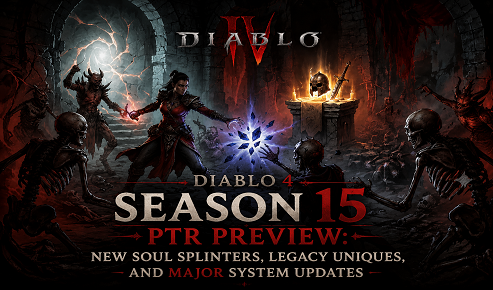
Soul Splinters are socketable items for jewelry, and the Splinter of Lies is particularly attractive while leveling.
At the Common-to-Unique range described by the PTR data, it provides +25% Bonus XP, alongside increased Gold and Crafting Material drop rates. Its drawback is that the character remains Weakened and Vulnerable.
| Soul Splinter | Leveling-Relevant Effect | Drawback |
|---|---|---|
| Splinter of Lies | +25% Bonus XP | Always Weakened and Vulnerable |
| Splinter of Anguish | Crit Chance + Attack Speed | Higher resource costs |
| Splinter of Sin | Maximum Health | Reduced maximum resource |
| Splinter of Pain | Damage Reduction | Movement Speed penalty |
| Splinter of Hellfire | Increased damage | Critical Strike penalty |
For pure leveling, the XP modifier makes Splinter of Lies the obvious specialist choice. Once you’re no longer concerned with gaining levels quickly, a combat-oriented Splinter can become more attractive.
Challenge Dungeons introduce another potentially valuable shortcut. Random portals can appear in the overworld and allow players to challenge bosses at difficulty levels above their normal progression. The PTR implementation allows encounters to scale several Torment tiers above the player’s current difficulty, potentially providing access to substantially better rewards.
For leveling, the principle is simple:
If a Challenge Dungeon appears and you can clear it efficiently, investigate it rather than automatically ignoring it.
The mechanic is particularly useful because it can accelerate gear progression alongside XP. However, these systems were still subject to change before the live Season 15 launch, so players should verify the final implementation once Patch 3.2.0 goes live.
The best leveling build isn’t necessarily the build with the highest theoretical endgame DPS.
For a 1–70 sprint, prioritize:
· High AoE damage
· Strong mobility
· Reliable resource generation
· Low gear dependence
· Fast elite clearing
· Minimal downtime
Based on the supplied Season 15 recommendations, several archetypes stand out:
| Class | Recommended Leveling Build | Primary Advantage |
|---|---|---|
| Warlock | Blazing Scream | Strong passive/area clearing and mobility |
| Necromancer | Minion Necro | Excellent clearing with minimal gear dependence |
| Barbarian | Whirlwind | Mobility plus effortless AoE |
The common theme is momentum. A build that kills slightly slower but never stops to recover resources can outperform a theoretically stronger setup that repeatedly pauses between packs.
One of the easiest ways to waste time is treating every dropped item as a serious gear decision. Don’t. Your character will replace equipment constantly during the climb to 70.
For armor, don’t spend minutes comparing tiny differences between affixes.
If a new piece is clearly better, equip it and move on. The supplied route recommends replacing armor roughly every 5–15 levels depending on the slot and quality of drops.
Weapons deserve considerably more attention. For offensive builds, weapon base damage can have a direct impact on skill damage, making a substantially stronger weapon worth equipping even when the old weapon has a more attractive Legendary Aspect.
During rapid leveling, weapon damage generally beats sentimental attachment to an old item.
If you’re accumulating excess gear, you can also convert unwanted drops into materials or currency rather than letting inventory management interrupt the leveling loop.
Movement speed is frequently undervalued by new players. Suppose two players have identical kill speed, but one takes several seconds longer to move between every Helltide event. Over hundreds of transitions, that difference becomes enormous.
That’s why movement speed belongs on the early-game priority list.
Temper movement-speed bonuses onto appropriate gear where available, particularly boots and other useful mobility slots. The goal isn’t merely to run faster—it is to increase the number of meaningful actions you complete per hour.
During the 1–70 sprint, inventory should be treated as a production line.
A simple process works well:
1. Pick up valuable gear.
2. Ignore obvious low-value comparisons while actively leveling.
3. Return to town when inventory becomes a meaningful constraint.
4. Equip obvious upgrades.
5. Salvage or otherwise process unwanted equipment.
6. Immediately return to the leveling activity.
Don’t interrupt a high-XP Helltide sequence because you want to compare two pairs of boots with nearly identical stats.
The same principle applies to your Diablo 4 Items economy: prioritize the gear that improves your immediate clear speed rather than trying to construct a permanent build before reaching level 70.
Use this as a compact route reference:
· Select Story Complete if campaign completion is available
· Start on Normal
· Equip pet and mercenary
· Visit Temis
· Speak with Tyrael
· Unlock War Plans
· Equip a useful Soul Splinter when available
· Avoid unnecessary side content
· Prioritize high-density Strongholds
· Kill quickly rather than pushing excessive difficulty
· Replace weapons aggressively
· Temper movement speed
· Avoid excessive inventory management
· Take advantage of Challenge Dungeon portals when efficient
· Transition into Helltide
· Look for favorable Double Helltide War Plans
· Build Threat/Cinders efficiently
· Prioritize high-XP monster waves
· Unlock useful War Plans nodes
· Consider difficulty swapping for reward turn-ins
· Use movement speed to minimize downtime
· Continue replacing weapons as upgrades appear
· Begin the Torment progression
· Complete the required Pit progression
· Start farming ancestral equipment
· Transition from XP-focused Soul Splinters to combat-focused options where appropriate
· Establish your preferred endgame farming loop
Gold isn’t the primary bottleneck during the first few levels, but its importance increases as you begin upgrading and optimizing equipment.
You’ll eventually need resources for activities such as crafting, tempering, enchanting, upgrading and other forms of character optimization. Season 15’s Splinter of Lies also provides increased Diablo 4 Gold and crafting-material drop rates, making it particularly attractive during an XP-focused run.
The key is still to avoid turning gold management into another source of downtime. A speed-leveling character should spend resources when they produce an immediate improvement in clear speed rather than constantly optimizing equipment that will be replaced shortly afterward.
The entire Season 15 route can be reduced to one concept:
Optimize XP per minute, not XP per monster.
That distinction explains almost every recommendation in this guide.
Normal difficulty can beat a higher difficulty if enemies die substantially faster. Strongholds can beat slower activities because their monster density is excellent. Helltide becomes powerful because it combines density with repeatable rewards. Movement speed matters because it reduces dead time. Splinter of Lies matters because its XP bonus affects the entire leveling process.
The fastest player isn’t necessarily the one who deals the most damage. It’s the one who spends the highest percentage of their play session actively killing valuable targets.
Layer Splinter of Lies, Challenge Dungeons, movement speed and efficient inventory management over that route, and the traditionally slow 1–70 journey becomes considerably more streamlined.
One important caveat: Season 15’s launch date is September 15, 2026, and several details in the supplied material come from the Patch 3.2.0 PTR. Blizzard can change numerical values, encounters, rewards, or mechanics before and at launch, so treat the route as a framework rather than an immutable script.
The U4N Editorial Team is made up of dedicated gamers and technical experts. We're not just a trusted marketplace for game assets—we're all about empowering players with top-tier, expert-driven content. Our team produces in-depth guides, strategies, and technical fixes for some of the biggest games out there, like MLB The Show 26, Aion 2, Forza Horizon 6, Arc Raiders, and Path of Exile.
Whether it's mastering market flipping in Diamond Dynasty or optimizing your endgame builds, all of our strategies are tested and proven by in-house experts. At U4N, we don't just follow the meta—we help you stay ahead of it.