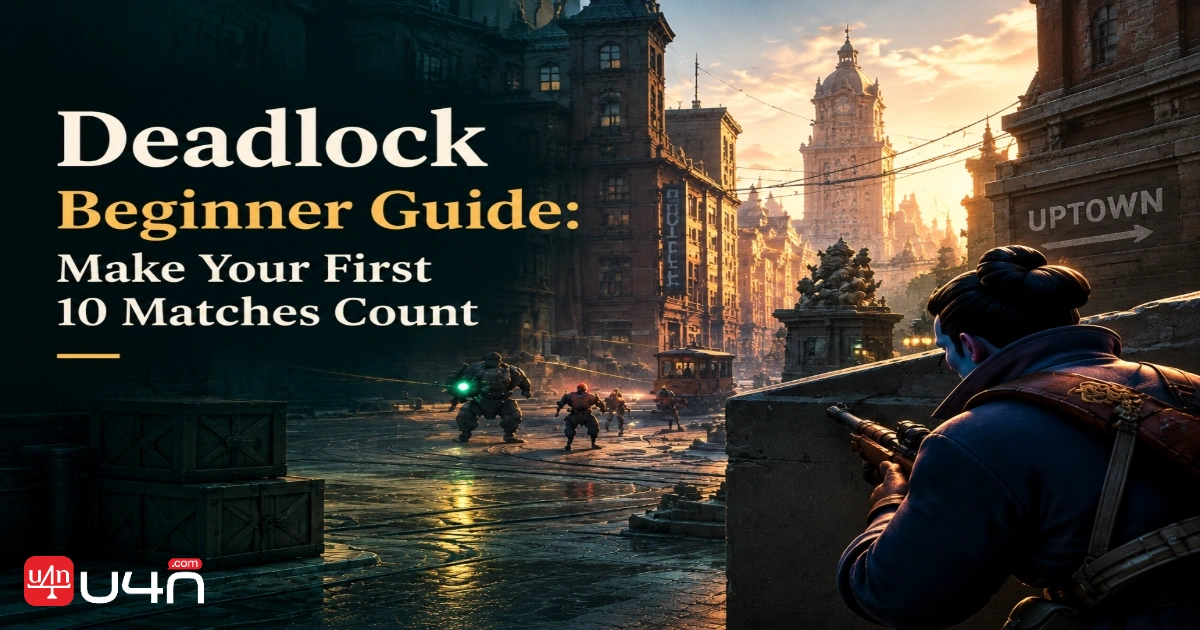
You land your shots, survive a messy fight, and still feel behind. Then another skirmish starts, someone calls for help, and you leave your lane without knowing whether that's the right move. Our team approaches this problem as a decision-making issue, not simply an aiming issue.
Before considering Deadlock Boosting, we recommend building a foundation you can repeat without outside help. This Deadlock beginner guide gives your first 10 matches a clear purpose: collect resources reliably, buy with intent, and recognize which fights deserve your time.
Give Each Match a Specific Job
We wouldn't ask a new player to learn every matchup, item, and rotation at once. Instead, we'd divide the first 10 matches into three manageable stages.
| Matches | Main Focus | Question to Ask Afterward |
|---|---|---|
| 1–3 | Lane survival and Souls | Did we maintain resource income without unnecessary risks? |
| 4–6 | Purchases and positioning | Could we explain what our key purchases were supposed to improve? |
| 7–10 | Rotations and follow-ups | Did our movement create something useful? |
These aren't graduation requirements. If laning still feels chaotic after match three, we'd stay with that focus rather than rush ahead.
We're deliberately avoiding fixed item prices and rigid timing benchmarks. Deadlock's official updates continue to adjust heroes, items, and economic systems, so we recommend using current in-game descriptions alongside this learning framework.
Our starting rule: practice one decision until you can explain it, then add another.
Choose a Hero With a Readable Game Plan
For the opening matches, we'd favor a hero whose basic job feels understandable, not whichever name sits highest on a tier list.
Before queuing, we want answers to three questions:
- How do we contribute damage?
- What keeps us alive when someone fights back?
- What tells us it's time to leave?
If those answers remain vague, we'd spend a few minutes practicing the abilities before adding live-match pressure.
Learn One Reliable Sequence
We recommend starting with a simple pattern: approach from cover, use an ability with a clear purpose, follow up, and preserve an exit.
That's more useful as a learning exercise than attempting a complicated combo while losing track of everything around you.
We'd also keep the hero pool small initially. Changing heroes after every difficult game makes it harder to separate unfamiliar controls from poor decisions.
The goal isn't to find a character that removes mistakes. It's to make those mistakes easier to recognize.
Matches 1–3: Make Your Lane Routine Reliable
We'd make resource collection the center of the first three matches, with trading and chasing treated as decisions that must justify their cost.
For the essential vocabulary: Troopers contribute to lane income, while their Soul orbs create opportunities to secure or deny resources. Official patch notes have changed how Troopers generate Souls, so we wouldn't teach an old last-hit requirement as a permanent rule.
Look at the Wave Before the Opponent
Our suggested attention loop is simple:
Check the wave → collect available resources → look for a safe trade → return to cover.
We wouldn't interpret that as "never fight." Instead, we'd ask whether the trade leaves us able to continue doing our job.
A few shots of damage aren't an attractive exchange if we end up too low to approach the next wave.
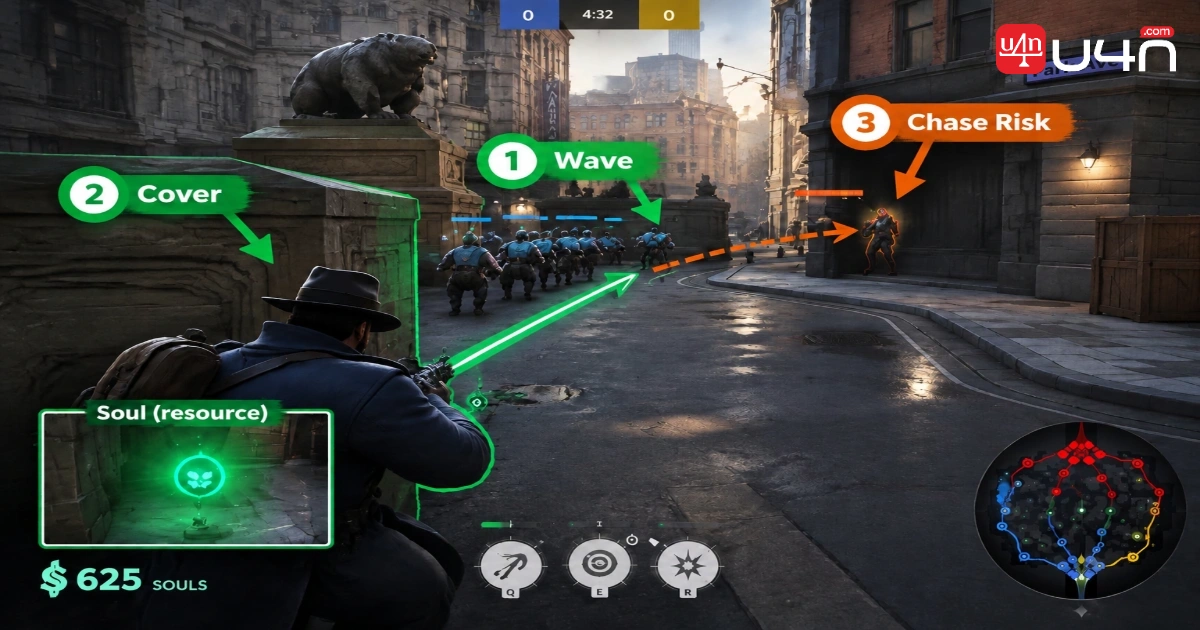
Give Every Chase a Price
Picture an opponent retreating around a corner with barely any health. We'd pause before following:
- Do we know what's beyond that corner?
- Can we finish the chase without spending every escape option?
- What happens in our lane while we're gone?
Our default for a new player would be to decline uncertain, expensive chases. We can practice calculated aggression later; we don't need every low-health enemy to become a personal assignment.
By match three, we want to explain one source of lost income, not merely notice that we're behind.
Matches 4–6: Buy for Your Next Useful Action
We recommend treating a build as a plan to understand, not a shopping list to obey.
Before each meaningful purchase, we'd finish this sentence:
"We're buying this because our next useful action requires ______."
That blank might be staying healthy in lane, surviving an enemy's opening damage, or contributing more reliably from a safe position.
| What's Going Wrong? | What We'd Examine First |
|---|---|
| We're forced away from the wave repeatedly | Positioning, trading habits, and sustain options |
| We die before using important abilities | Exposure, engagement timing, and defensive options |
| We survive but contribute little | Damage choices, effective range, and target access |
| We struggle to finish a fight | Whether damage, control, or coordination is missing |
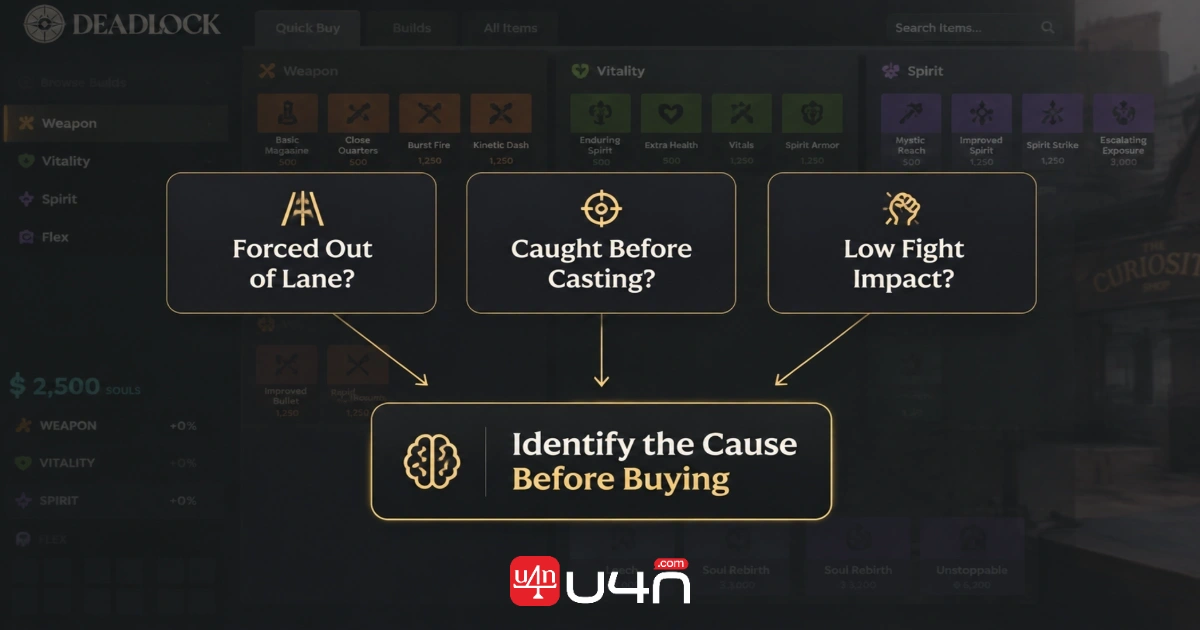
Separate an Item Problem From a Positioning Problem
If we keep stepping into the same dangerous angle, we wouldn't assume another defensive purchase will solve everything.
We'd review where the damage began. Could cover have blocked it? Did we advance without information? Were we trying to fight before our teammate arrived?
Likewise, we'd treat a power spike, an upgrade that meaningfully improves what we can attempt, as permission to reassess, not permission to charge forward blindly.
By match six, we want a reason for our key purchases and a plan for using them.
Matches 7–10: Rotate With a Reason
For these matches, we'd focus on the hardest beginner question: should we stay, move, or fight?
A rotation simply means moving away from our current area to influence another. Our team would judge that move through three questions:
1. What are we giving up?
2. What can we realistically gain?
3. Can we arrive while the opportunity still exists?
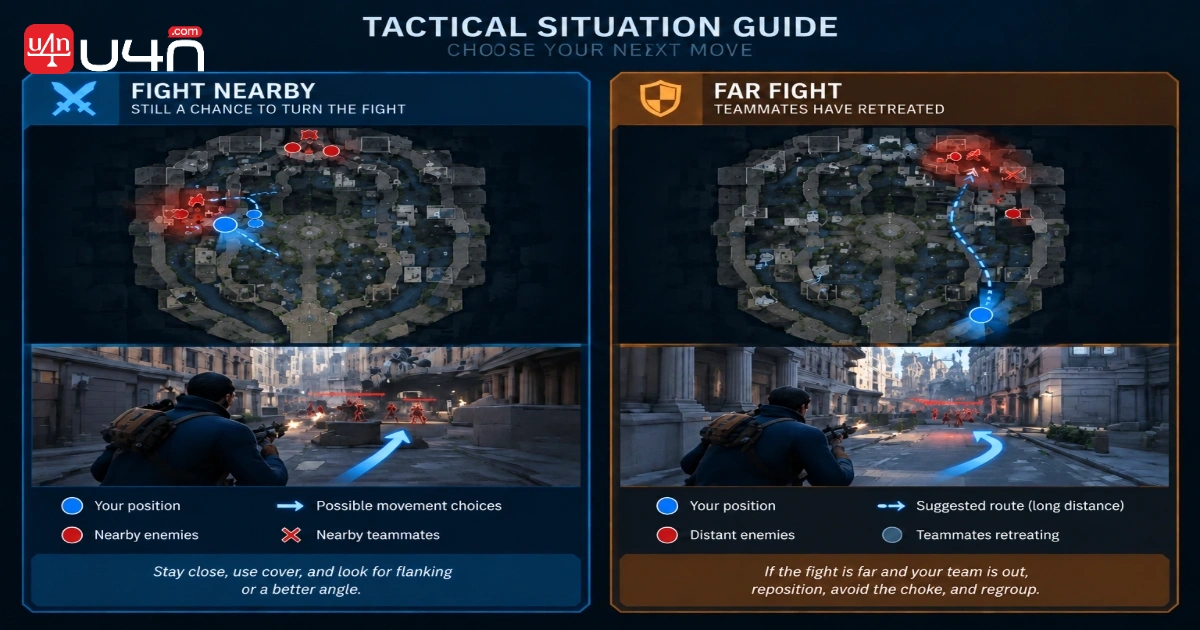
Don't Confuse Movement With Help
Consider two situations.
In the first, a nearby teammate is holding an even fight, our lane is manageable, and we can arrive quickly. We'd examine whether joining creates a clear advantage.
In the second, teammates are already retreating and we're several turns away. We'd avoid committing just to prove we responded. Instead, we'd look for a safe way to support their retreat or create value elsewhere.
We don't want passive play. We want purposeful movement.
Decide What Comes After the Fight
Before committing, we'd also ask what a successful fight could unlock.
Could we pressure a structure? Improve the lane position? Take nearby resources? Recover safely before the next engagement?
Afterward, we'd reassess rather than follow the original plan automatically. A narrow win with exhausted teammates may call for a reset, not another push.
By match ten, we want to explain both why we joined a fight and why we sometimes stayed away.
When Behind, Stop Trying to Win Everything Back
We'd resist the urge to recover an entire deficit through one dramatic fight.
Instead, our recovery plan would start with a smaller task: find the next useful action we can complete without repeating the mistake that put us behind.
That might mean collecting a safer wave, moving closer to support, or waiting for an important ability before contesting space.
Review the Decision Before the Death
When a death feels unavoidable, we'd look a little earlier:
- Where did we leave cover?
- When did we lose track of nearby opponents?
- Did we continue after our teammate backed away?
- Did we spend our escape option before the danger appeared?
We prefer this review to simply writing "bad mechanics." It gives us something specific to change.
We also wouldn't answer every setback by retreating permanently. The recovery goal is to rebuild useful choices, not disappear from the match.
Finish With a Two-Minute Review
Our preferred review is short enough to complete before queuing again.
| Review Prompt | Example Answer |
|---|---|
| Which decision hurt us most? | We chased beyond cover without checking nearby enemies. |
| What useful opportunity did we miss? | We could have improved the lane after the fight. |
| What changes next match? | We check the map before committing to a chase. |
We'd keep the next adjustment narrow. "Play better" gives us nothing to practice. "Check the map before leaving the lane" gives us a recognizable action.
If you're browsing cheap Deadlock Accounts, we'd keep that decision separate from this learning plan: getting an account and understanding a match are different tasks. Our focus here is building habits you can carry into each queue, whatever your starting point.
For the next match, we recommend choosing just one job: protect your lane income, explain your purchases, or rotate with a clear purpose. We don't need all three to be perfect tonight. We need one better decision we can recognize, repeat, and build on.