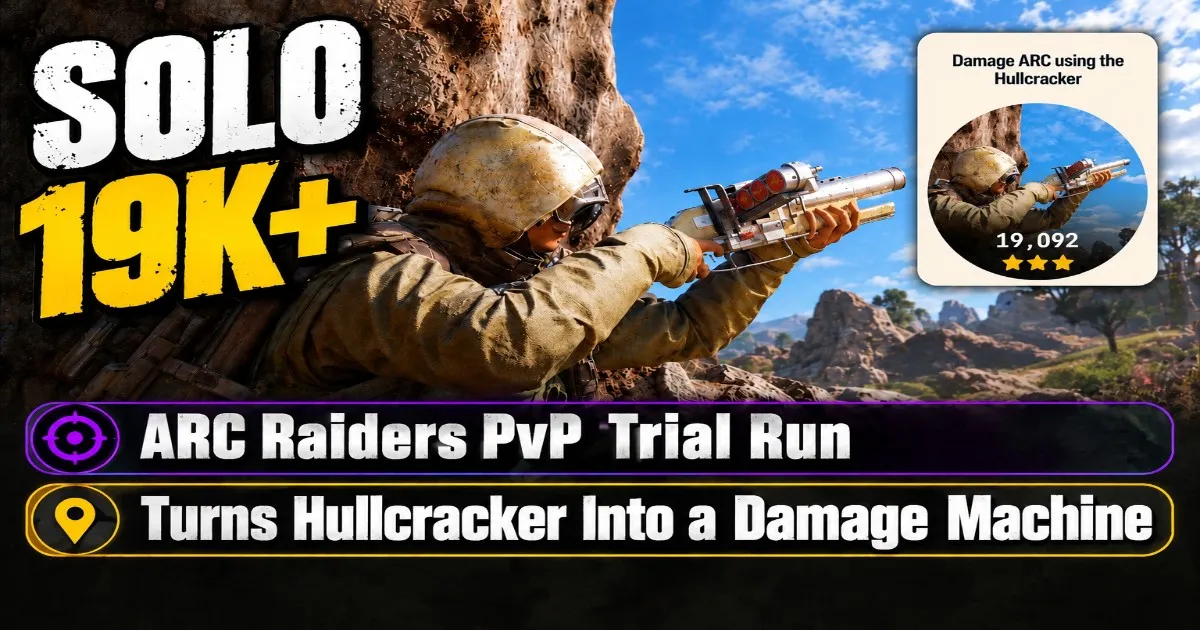
Weekly Trials can completely change the way a familiar ARC Raiders loadout feels, especially when the objective pushes you toward damage instead of simply surviving an extraction. For players already collecting ARC Raiders BluePrints and experimenting with different weapons, the Hullcracker Trial Run offers another reason to step into a dangerous PvP lobby and play much more aggressively. One recent run showed how quickly damage can build when a player commits to high ground, smart positioning, and constant pressure.
The interesting part of this run is not just the final damage result. It is the decision-making throughout the match. The player chooses a PvP lobby, prepares extra healing and defensive equipment, searches for areas where several Raiders are likely to collide, and uses the chaos to create opportunities against both players and ARC enemies. That makes the run useful as a practical example of how to approach a damage-focused Trial rather than treating it like a normal extraction.
Why PvP Changes the Trial
The biggest difference between a PvP and PvE Trial is unpredictability. In a PvE-focused run, you can usually plan around known threats and concentrate on dealing damage efficiently. PvP removes much of that control.
Other Raiders can appear at almost any moment. They may be fighting each other, attacking ARC machines, gathering materials, or simply waiting for someone to make a mistake. Every encounter becomes another possible source of damage, but it also creates another way for the run to end.
That is why the featured setup puts extra emphasis on survivability. More healing, a Barricade Kit, additional health, and enough resources to stay in the fight are valuable when the lobby is active. The goal is not to win every duel immediately. It is to remain alive long enough for more opportunities to appear.
| Trial Factor | PvP Approach | Why It Matters |
|---|---|---|
| Main objective | Build damage quickly | Encourages active engagements |
| Positioning | High ground and towers | Provides better sightlines |
| Healing | Carry extra recovery | Supports longer fights |
| Defense | Barricade Kit | Adds another defensive option |
| Target selection | ARC enemies and Raiders | Keeps damage opportunities open |
| Risk | High | Players can interrupt at any time |
High Ground Is More Than a Safety Tool
One of the strongest lessons from the run is how useful elevation can be. Moving toward towers and other high positions gives the player a wider view of the battlefield. In a crowded PvP lobby, that extra information is extremely valuable.
From above, it becomes easier to spot players fighting each other or attacking an ARC machine. Instead of blindly pushing into a fight, the player can wait for an opening and decide which target makes the most sense.
This is especially important when several Raiders are nearby. Charging into the middle of a fight may produce quick damage, but it also exposes you to multiple angles. Holding a better position allows you to participate without immediately becoming the easiest target.
The run repeatedly demonstrates this balance. The player sees several encounters developing around the same area and has to keep moving whenever the pressure becomes too high. Sometimes the correct decision is to shoot. Sometimes it is to reposition. Sometimes simply surviving for another few seconds creates a better opportunity.
Turning Chaos Into Damage
A damage Trial rewards a different mindset from a standard loot run. You are not necessarily looking for the cleanest extraction or safest route. You are looking for situations where you can keep contributing damage without throwing away the entire run.
The featured run becomes increasingly chaotic as more Raiders arrive. Players are shooting one another, ARC enemies are creating additional threats, and engagements are happening from several directions. That chaos can actually benefit a damage-focused player who knows when to stay nearby.
One useful technique is to avoid committing too early. Let other players reveal their positions first. If two Raiders are already fighting, their attention is divided. If someone is damaging an ARC enemy, they may be less prepared for another player entering the area.
However, this approach requires discipline. The run also contains several moments where the player runs low on ammunition, gets chased, or realizes that another Raider has a better angle. These moments show that aggression without preparation can quickly become a liability.
Ammunition and Armor Still Decide Fights
One of the clearest practical lessons is that PvP preparation cannot stop at choosing a weapon. Ammunition management becomes much more important when several fights happen back to back.
There are moments when the player is forced to reload at an awkward time or realizes that available ammunition is becoming limited. In a PvE lobby, that problem can sometimes be managed by creating distance. Against another Raider, a reload can give the opponent the exact opening they need.
Armor is another important consideration. A build designed around maximizing damage may feel efficient until another player suddenly appears at close range. The run itself suggests that bringing more armor could have made some encounters less dangerous.
For future PvP Trials, the lesson is straightforward: damage potential is only useful if the loadout can survive long enough to use it.
Choosing Targets Without Losing Control
A common mistake in PvP-heavy extraction gameplay is chasing every opponent who shoots at you. That can turn one manageable encounter into a chain of unnecessary fights.
The Hullcracker run shows why target selection matters. Some enemies are worth pursuing because they are already exposed or fighting another player. Others are better left alone when pushing them would force you into a poor position.
A simple decision process helps:
1. Check your ammunition and health.
2. Identify how many Raiders are nearby.
3. Look for ARC enemies that can add damage opportunities.
4. Avoid pushing an opponent who already has the positional advantage.
5. Move when multiple players begin focusing on your location.
This keeps the Trial focused on its real objective: building damage throughout the run rather than winning every single encounter.
Why PvP Can Be More Fun Even With Less Efficiency
The player points out an important tradeoff: PvP may produce fewer points in some situations, but it can also make the Trial considerably more exciting.
That is easy to understand from a gameplay perspective. PvE encounters are generally more predictable. Once you understand an enemy's behavior and your preferred route, repeated runs can start feeling routine.
PvP changes that rhythm. Every raid develops differently. A quiet area can suddenly become a firefight. A player who appears harmless can become a serious threat. Two Raiders can fight each other, giving you an opportunity, or their battle can attract even more players.
For players who are tired of repeating the same PvE routine, that unpredictability can make Weekly Trials feel fresh again.
What This Run Teaches About Future Trials
The most useful takeaway from this Hullcracker run is not one specific weapon choice. It is the idea of building your entire loadout around the Trial's actual objective.
If the goal is damage, think about positioning, ammunition, healing, defensive tools, and target selection before entering the match. A strong damage setup should give you enough flexibility to continue fighting after the first unexpected encounter.
The run also shows why experienced players should not judge a PvP Trial only by its final result. Even a messy encounter can teach you something about positioning, resource management, or when to disengage.
Final Thoughts
This Hullcracker PvP Trial Run is a good example of how much personality a Weekly Trial can add to an extraction match. The player enters knowing the lobby will be dangerous, accepts the extra risk, uses elevation to find opportunities, and keeps adapting as more Raiders enter the fight. The result is a chaotic run that prioritizes action over perfect efficiency.
For players preparing their next sessions, the main lesson is simple: build around the objective, not just the weapon. Keep enough healing and ammunition to survive extended engagements, use high ground whenever possible, and do not chase every opponent who appears. If you plan to buy ARC Coins for your broader progression setup, remember that resources can support a run, but smart positioning, target selection, and decision-making are what ultimately keep a PvP Trial alive.