
Reaching level 40 in WoW Forever is exciting, but the experience can feel less rewarding if you arrive without enough gold for riding training and your first mount. Most players do not need a complicated market strategy at this stage. They need a reliable place where they can kill mobs, sell useful drops, reduce downtime, and keep leveling without draining their savings.
Our team has focused on five solo-friendly farming locations suited to characters around level 30 and above. Each area offers a different income pattern. Badlands is built around elemental drops and Auction House value. Riverglades gives players a strong mix of raw gold, vendor trash, and skinning materials. Swamp of Sorrows provides dense beast packs with a simple farming loop, while Arathi Highlands favors players who are comfortable selling materials through the Auction House.
The goal is not to claim that every player will earn the same amount per hour. Class, gear, profession, server population, mob competition, travel time, and market prices all affect the result. A player who wants to reduce the amount of time spent farming can also review WoW Forever Boosting options, but this guide stays focused on normal solo play and practical in-game routines.
Start With a Mount Budget
Before choosing a farming location, we recommend checking how much gold your character already has and how much you expect to spend on skills, repairs, consumables, professions, and gear upgrades. The level 40 riding skill currently costs 100 gold before discounts, while Paladins and Warlocks have class-specific mount paths that can reduce or avoid the standard riding expense.
That does not mean every player should stop farming once they reach 100 gold. You will still need money for flight paths, food, potions, training, bags, and equipment repairs. A safer target is to build a small reserve instead of spending every coin on the mount the moment you reach level 40.
| Player situation | Suggested approach |
|---|---|
| You already have useful gear | Farm until the riding budget is secured, then keep a repair and consumable reserve |
| You are undergeared | Choose safer beast farms and sell vendor loot while improving equipment naturally |
| You have Skinning | Prioritize Coyotes, Lions, and Jaguars |
| You use gathering professions | Pick locations where extra materials can be collected during the farming route |
| You dislike Auction House trading | Focus on raw gold, vendor items, and stable NPC sales |
| You play a Paladin or Warlock | Check your class mount quest before reserving the full standard riding cost |
The important calculation is simple:
Required farming time = Gold still needed ÷ realistic net gold per hour
Use net gold, not the value of every item in your bags. Repair costs, ammunition, food, travel, Auction House deposits, and unsold materials all reduce the final result.
Badlands: Elemental Drops With Strong Market Value
Badlands is a natural starting point for players who want a dependable elemental farm. Earth Elementals are the main target, and the area works especially well for characters who can kill steadily without spending too much time recovering between pulls.
The value here comes from several layers of loot. Common stone items can be sold directly to vendors, while Elemental Earth should usually be checked against the current Auction House price before being sold. This material may be useful to players working on professions, crafting recipes, or later progression, so its market price can be much higher than its vendor value.
What to collect
- Elemental Earth
- Lifeless Stone
- Jagged Piece of Stone
- Solid Stone
- Deeprock Salt
- Green-quality equipment
- Blue-quality equipment when luck is on your side
The deeper areas of Badlands can provide more valuable drops, but the mobs also become more dangerous. We do not recommend moving inward simply because the loot table looks better. A location that forces you to drink after every fight may produce less gold than a safer route with faster kills.
The better approach is to test two routes. Spend around 15 minutes in a safer section, then compare it with a deeper section. Count vendor loot, materials, repair costs, and the number of completed pulls. If the deeper area produces better items but cuts your kill speed by half, the extra value may not be worth the risk.
Badlands also benefits from lower competition in its less-traveled sections. On a crowded server, the obvious elemental camps may be occupied. Moving a short distance away can often produce a better result than fighting other players for the same spawn points.
Who should farm here?
Badlands is a strong choice for:
- Classes with reliable sustained damage
- Players who can handle tougher mobs without frequent downtime
- Characters without Skinning
- Players willing to monitor Auction House prices
- Farmers who prefer elemental materials over beast drops
The main weakness is market dependence. If Elemental Earth is selling poorly, your income may fall closer to ordinary vendor farming. Check the market before committing to a long session.

Riverglades Coyotes: A Reliable Beast Farm
Riverglades is one of the most accessible choices for level 30 players because the Coyote population is dense and the farming loop is easy to understand. The main area is located below Wheeler's Grange, where a small cave contains a large number of Coyotes. The route can continue from the cave toward the large tree in the distance.
This farm is attractive because the income does not rely on a single rare drop. Coyotes provide direct raw gold, vendor items, and materials that become more valuable when the character has Skinning. The mobs also respawn quickly, which helps maintain a steady pace when the area is not heavily contested.
Recommended route
- Enter Riverglades and travel toward Wheeler's Grange.
- Clear the Coyote cave.
- Move from the cave toward the large tree.
- Kill the beasts along the path.
- Return to the cave as the first group begins to respawn.
- Vendor low-value items and store materials for later Auction House checks.
Darkmoon Faire-related items and Thick Furry Manes can add useful vendor income. They may not look impressive one by one, but they become meaningful when you are killing continuously. We have found that players often undervalue these small drops because they focus too heavily on rare equipment.
Skinning makes this location much stronger. A skinner can turn each kill into another source of income without changing the route. The extra materials also reduce the feeling that a bad loot streak has ruined the entire session.
The main limitation is competition. When several players are clearing the same cave, your income can drop sharply. Do not stay in the area just because it appears on a recommended list. If you are waiting for spawns or tagging only one mob out of every few, move to Wild Plains Lions or another location.
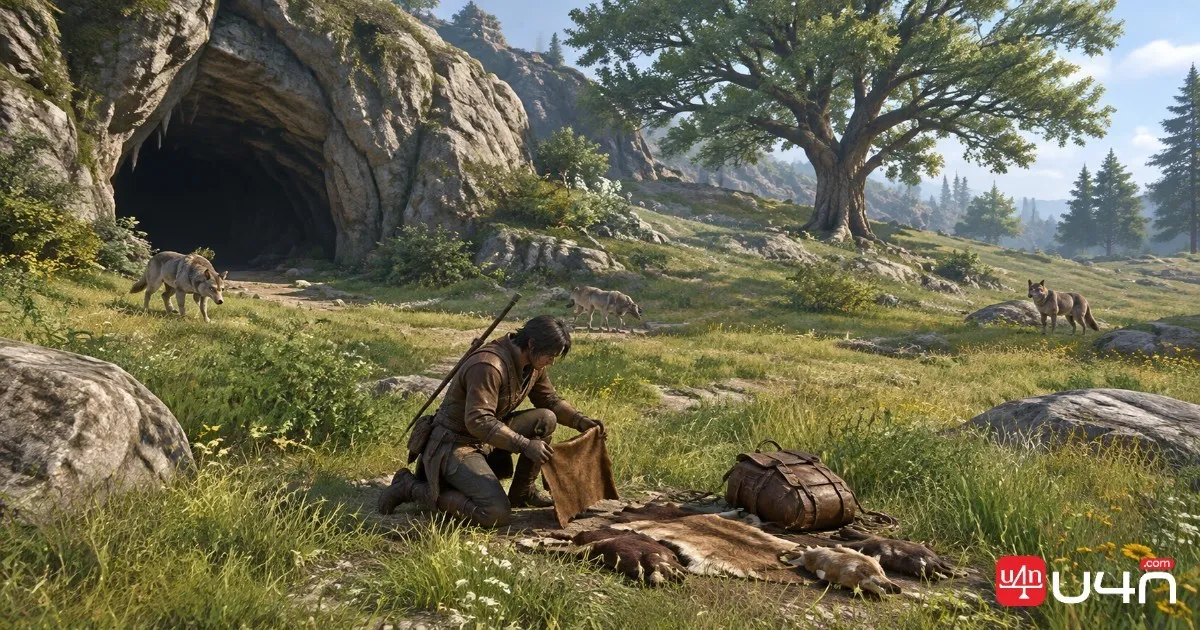
Riverglades Wild Plains Lions: Raw Gold and Gear Drops
Wild Plains Lions occupy the rocky area below Rog'Mar. They are another practical Riverglades target, but the experience feels slightly different from the Coyote route. The Lions are useful for players who want vendor income from beast drops and are comfortable fighting through a more open area.
Their common drops include Long Soft Tails and Bristly Whiskers, with each item selling for more than ordinary low-level trash. The value comes from volume. If you can keep moving and kill without long pauses, the small vendor payments add up.
Players with stronger characters can travel farther upward and encounter a boss connected to a WoW Forever side quest. We do not recommend treating the boss as the main source of income unless you can defeat it safely and quickly. Boss attempts create downtime, add repair risk, and may force you to wait for a respawn. The ordinary Lions should remain the foundation of the route.
Skinning is available here, although the materials are generally less attractive than those from Coyotes. If skinning each Lion slows you down or fills your bags too quickly, skip the lower-value hides and keep the combat loop moving.
One reason this area feels profitable is its mob density. More kills per minute mean more chances to receive green or blue items, even if the individual drop chance is not actually higher than in other zones. That distinction matters. Dense spawns improve your results through volume, not necessarily through a hidden loot-rate advantage.
A practical decision rule
Stay with Wild Plains Lions when:
- You can kill several mobs in a row without drinking
- The cave in Riverglades is crowded
- You want raw vendor income
- You are comfortable collecting large amounts of vendor trash
- You occasionally want to check for green or blue equipment drops
Leave when the area becomes overcrowded or when your bags fill too often. A farm with slightly weaker loot but better uptime will usually produce a better session.

Swamp of Sorrows: Dense Swamp Jaguar Routes
Swamp of Sorrows is another strong option for players who prefer beast farming. Swamp Jaguars are spread across a wide area, with many of them concentrated toward the western side and the southern portion of the zone.
The farming pattern is straightforward. Move through the clusters, clear Jaguars in groups that match your class strength, collect Long Soft Tails and Bristly Whiskers, and use Skinning whenever the extra materials are worth the time. The route does not require complicated positioning or rare spawn knowledge, which makes it suitable for players who want a low-stress farming session.
The zone also gives gathering professions room to add value. While traveling between Jaguar packs, check nearby resources instead of treating the area as a pure kill farm. The extra materials may not transform your income by themselves, but they improve the total value of every circuit.
Strengths of Swamp of Sorrows
- Large number of available mobs
- Simple route with limited setup
- Suitable for Skinning
- Good option when Riverglades is crowded
- Consistent vendor loot from repeated kills
- Enough open space to avoid fighting over every target
The main issue is travel efficiency. If your character spends too much time moving between scattered groups, the farm becomes less attractive. Try to identify a compact loop rather than covering the entire zone. A smaller route with steady respawns is easier to repeat and easier to measure.
Swamp of Sorrows is also a safer recommendation for players who do not want to rely heavily on market prices. Much of the value comes from direct vendor sales and common beast drops. You may earn less during a strong market spike, but your results are easier to predict.

Arathi Highlands: Auction House Materials and Elementals
Arathi Highlands is better suited to players who understand the Auction House and are willing to wait for profitable sales. The main targets include Thundering Exiles, West Bindings, Cresting Exiles, and other elemental mobs found around the zone.
Unlike the beast farms, Arathi Highlands depends less on vendor trash and more on materials such as Charms and Elemental Air. These items can sell well when players are leveling professions or preparing for later content, but their value can change quickly.
How to manage the drops
Do not send every item to the Auction House automatically. Check the recent market price, current listing volume, and whether similar items are already flooding the market. Posting at an unrealistic price may produce no sale, while undercutting too aggressively can reduce your earnings for no reason.
We recommend separating the loot into three groups:
| Loot type | Usual action |
|---|---|
| Low-value vendor items | Sell to an NPC after the farming circuit |
| Materials with active demand | List on the Auction House after checking current prices |
| Green or blue equipment | Compare vendor value with possible player demand |
| Items required for your own profession | Keep them if replacing them would cost more later |
Elemental farming can be efficient for classes with strong area damage or dependable ranged attacks. Melee characters can still perform well, but they should pay attention to pull size and incoming damage. A farm that looks profitable on paper can become expensive if every circuit requires food, potions, or repairs.
Arathi Highlands also rewards players who know when to stop. Once the Auction House is saturated with the same materials, moving to a vendor-based farm may provide better short-term results. Market awareness is part of the farming route, not a separate task.

How to Choose the Right Location
The five spots are not ranked by a single universal number. They serve different kinds of players.
| Location | Main income | Best suited for | Main limitation |
|---|---|---|---|
| Badlands | Elemental materials and vendor loot | Players who can sell through the Auction House | Tougher mobs and market dependence |
| Riverglades Coyotes | Raw gold, vendor items, Skinning | Skinners and level 30 solo players | High competition around the cave |
| Wild Plains Lions | Vendor loot and equipment drops | Players with strong kill speed | Skinning value is less impressive |
| Swamp of Sorrows | Beast loot and gathering materials | Players seeking a simple, steady route | Travel distance can reduce efficiency |
| Arathi Highlands | Charms and Elemental Air | Auction House-focused farmers | Prices and demand can fluctuate |
Our team usually recommends starting with the location closest to your current quest route. Travel time is often ignored in farming guides, yet it can remove a surprising amount of income from a session. If you are leveling in the Eastern Kingdoms and already passing near Riverglades, there is little reason to travel across the world for a farm that produces only slightly better loot.
Class ability matters just as much. A Mage, Hunter, Warlock, or other ranged class may prefer a different camp from a Warrior or Rogue. The best test is not a single lucky drop. Track three short sessions of 15 to 20 minutes and compare the results.
Record:
- Total vendor value
- Auction House value before fees
- Repair expenses
- Travel time
- Number of kills
- Number of green or blue items
- Time spent waiting for respawns
- Competition from other players
After three sessions, the most suitable spot becomes much easier to identify.
Farming Habits That Protect Your Gold
A good location can still produce weak results if the routine is inefficient. Sell low-value junk before your bags become full. Keep a separate stack of materials for Auction House pricing, and do not carry items for days without checking whether they are actually selling.
Use a simple withdrawal rule. For example, every time your character reaches a farming milestone, place part of the income in the bank and leave the rest available for repairs and consumables. This prevents one expensive upgrade from consuming the entire mount fund.
Avoid farming only rare drops. Rare gear can create exciting screenshots, but regular income comes from consistent kills, fast looting, and controlled expenses. We would rather complete a clean two-hour session with stable vendor income than spend the same time chasing a low-probability drop that never appears.
Players who prefer to purchase currency instead of spending hours farming can explore World of Warcraft Forever Gold for sale as another way to prepare for their in-game adventures and make steady progress. For players staying within normal gameplay, the five locations above are enough to build a practical level 40 mount fund when used with reasonable spending discipline.