

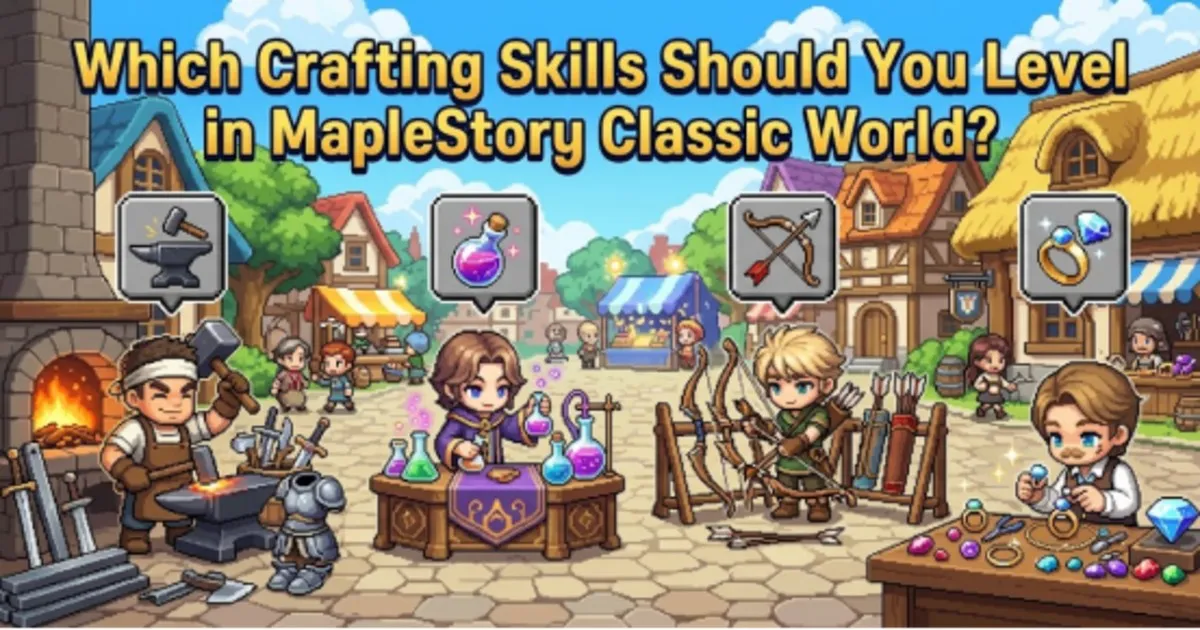
Crafting in MapleStory Classic World can look complicated at first, especially when you have several skills to choose from. However, you probably do not need to max every crafting skill on your character. Choosing the right skills for your class can save materials, time, and MapleStory Classic World Mesos while still giving you access to the recipes that matter most.
The information currently available suggests that each crafting skill has a specific purpose. Some are especially useful for certain classes, while others are mainly worth leveling enough to unlock important material recipes. Since crafting information can still change before the official release, these recommendations should be viewed as a practical guide rather than a final rule.
Understanding Crafting Levels
All six crafting skills currently use the same experience table, with the crafting level capped at 10. There is also a character-level requirement for increasing your crafting rank. For example, a character needs to reach level 10 before advancing to crafting level 2, while level 15 is required for crafting level 3.
This means you should not rush to spend materials simply because your crafting experience is close to the next level. If your character has not reached the required level, crafting experience can effectively stop at 100 percent. Waiting until your character qualifies for the next rank can therefore help you avoid wasting valuable materials.
The best approach is to focus on the crafting skills that support your class while keeping the others at useful minimum levels.

Smithing: A Strong Choice for Warriors
Smithing focuses on producing ingots and crafting several Warrior equipment pieces, including helmets, gloves, boots, and some shields. Because ingots are also used in other crafting systems and quests, Smithing has value even for players who are not Warriors.
For most characters, reaching around level 5 Smithing should be enough to unlock the important ingot recipes. You can naturally gain experience by processing ore as you collect it, making this a relatively convenient skill to level.
Warriors have a stronger reason to continue beyond level 5 because they can use Smithing to produce their own equipment. If you plan to craft Warrior gear regularly, pushing Smithing toward level 10 can make more sense.
Leatherworking: Mostly for Archers and Thieves
Leatherworking is primarily used to process leather and craft gloves and boots for Archers and Thieves. It can also produce a Red Chair that is tradable, which gives the skill an additional use.
Players outside these classes do not necessarily need to invest heavily in Leatherworking. Basic leather processing is available early, so the main reason to level beyond the early stages is access to higher-tier leather recipes or equipment.
Archers and Thieves should consider Leatherworking more seriously because crafted gloves and boots can complement their class-specific gear progression. For everyone else, keeping the skill at a low level may be enough.
Tailoring: Useful for Magicians and Work Gloves
Tailoring specializes in materials such as Processed Cloth and Spool of Thread. It also provides Magician gloves and shoes, along with Work Gloves and various capes.
Magicians have the clearest reason to invest in Tailoring because of their class equipment. Other classes can consider reaching level 2, which provides access to the Work Glove recipe.
Level 7 Tailoring unlocks level 35 capes, but reaching that point requires a considerable amount of crafting. Unless you specifically need those items, there may be little reason to power level Tailoring.
For efficient experience, Processed Cloth can be made using Pig's Ribbons and Leaves, while Animal Fur Bundles are better reserved for Spool of Thread. Using Animal Fur Bundles for Processed Cloth provides significantly less crafting experience compared with using them for thread.
Woodcrafting: Essential for Bow and Crossbow Users
Woodcrafting is mainly associated with Archer weapons, arrows, and Processed Wood. It also includes several miscellaneous craftable items.
If you play a Bow or Crossbow Archer, Woodcrafting is one of the most important skills to level. You can process wood and eventually use it to make weapons and arrows that support your character's progression.
For players who do not need bows or crossbows, level 2 is likely enough for the basic Processed Wood recipes. There is little reason to invest heavily unless you want specific furniture or other Woodcrafting items.
Weaponcrafting: A Priority for Thieves
Weaponcrafting has a wider range of equipment recipes. It can produce screws, Claws, Daggers, two-handed blunt weapons, two-handed axes, and Polearms, along with several lower-level miscellaneous weapons.
This makes Weaponcrafting especially valuable for Assassins and Bandits. Warriors can also benefit from it if they plan to use one of the supported weapon types.
One particularly interesting target is the level 5 Screw recipe. The early Screw recipe appears less efficient because it requires relatively expensive materials for the experience gained. Reaching level 5 and using the better recipe may therefore be a more practical long-term strategy.
Iron Hogs could become important for players looking to level Weaponcrafting because their materials may be useful for producing Screws. Those materials could potentially become valuable if many players decide to power level the skill.
There is also a low-level recipe that costs one Iron Ingot, provides a useful amount of crafting experience, and produces an item that can be sold to an NPC for roughly enough to offset its cost. This could make it an interesting option for players trying to reach higher Weaponcrafting levels efficiently.
Arcforge: Important for Every Character
Arcforge focuses on gems, as well as Wands and Staves for Magicians. It also allows players to craft Scrolls, although the Scroll system has some important limitations.
Magicians should prioritize Arcforge because of the access to their weapons. However, every class can benefit from reaching at least level 6 because this unlocks the gem crafting recipes. Gems are used in other crafting recipes and quests, so having access to them can be useful even if you are not a dedicated crafter.
Arcforge can also be leveled naturally by processing ore into gems. Early crafting costs may be significant, though, and players may want to keep the gems they produce rather than immediately selling them.
Scroll crafting is considerably more expensive, with each Scroll costing a substantial amount of Mesos. Unless you specifically need a Scroll, it may be better to avoid producing them early. More valuable damage-oriented Scroll recipes appear at higher Arcforge levels, making the later stages more interesting for dedicated crafters.
Which Skills Should You Prioritize?
Your class should determine most of your crafting priorities.
Archers should focus on Woodcrafting for bows, crossbows, and arrows, while Leatherworking provides useful gloves and boots. Thieves should prioritize Weaponcrafting and can also benefit from Leatherworking.
Warriors should focus on Smithing for their armor and consider Weaponcrafting if their preferred weapon type is supported. Magicians should prioritize Arcforge for Wands and Staves and Tailoring for gloves and shoes.
For skills that are not directly connected to your class, reaching the basic recipe milestones is generally a better goal than immediately trying to reach level 10.
Final Thoughts
The main takeaway is that you do not need to treat every crafting skill equally. Reaching useful recipe milestones can provide most of the benefits without consuming huge amounts of materials. Passive crafting while gathering ore, leather, cloth, and wood can also help you progress naturally instead of forcing you to spend resources all at once.
These recommendations are based on the currently available crafting information and may change when MapleStory Classic World officially releases. If you are preparing an Ironman character or simply want to manage your resources efficiently, choosing a few important skills and keeping the others at practical levels should be a sensible starting point.
As the crafting system develops, the value of materials and equipment may also change. Players who want to save time or avoid long farming sessions may eventually look for MSCW Mesos for sale, but understanding which crafting skills actually matter first can help you spend your resources more efficiently.