Cart Empty
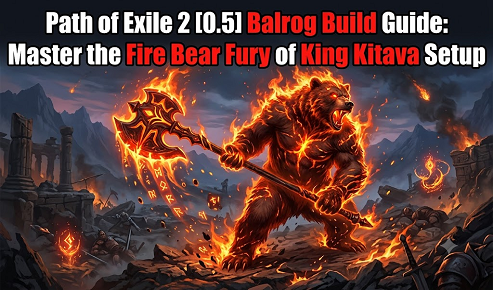
Continue ShoppingThe Path of Exile 2 0.5 Balrog build is a powerful fire-based shapeshifter setup that transforms the bear form into a walking destruction machine. This guide focuses on creating a near-zero-button gameplay style by combining Ancestral Cry, Walking Calamity, and Smith of Kitava mechanics. Players looking to optimize their progression, including collecting POE2 Currency for upgrades, can use this build as a foundation for a powerful endgame character.
The main idea behind this build is simple: activate the required buffs, transform into bear form, and let your movement trigger massive waves of fire damage. By combining Fury of the King, Molten Crash fissures, Fire Spell on Hit, and Cast on Elemental Ailment effects, the Balrog setup creates continuous explosions while maintaining strong recovery and mobility.
Patch 0.5 introduced several important adjustments that affect how this build works. Ancestral Cry and Walking Calamity can no longer trigger Fire Spell on Hit and Cast on Elemental Ailment directly. However, Molten Crash fissures still activate these effects, allowing the build to maintain its powerful fire-based damage pattern.
The build also includes a Titan variant for players who want stronger defenses and improved late-game performance. The combination of permanent Ancestral Cry steps, increased glory generation, and the rage/endurance charge loop keeps the character active while reducing the need for frequent skill presses.
The build revolves around maintaining two major glory skills: Ancestral Cry and Walking Calamity. Fury of the King provides passive glory generation outside combat, while Smith’s Masterwork and Invigorating Grandeur increase glory gain. With enough investment, each skill can generate large amounts of glory every few seconds.
Ancestral Cry requires 100 glory before activation and becomes extremely powerful when supported by endurance charges. Each endurance charge increases its duration, allowing the buff to remain active for a long time. This creates the foundation for the walking-based combat style where every step contributes to damage and recovery.
Walking Calamity works together with the rage system. The skill naturally generates rage over time, while Rageforged I consumes rage to create a continuous resource loop. The Primal Hunger keystone then restores consumed rage, allowing the character to maintain the cycle without manual management.
One of the strongest features of the Balrog build is its incredible sustain. Bear form naturally generates endurance charges when spending rage, and Jagged Ground I inside Ancestral Cry allows movement to consume these charges.
Each consumed endurance charge provides life recovery through passive tree bonuses such as Guts and Flare. This means the character constantly restores health while moving through enemies. The result is a playstyle where walking forward is not only a method of dealing damage but also a defensive strategy.
Before taking Self Immolation, players must obtain One With Flame. Without this protection, the build can suffer from dangerous self-inflicted ignite damage. Vaal Pact should also only be taken after acquiring Undying Hate to maximize its effectiveness.
The weapon setup should prioritize increased physical damage, added physical damage, damage gained as extra fire, and bonuses to melee skill levels. These stats improve the damage scaling of Molten Crash and other fire-related effects.
For armor and jewelry, focus on movement speed, elemental resistance, maximum life, armor bonuses, and additional melee skill levels. Maintaining approximately 74% fire, cold, and lightning resistance with strong chaos resistance is recommended for difficult content.
Important unique equipment includes Fury of the King, which supports glory generation and creates additional Molten Crash fissures. Undying Hate is valuable because it converts the Vaal Pact keystone into Sacrifice of Flesh. Boots can use defensive options like Citaqualotl’s Thesis or speed-focused choices such as Farrul’s Rune of Grace.
Alternative items can also improve different playstyles. Headhunter is excellent for mapping, while Mageblood provides strong utility through flask improvements. Defiance of Destiny is another option for players who prefer additional recovery instead of maximum damage.
The recommended skill setup focuses on improving Ancestral Cry, Walking Calamity, and Molten Crash. Ancestral Cry should be active on both weapon sets to prevent deactivation when swapping forms. Players should also remember that Ancestral Cry must be placed inside Ferocious Roar to function correctly in bear form.
For boss encounters, summon Ancestral Warrior Totem before the fight begins to reduce enemy defenses. Molten Crash fissures from Fury of the King and weapon swaps can create additional explosions, allowing Fire Spell on Hit and Cast on Elemental Ailment effects to trigger repeatedly.
The gameplay rhythm is straightforward: maintain your buffs, enter bear form, move through enemies, and allow your fire effects to clear the battlefield. Bosses require slightly more preparation, including totem usage and additional fissure generation, but the core strategy remains the same.
During levels 1 to 52, players should follow the early leveling variants from Acts 1 to 4. Useful early rewards include Venom for increased stun threshold, Tribal Medicine for defensive stats, and resistance bonuses from different quest rewards.
Important rewards include additional weapon set passive points, spirit increases, resistance improvements, life bonuses, and defensive enhancements. These upgrades help the character smoothly transition from leveling into the final Balrog setup.
Several problems may appear while playing this build. If Ancestral Cry does not gain glory, especially in Abyssal Depths, removing and resocketing the skill can fix the issue. Players must also place Ancestral Cry on both weapon sets to prevent unexpected deactivation.
Game crashes may happen during certain animations or when specific visual effects are active. Avoiding problematic effects and checking skill gem socket requirements can prevent many common issues.
The Balrog build rewards players who enjoy unique mechanics and explosive visual effects. With the right equipment investment and understanding of its glory system, it becomes one of the most satisfying fire shapeshifter experiences in Path of Exile 2. Players planning upgrades can use POE 2 Divine Orbs to improve their gear and push the build toward its strongest endgame version.
This setup delivers a powerful combination of speed, durability, and effortless clearing. Whether farming maps or challenging bosses, the Fury of King Kitava concept provides a memorable playstyle built around movement, fire damage, and unstoppable momentum.
The U4N Team
Authored by elite gamers and industry insiders, the U4N Editorial Team delivers authoritative game updates, patch notes breakdowns, and expert strategies for trending titles including World of Warcraft, Path of Exile 2, MapleStory, Aion 2, and Arc Raiders.
From deep-dive guides to the latest meta shifts, our in-house veterans test every tactic firsthand to keep you ahead of the game.