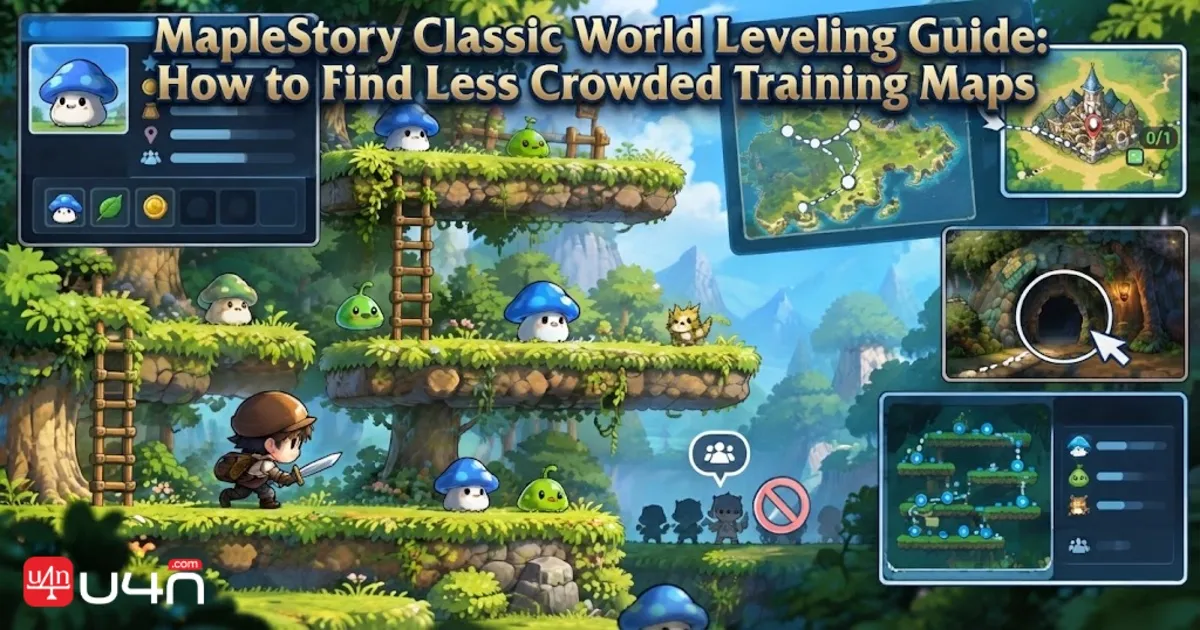
For new players, leveling in MapleStory Classic World isn't just about finding a monster close to your level. MapleStory Classic World Mesos, potion costs, travel time, monster density, and how crowded a map is can all affect how efficiently a session actually feels. Instead of memorizing a fixed leveling route, one useful approach is to learn how to search for suitable monsters and then trace their locations through the world map.
The method featured here is especially useful for players who are unfamiliar with MapleStory or who simply do not remember the old map routes. Rather than telling everyone to train at exactly the same locations, it gives you a repeatable way to find monsters that fit your level and then work out how to reach them.
Start With the Monster List
The basic idea is simple: open the monster database and browse monsters by level. From there, choose an enemy that makes sense for your current character rather than blindly following a popular training spot.
Recommends fighting monsters slightly below your character's level, especially when potion use is a concern. The reasoning is straightforward: enemies you can defeat quickly while taking less damage can make leveling smoother and help preserve your resources.
Once you select a monster, the database provides useful information about it, including its level, HP, EXP, drops, and special drops. More importantly for this method, you can scroll down to the Map Location section to see where that monster appears.
That turns the database from a simple monster reference into a practical leveling-planning tool.

Check Monster Density Before Choosing a Map
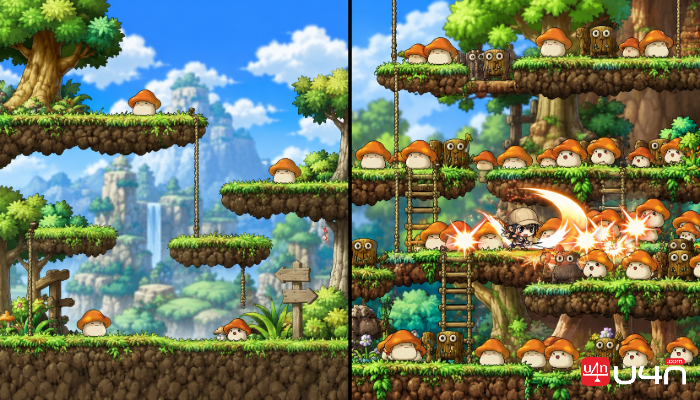
The number of monsters listed for each map is another useful detail. If one location has substantially more of your target monster than another, it may be worth checking first because a denser map can reduce the time spent running between enemies.
This is particularly valuable when you are comparing several possible locations. Instead of looking only at the monster's level, you can consider:
| What to Check | Why It Matters |
|---|---|
| Monster level | Helps determine whether the enemy fits your current progression |
| EXP | Gives you an idea of the experience available from the target |
| HP | Helps judge how comfortably you can clear it |
| Monster count | Higher density can make a map more convenient |
| Drops | Useful when you also care about loot and resources |
| Map location | Shows where you need to travel |
| Nearby town | Gives you a practical starting point for the journey |
| Warp connections | Helps trace the actual route |
The important part is that there is no need to choose a training map solely because another player recommended it. If your character performs better somewhere else, that can be the more practical choice.
Use the Nearby Town to Build Your Route
Finding a monster is only half the problem. The database can tell you where the monster is, but a new player may still have no idea how to get there.
The guide solution is to look for the town closest to the selected map. Once you identify that town, open the in-game World Map and use it as your starting reference.
For example, when searching for Blue Mushroom locations, the process is roughly:
1. Find Blue Mushroom in the monster list.
2. Open its map locations.
3. Select a map with a useful monster count.
4. Identify the nearby town.
5. Open the in-game World Map.
6. Locate that town or surrounding area.
7. Follow the connected maps until you reach the target location.
This sounds obvious once you understand it, but it is an important distinction for beginners: the monster database tells you where the destination is, while the World Map helps you understand how to get there.
Pay Attention to Maps That Do Not Appear Directly on the World Map
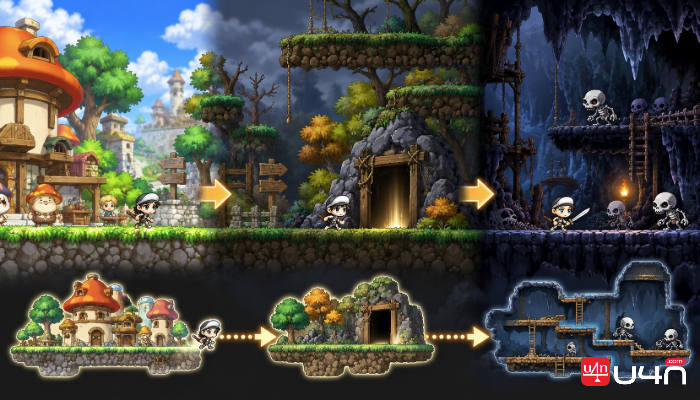
Things become more complicated when the target is inside a dungeon or another map that is not displayed as an obvious destination on the main World Map.
In those cases, the database's map connections become much more useful. Instead of trying to locate the dungeon directly, work backward through the maps that lead into it.
The guide demonstrates this with a dungeon-based monster. The process is essentially:
Monster → Dungeon Map → Entrance Map → Nearby Town → World Map
Once you reach the normal outdoor map connected to the dungeon, the route becomes much easier to follow through the game's World Map.
This is one of the most useful habits for new players because dungeon locations can otherwise feel completely disconnected from the normal travel network.
A Practical Example for Level 20+ Players
The same process works when you are looking for a monster around a particular level range.
If you are around Level 40 and want to fight something somewhat below your level, open the monster list and search for an appropriate enemy. After selecting it, compare its available maps and look at monster counts.
If one map contains more of the target monster, select that location and check its nearby town. You can then use the World Map to determine how to reach the area.
The important thing is that the process is repeatable. You do not need to remember every map in Victoria Island or memorize an entire leveling guide before starting your character.
Why Less Crowded Maps Can Be Better
A popular training spot is not automatically the most efficient training spot.
When a new server or world opens, large numbers of players naturally concentrate around familiar locations. That can make normally comfortable maps feel much more crowded. Players may compete for the same monsters, clear the same platforms, or simply spend more time waiting for enemies to respawn.
A less crowded map with a healthy supply of monsters can therefore be a practical alternative.
Specifically recommends looking for the combination of plenty of monsters and fewer players. This is especially useful during the early days of a new world, when population pressure can make the most obvious training locations considerably busier.
For a new player, this also removes some unnecessary frustration. You can focus on your own route rather than constantly searching for an available platform.
Think About Training Efficiency, Not Just Recommended Levels
One of the biggest lessons from this approach is that your character's actual performance matters more than a rigid leveling chart.
A monster slightly below your level can make sense if you can defeat it quickly and take relatively little damage. Another monster at a similar level might look attractive on paper, but produce a worse experience if it takes much longer to kill or forces you to spend more on recovery.
That means a good training decision should consider clear speed, survivability, monster density, travel time, and competition together.
This is also where your resource management matters. Keeping your potion spending under control and collecting useful drops while leveling can help you maintain your MapleStory Classic World Mesos rather than constantly spending everything you earn.
The Best Beginner Tool Is a Search Method
The real value of this strategy is not one specific monster or one specific map. It is learning how to answer the question, "Where should I train right now?"
The database can help you identify monsters and their locations, while the World Map helps you understand the broader route. Map connections then fill in the gaps when a dungeon or secondary area is not immediately visible. The official MapleStory Support guide also explains that players can search for monsters and maps through the World Map and jump to a monster's location from search results.
For beginners, this is arguably more useful than memorizing a single leveling route. Your preferred class, damage output, potion budget, and server population can all change how comfortable a map feels.
Prepare for Launch With a Flexible Route
Once you are in-game, the safest approach is to stay flexible: find a monster appropriate for your current level, check its map density, identify the nearest town, and trace the route through the World Map. If the obvious training spot is packed, simply repeat the process and find another location.
That approach gives new players a much better foundation for building an efficient route — and if you are also looking for MSCW Items for sale, keeping your leveling path organized can make it easier to balance progression, drops, and the resources you spend along the way.