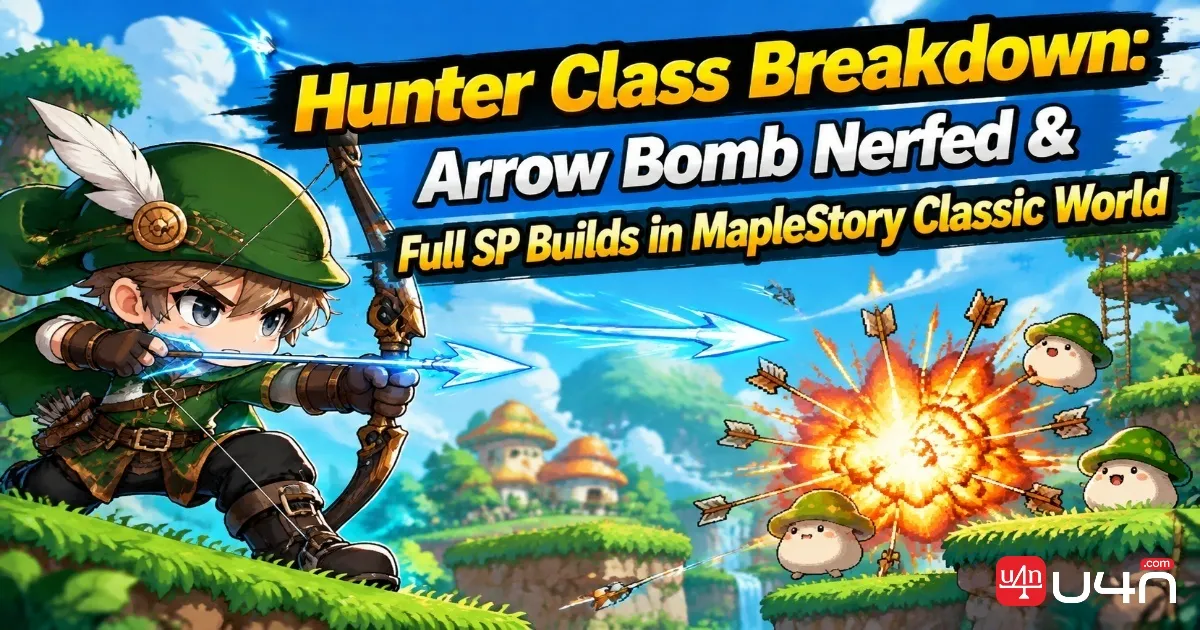
For players planning their early MapleStory Classic World Mesos, the Hunter is shaping up to be a very different experience from the classic Bowman fantasy many veterans remember. Arrow Bomb is still here, but its role has changed; Monkey Forest 2 no longer offers the same safe-spot strategy, and Final Attack has been redesigned into a toggle that gives Hunters a completely different way to handle groups.
The breakdown below focuses on the first- and second-job experience from levels 10 to 70, using data and damage simulations from MapleStory Classic World's second closed beta. Those numbers should be treated as test-build information rather than guaranteed launch values. Nexon's official community discussion also confirms that Classic World is deliberately bringing back the spacing and kiting considerations that historically defined ranged Bowman gameplay.

Hunter's Core Identity Has Changed
The traditional Hunter loop is easy to understand: stay at range, fire arrows, use Arrow Bomb when enemies group up, and keep moving whenever something gets too close.
That basic idea remains intact, but Classic World changes several pieces around it.
The most important differences are:
· Arrow Bomb now hits up to four monsters instead of six
· Its stun duration is shorter than the old version
· Its damage has been increased
· The explosion has a noticeable delay rather than detonating immediately
· Final Attack is now a toggle
· Final Attack can fire extra arrows against up to three targets
· Monkey Forest 2 no longer has its old safe spot
· Power Knockback has been moved into first job
· Blessing of Amazon has been removed
· Amazon's Judgment has been added as a second-job passive
That means Hunter isn't simply the old Arrow Bomb class with slightly different numbers. The class now has two noticeably different second-job approaches.
| Hunter route | Main idea | Best fit |
|---|---|---|
| Arrow Bomb | Group enemies, fire Bomb, play around the delayed explosion | Players who enjoy active mob control |
| Judgment | Spam Arrow Bomb while Final Attack handles nearby targets | Players who prefer consistent ranged attacks |
| Shared core | Bow Mastery, Final Attack, Bow Booster, Soul Arrow | Both builds |
The important point is that Arrow Bomb is no longer the only reason to play Hunter.
First-Job Bowman: Your SP Is Extremely Tight
The Bowman first job has six skills:
· Critical Shot
· The Eye of Amazon
· Focus
· Arrow Blow
· Double Shot
· Power Knockback
Maxing every skill would require more SP than the first-job leveling period provides. That makes the early build much more restrictive than simply putting points into everything useful.
The biggest decision is between Arrow Blow and Double Shot.
At maximum level, Arrow Blow fires one arrow for 240% damage, while Double Shot fires two arrows at 120% each. Against one target, their total damage is therefore equivalent at the same skill level.
The practical difference is ammunition and MP consumption.
Arrow Blow uses one arrow per attack, while Double Shot uses two. For a Hunter who expects to spend a lot of time grinding, that difference adds up over long sessions. Arrow Blow also avoids the additional MP cost attached to Double Shot.
That makes Arrow Blow the more economical default for most players.
Double Shot still has a reason to exist, though. Against two targets, its two arrows can split between enemies, allowing it to attack both at once. The trade-off is that one of the arrows can behave awkwardly when a monster is extremely close because of the game's melee-range interaction.
For a straightforward leveling build, I'd therefore keep Double Shot at zero and build around Arrow Blow.
Critical Shot, Focus and Eye of Amazon Matter More Than They Look
Critical Shot is the first-job skill that directly increases offensive output.
At maximum level in the tested build, it provides additional critical chance and critical damage. Because the character already has a base critical chance, the resulting improvement is meaningful without requiring any complicated setup.
For a Hunter who expects to spend dozens of levels firing Arrow Blow, Critical Shot is an obvious priority after the main attack is secured.
Focus is more interesting.
At maximum level, Focus provides accuracy and avoidability for several minutes. Accuracy is particularly important because Classic World's Bowman setup no longer gets the same accuracy support from some of the older skills.
DEX is therefore doing several jobs at once: it contributes to damage while also helping with accuracy.
The Eye of Amazon is similarly easy to underestimate. At maximum level, it adds substantial range to Bowman attacks. Combined with Arrow Blow, the tested build reaches a much longer effective firing distance.
That extra space matters because Hunters still have to deal with the classic ranged-class problem: if the monster gets too close, your bow is not nearly as useful.
The Bow Swing Is Still a Real Weakness
One of the defining Hunter habits is learning to create space.
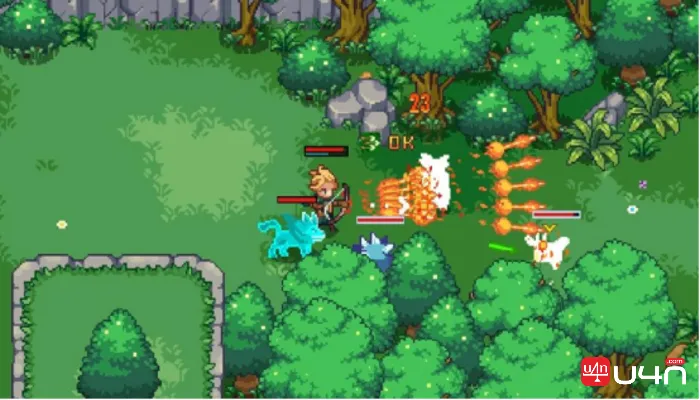
When an enemy gets directly in your face, you cannot simply keep firing your bow as if nothing happened. You are pushed into the bow's melee attack, which has a very narrow hitbox.
That makes movement part of Hunter's actual damage rotation rather than just something you do between fights.
The practical loop is simple:
Shoot → enemy approaches → jump back → create space → shoot again.
Players who enjoy that rhythm will probably find Hunter satisfying. Players who prefer standing in one position and unloading attacks will notice the limitation very quickly.
Power Knockback Is More Utility Than Damage
Power Knockback being moved into first job sounds useful on paper, but the skill is difficult to justify when SP is already scarce.
Its main purpose is pushing enemies away rather than dealing meaningful damage. Because its attack range is tied to the already-small bow swing, enemies need to be extremely close before the skill can actually connect.
In practice, I'd treat Power Knockback as an emergency spacing tool rather than a core part of the build.
That also explains why it is the easiest first-job skill to leave at zero.
Monkey Forest 2 Is Not the Same Hunter Haven
Veteran MapleStory players will probably remember Monkey Forest 2 as one of the classic places to stand and repeatedly fire Arrow Bomb from a safe position.
Classic World's version does not provide that same safe spot.
That matters because the map's value for Hunters was never just about monster density. The old positioning allowed the Bowman to attack while avoiding the normal risk of enemies reaching melee range.
Without that setup, the map no longer automatically solves Hunter's biggest weakness.
For players remembering the old training route, this is one of the clearest examples of why Classic World Hunter should not be approached as a perfect recreation of an old leveling guide.
Arrow Bomb Has Been Nerfed, But Not Simply Made Worse
Arrow Bomb remains Hunter's signature second-job skill, but this is probably the biggest change to the class.
In the tested Classic World version, maximum Arrow Bomb:
· Costs 28 MP
· Hits up to four monsters
· Deals 140% damage to each target
· Has a chance to stun for several seconds
· Covers a sizeable blast area
· Has a delayed explosion
The old version could hit more targets and had a longer stun duration, while the Classic World version compensates partly with more serious damage.
The delay is the part that changes the skill's feel the most.
You fire the arrow, but the explosion does not happen immediately. That means you have to learn the timing instead of simply treating Arrow Bomb as an instant area attack.
For grinding, this makes positioning much more important. You want enemies grouped before committing to the shot, and you need to account for where they will be when the explosion actually triggers.
This is why I would call Arrow Bomb a meaningful nerf to the old Hunter mobbing style rather than simply a numerical balance change.
Final Attack Is the Hunter's New Mobbing Tool
Fortunately, Classic World gives Hunters another way to deal with groups.
Final Attack has been converted from a traditional passive-style skill into a toggle. Once activated, your normal attacks have a chance to fire additional arrows.
At maximum level in the tested version, the extra attack can fire three arrows and hit up to three monsters.
That changes how Hunter handles clustered enemies.
With one monster, the extra arrows can all connect with the same target. With multiple enemies, the arrows can split between them. As a result, Final Attack contributes meaningful additional damage while also functioning as a form of mobbing.
The tested calculations put the additional average damage at a substantial level when used alongside Arrow Blow, while it also adds noticeable damage to Arrow Bomb.
More importantly, Final Attack fills part of the role Arrow Bomb lost.
Instead of relying entirely on one delayed area attack, Hunters can keep firing their main ranged attack while Final Attack deals with nearby targets.
Amazon's Judgment Creates a Second Hunter Playstyle
Amazon's Judgment is one of the most interesting additions because it gives Hunters another route through second job.
The passive is tied to critical hits and can slow enemies after a successful critical.
That creates an interesting contrast with Arrow Bomb.
Arrow Bomb already provides crowd control through its stun, while Amazon's Judgment gives a different form of control through slowing.
Because the two effects encourage different attack patterns, I would not treat Amazon's Judgment as something every Hunter automatically needs to max.
Instead, it makes sense to choose based on how you actually want to train.
Arrow Bomb Build
This route is for players who still enjoy the classic Hunter fantasy.
You group monsters, fire Arrow Bomb, wait for the explosion, and use the stun window to continue attacking.
The delayed blast is something you have to get used to, but if you like active positioning and timing, this build keeps the classic identity alive.
Judgment Build
This route is more straightforward.
You rely heavily on Arrow Blow and let Final Attack add extra arrows to nearby targets, while Amazon's Judgment provides additional control when critical hits trigger its effect.
It feels more like continuous ranged combat and less like setting up a delayed area attack.
Neither route changes the Hunter's identity completely. They simply emphasize different parts of it.
Bow Mastery Is the First Second-Job Priority
Once you become a Hunter, Bow Mastery should be one of your priorities.
Mastery is especially important because it raises minimum damage and makes your damage output more consistent.
The tested level 50 character showed a large difference in average damage after maxing Bow Mastery. That is exactly the kind of improvement you want from an early second-job investment: not just a slightly bigger maximum hit, but a much more reliable damage floor.
Bow Mastery also unlocks several of Hunter's important skills.
That makes the skill valuable both directly and as the foundation for the rest of the build.
Bow Booster and Soul Arrow Make Training Easier
Bow Booster requires Bow Mastery investment and increases attack speed.
Even at low levels, the speed increase is noticeable. The higher your attack speed becomes, the more important weapon choice becomes as well, because a faster bow can improve practical damage output beyond what its raw attack value suggests.
Soul Arrow is the other major quality-of-life skill.
It allows you to attack without consuming arrows while active. The catch is that you don't receive the attack value of equipped arrows while using it.
That creates an interesting choice between ammunition damage and convenience.
For most regular leveling, however, the convenience is difficult to ignore. Plain arrows plus Soul Arrow remove a lot of inventory management and reduce the need to constantly return to town.
Bow Choice Is About More Than Weapon Attack
Hunter weapon progression also has an important wrinkle: attack speed.
A higher-level bow isn't automatically better just because its attack value is higher.
The tested comparison between two level-35 bows showed that the faster weapon could produce a considerably larger damage-per-second improvement than the raw attack difference suggested.
The same principle applies later when comparing higher-level bows.
In other words, don't evaluate a Hunter weapon by looking only at the attack number. Attack speed changes how frequently you can actually convert that attack value into damage.
| Weapon factor | Why it matters |
|---|---|
| Weapon attack | Raises the damage of every shot |
| Attack speed | Determines how quickly shots are fired |
| Arrow attack | Adds damage, but becomes relatively less important with stronger bows |
| STR requirement | Determines how much base STR you need |
| Availability | Some higher-level bows require crafting rather than shops |
Woodcrafting Is Practically Part of Hunter Progression
If you're planning to main Hunter, Woodcrafting deserves attention early.
Classic World ties bow and arrow crafting into the profession, and some later bow upgrades aren't simply sitting in a shop waiting to be purchased.
That makes crafting more than an optional side activity for Hunters who want to keep their weapon progression smooth.
The same applies to higher-attack arrows.
There are several arrow types, with better versions providing additional attack. However, the testing suggests that arrow attack represents only a relatively small portion of total damage once your bow becomes stronger.
That makes the convenience of plain arrows surprisingly competitive.
Should You Use Better Arrows?
The answer depends heavily on how much you value damage versus convenience.
| Arrow approach | Advantage | Trade-off |
|---|---|---|
| Plain arrows | Cheap and simple | No additional arrow attack |
| Bronze arrows | Adds attack | Costs more per arrow |
| Iron arrows | Higher attack | Requires crafting |
| Adamantium arrows | Highest listed arrow attack | Requires higher-level crafting |
| Soul Arrow | No arrow consumption | Gives up equipped arrow attack |
The tested level 50 comparisons showed that stronger arrows improve damage, but the overall percentage increase becomes smaller as the bow itself gets stronger.
That is an important economic point.
If you're trying to preserve your MapleStory Classic World Mesos, don't feel pressured to chase the highest-attack arrows immediately. The damage improvement is real, but the convenience of cheap arrows and Soul Arrows can make a simpler setup perfectly practical for everyday training.
Recommended AP Build
Hunter's stat allocation is straightforward.
Put enough STR into your character to meet the requirement of your next bow, then put the rest into DEX.
Bowman armor also has STR requirements, but matching your weapon requirement generally keeps the build on track.
Trying to minimize base STR by relying heavily on STR gear can free some points for DEX, but the tested damage gain is small.
For a normal leveling character, I would rather keep the stat plan simple than build around squeezing every last point of STR out of the character.
Recommended First-Job SP Builds
There are two practical first-job routes.
| Skill | Arrow Blow Build | Double Shot Build |
|---|---|---|
| Arrow Blow | 20 | 1 |
| Double Shot | 0 | 20 |
| Critical Shot | 15 | 15 |
| Focus | 20 | 20 |
| The Eye of Amazon | 6 | 5 |
| Power Knockback | 0 | 0 |
| Total | 61 | 61 |
My Default Pick: Arrow Blow
For most players, I'd use:
Arrow Blow 20 → Critical Shot 15 → Focus 20 → The Eye of Amazon 6
This route gives you the cheaper, simpler attack pattern and takes better advantage of Hunter's long-range identity.
The Double Shot route is there for players who specifically like splitting attacks between two targets.
Recommended Second-Job SP Builds
Second job gives enough SP to establish a common core before forcing a choice between Arrow Bomb and Amazon's Judgment.
The shared foundation is:
· Bow Mastery
· Final Attack
· Bow Booster
· Soul Arrow
From there, the remaining SP determines your preferred playstyle.
| Skill | Arrow Bomb Build | Judgment Build |
|---|---|---|
| Bow Mastery | 20 | 20 |
| Final Attack | 30 | 30 |
| Bow Booster | 20 | 20 |
| Soul Arrow | 20 | 20 |
| Arrow Bomb | 30 | 11 |
| Amazon's Judgment | 1 | 20 |
Arrow Bomb Build
After establishing the core skills, push Arrow Bomb toward maximum.
This is the more traditional Hunter route and makes the most sense if you enjoy setting up groups before firing the delayed blast.
Judgment Build
Instead, max Amazon's Judgment and leave Arrow Bomb at a lower level.
At that point, Arrow Bomb becomes more of an occasional tool while your everyday combat revolves around Arrow Blow and Final Attack.
Recommended Leveling Order
The leveling order is almost as important as the final build because your strongest tools become available at different points.
A practical progression is:
1. Start with Bow Mastery
2. Put an early point into Bow Booster
3. Put an early point into Final Attack
4. Finish Bow Mastery
5. Follow the Arrow Bomb or Judgment route
6. Finish Final Attack
7. Finish Bow Booster
8. Finish Soul Arrow
This order gets the most important damage consistency and attack-speed tools online early instead of delaying them for a late-game payoff.
What Hunter Actually Feels Like to Play
The numbers explain the build, but the movement loop explains the class.
Hunter is fundamentally a spacing class.
When the map is under control, you stand at range and fire continuously. When monsters begin closing in, you jump away and rebuild your distance.
With the Arrow Bomb build, you add another layer: gather several monsters, fire the Bomb, account for its delayed explosion, then continue attacking while the crowd-control effect buys you time.
With the Judgment build, combat is more continuous. Arrow Blow remains your main attack while Final Attack provides additional arrows against nearby enemies.
That distinction is important because the two builds don't just look different on a skill screen. They change the rhythm of actual grinding.
Who Should Play Hunter?
Hunter is a particularly natural fit for four types of players.
Players who like ranged combat.
If you enjoy attacking from a distance and constantly repositioning when monsters approach, Hunter's gameplay loop makes sense immediately.
Players who prefer simple stat management.
The AP plan is basically STR for your bow requirement and DEX everywhere else.
Players who don't mind crafting.
Later bows and stronger arrows make Woodcrafting useful enough that it becomes part of normal Hunter progression.
Players who want build variety.
The Arrow Bomb and Judgment routes give second-job Hunters noticeably different ways to approach mobbing.
On the other hand, Hunter may not be ideal if your favorite style is pulling a huge group and deleting everything instantly. Arrow Bomb is limited to four targets in the tested build, while Final Attack handles up to three, so Hunter's mobbing is more controlled than explosive.
Final Verdict: Hunter Is Still Good, Just Not the Same Hunter
The biggest mistake would be expecting Classic World Hunter to play exactly like the old Arrow Bomb machine.
Arrow Bomb has clearly lost some of its old dominance. The smaller target limit, shorter stun, delayed explosion, and changed Monkey Forest 2 environment all weaken the traditional strategy.
But Final Attack gives the class something important in return.
It provides another way to deal with groups without forcing every Hunter to build entirely around Arrow Bomb. That makes the class feel less dependent on one signature skill and gives players a genuine choice between an Arrow Bomb-focused setup and a more consistent Judgment/Final Attack approach.
The safest starting point is still the Arrow Blow first-job build, followed by Bow Mastery, Final Attack, Bow Booster, and Soul Arrow in second job. After that, choose between Arrow Bomb and Amazon's Judgment based on whether you prefer delayed crowd control or constant ranged attacks.
If you're planning your early economy alongside your Hunter build, keeping your ammunition and crafting costs under control will matter just as much as squeezing out the last bit of damage. For players who want to save time on the grind, it's also worth considering where to buy MapleStory Classic World Mesos only after understanding which parts of your build actually need additional spending.