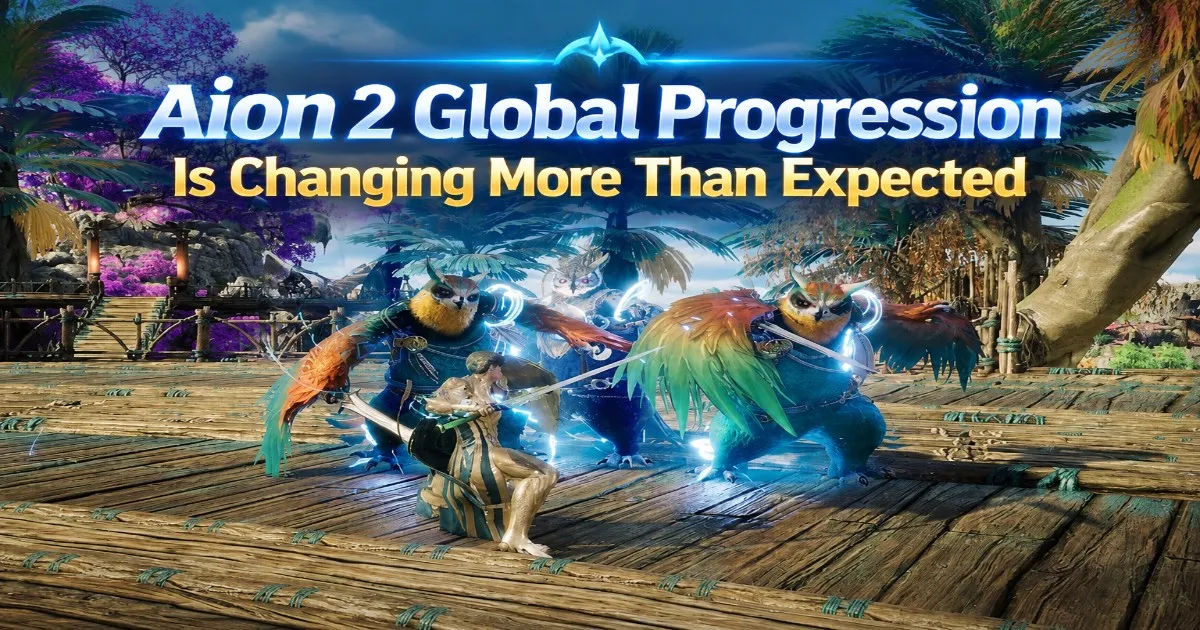
As Aion 2 Global gets closer, the latest test-build information is making one thing increasingly clear: this version may feel substantially different from the Korean and Taiwan versions many players have been watching. Anyone preparing Aion 2 Items, equipment, and a long-term character build should pay attention to these changes because Global appears to spread progression across more systems instead of putting most of the power directly into finished gear.
The biggest changes currently visible involve crafting, Potential, Genus, Stigma progression, dungeon rewards, trading, skill points, and PvP rules. This is still test-build information, so details can change before launch. However, the overall design direction is already interesting. Rather than rushing toward one powerful finished item, players appear to be encouraged to complete content, collect materials, craft equipment, develop its Potential, and gradually move into harder content.
Global Is Building a Different Progression Loop
The most noticeable difference is how several systems now connect to one another. Dungeon rewards are not simply about receiving finished equipment. Players can obtain specialized materials that feed directly into crafting, while crafted equipment can then be developed through additional progression systems.
| System | Current Global Direction | What Players Should Watch |
|---|---|---|
| Dungeon Rewards | Multiple reward pools | How reward activation works |
| Crafting | Initial crafts can fail | Material costs and failure risk |
| Potential | Adds additional combat properties | Transfer rules during upgrades |
| Genus | Different slots have different stat pools | Build combinations and rarity |
| Stigma | Sources spread across activities | Activity-based progression |
| Skill Points | Connected to PvE activities | Permanent progression requirements |
| Trading | Some equipment remains tradable | Binding rules for upgraded gear |
| PvP | Dedicated combat status system | Flagging and forced PvP conditions |
This creates a progression loop that feels deliberately layered. You run content, collect resources, craft a base item, improve it, develop its properties, and eventually use that equipment to tackle stronger content.
Crafting May Become More Important
Crafting appears to be one of the biggest changes in the Global build. Some recipes require several high-level materials and include a chance for the initial craft to fail. If the craft fails, the required materials are consumed.
That sounds harsh, but there is an important distinction. Later transfer or upgrading steps appear to be guaranteed in the information currently available. In other words, the developers may be concentrating randomness around creating the initial equipment rather than making every stage of progression dependent on chance.
The equipment itself is also interesting because some crafted items no longer appear to carry the large built-in PvE damage advantage familiar from other versions. Instead, the item provides its basic stats and slots, while a greater portion of its potential strength can come from additional systems.
That changes how players may think about crafting. The goal is not simply to make an item and immediately consider it finished. The base item becomes the foundation for further development.
Potential Adds Another Layer of Character Building
Potential could become one of the most important systems in Global because it allows equipment to gain additional combat properties.
Possible properties shown in the test information include damage boost, critical damage boost, PvE damage, weapon damage, front and back attack damage, endurance, regeneration penetration, multi-hit, perfect chance, double chance, and Genus-specific damage.
The important part is that these properties have ranges. Getting the property you want is only one step; getting a favorable value within its range can create another level of optimization.
That naturally creates a question every serious player will have: does Potential transfer when equipment is upgraded?
If it does, investing heavily in a current item becomes much safer. If it does not, players may have to think carefully before spending rare resources on perfecting equipment that could eventually be replaced. Until the final rules are confirmed, this is one system worth watching closely.
Genus Is Moving Toward Build Customization
Genus also appears to have received a major redesign. Instead of drawing every possible property from one universal pool, different Genus slots can focus on different categories of stats.
One slot may emphasize offensive properties, while another can offer accuracy, critical hit, front and back attack, or defensive options such as HP and defense.
Special Genus properties can also provide mechanics such as double chance, multi-hit, and perfect chance. These mechanics have not simply disappeared; their availability and placement appear to have changed.
This makes Genus less about finding one universally perfect stat and more about building a combination that matches your class and preferred content. PvE damage, general damage, and damage against specific Genus types can all play different roles depending on the situation.
Dungeons Are Becoming Part of the Full Gear Pipeline
Dungeon progression appears to connect directly with crafting. Some dungeons provide specialized materials used for higher-level equipment, while dungeon pity systems also appear to remain part of the current build.
The important takeaway is not any individual reward probability shown in the interface. Those numbers can be difficult to interpret without the final reward formulas. What matters more is the structure: dungeons provide resources that feed the next stage of progression.
This creates a familiar MMO rhythm with a different emphasis. Instead of simply farming a dungeon until the final weapon drops, players may be farming materials, crafting equipment, transferring progression, and eventually moving into higher-tier content.
Binding rules reinforce this idea. Some lower-level or crafted equipment can remain tradable, while certain dungeon or upgraded equipment can become bound. That could allow the marketplace to help players acquire materials or base equipment without necessarily allowing someone to skip every stage and directly purchase a finished endgame item.
Skill Points and Stigma Are Also More Activity-Based
Permanent progression appears to be connected more closely to actual gameplay. The current information indicates that skill points can come from sealed dungeons and certain side quests.
Stigma progression is also being distributed across several activities, including Abyss-related content, Nightmare Arena, Shugo Festival, Battlefield, and Ascension.
For players, that means progression may encourage variety rather than repeatedly farming one single activity. If these systems remain in the final release, daily and weekly planning could become much more important.
PvP Has Its Own Rules
Global also appears to introduce a dedicated PvE/PvP combat status system. Players can manually activate PvP status within their own faction territory, while certain actions can temporarily force PvP status.
The current test information indicates that attacking enemy players or enemy Kisks can trigger PvP conditions, and joining a party with someone already flagged can also have consequences. There is also a cooldown associated with changing status.
This could create a more controlled PvP environment than simply allowing unrestricted combat everywhere. A trust-level system is also reportedly present, apparently connected in part to broader account or anti-bot measures, although the final purpose and implementation still need confirmation.
What This Means for Global Players
Taken together, these changes suggest that Aion 2 Global is not simply a translated version of another regional build. Its progression philosophy appears to be different.
The emerging loop is straightforward: complete content, collect materials, craft equipment, improve it, develop Potential and Genus, enhance the character, enter stronger content, and repeat. That makes individual systems less important than how they work together.
Final Summary
For players preparing for launch, the biggest lesson is to avoid assuming that strategies from Korean or Taiwan versions will transfer perfectly to Global. Crafting, Genus, Potential, Stigma, dungeon rewards, skill points, trading, and PvP rules may all influence progression in different ways.
The marketplace may still help players accelerate parts of that journey, particularly when obtaining resources or tradable equipment, but the current direction suggests that character development itself remains important. Players considering Aion 2 Kinah for sale should therefore look at their overall progression plan rather than treating currency as a replacement for learning the game's systems. Until the final Global build is confirmed, the smartest preparation is understanding how these systems connect and being ready to adapt once the launch rules are locked in.