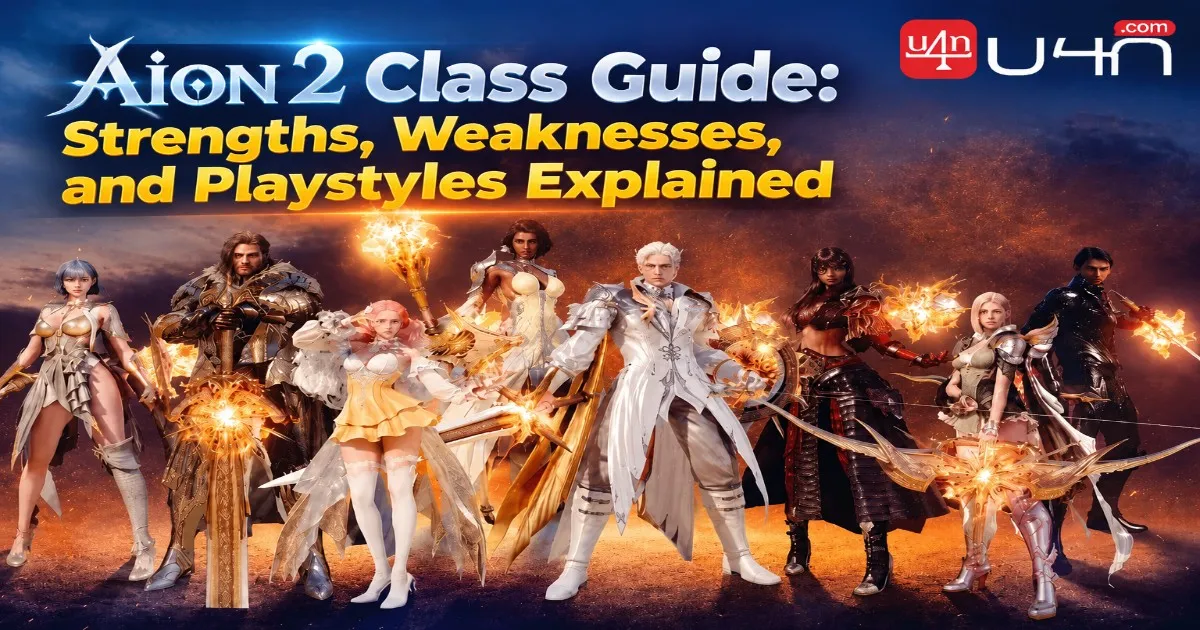
Choosing a main class in Aion 2 is less about finding one universally powerful option and more about understanding how each class actually feels in combat. Your preferred role, ping, gear investment, PvE or PvP focus, and comfort with a class's rotation can all change the experience. If you are preparing your character and looking at Aion 2 Items, it is worth deciding on your playstyle first rather than building around a class simply because it looks strong in someone else's hands.
After spending a long time with the different classes across Korean and Taiwanese versions, the biggest lesson is that every class comes with a trade-off. Some deliver exceptional burst but demand precise positioning, while others sacrifice personal damage for healing, buffs, durability, or group utility. The global launch roster gives players eight main choices, so here is how each one fits into actual gameplay.
Assassin: Burst Damage With a High Skill Ceiling
Assassin is a melee DPS class built around daggers, mobility, stealth, and explosive single-target damage. The class feels especially strong when you can control positioning and choose the right moment to engage.
Its biggest advantage is burst. Gap closers, attacks from behind, jumps, and stealth give Assassin plenty of ways to start or escape a fight. In small-scale PvP, especially one-on-one situations, these tools can make the class extremely dangerous.
The downside is that Assassin asks a lot from the player. Positioning and timing matter constantly, and mistakes are punished quickly. Ping is another major consideration because delayed inputs can make an already demanding rotation much harder to execute. Large-scale Abyss combat can also be less comfortable when ranged classes can take advantage of aerial positioning.
| Assassin Strengths | Assassin Weaknesses |
|---|---|
| Very high single-target burst | High mechanical demand |
| Stealth and strong mobility | Very sensitive to positioning |
| Excellent small-scale PvP tools | Less comfortable in large-scale aerial combat |
| Strong PvE damage potential | Low ping is especially valuable |
Ranger: Flexible Ranged Damage
Ranger uses a longbow and offers one of the clearest advantages in the roster: distance. Being able to attack from range is particularly valuable in open-world PvP and Abyss combat, where positioning can change rapidly.
The class also feels fast during combat. Ranger can move effectively while maintaining pressure, making it enjoyable for players who dislike standing still and casting from one location.
The trade-off is durability. Ranger can feel fragile when caught out of position, and getting the most from the class generally requires meaningful investment in gear and stats. It is a class where better preparation can noticeably change the experience.
Sorcerer: The Classic Glass Cannon
Sorcerer is a ranged magical DPS class focused on elemental attacks, burst damage, and powerful area-of-effect abilities. If you enjoy watching groups of enemies disappear under large spells, this is the classic choice.
The major strength is damage. Sorcerer can deliver powerful burst while also contributing strong AoE pressure. The class has also become more comfortable to play as its abilities and overall combat flow have been improved over time.
The weakness is the other half of the glass-cannon formula: durability. A poorly geared Sorcerer can feel extremely fragile. Positioning and gear matter in both PvE and PvP, so this is not necessarily the easiest class for someone who wants a forgiving playstyle.
Spiritmaster: Damage Plus Battlefield Utility
Spiritmaster combines ranged magical damage with summoned spirits. The class has a different rhythm from other ranged DPS because managing the spirit is part of the overall combat experience.
One of its biggest advantages is versatility. Strong damage, fear abilities, defensive interaction with spirits, and useful PvP tools give Spiritmaster several ways to contribute. The class can also feel surprisingly comfortable while leveling because enemies can be cleared efficiently.
The main drawback is management. Players who do not enjoy coordinating their spirit abilities may find the class less intuitive. Its performance is closely connected to how well the player handles those additional tools.
Cleric: The Dedicated Healer
Cleric fills the traditional healer role and uses a mace and shield. If your priority is keeping a party alive rather than chasing the highest personal DPS number, Cleric is the obvious direction.
Healing is the class's defining strength. Cleric also brings defensive support and party utility, while its survivability makes it comfortable in many situations. The class remains useful across different stages of group content because reliable healing is always valuable.
The cost is personal damage. Cleric is not designed to clear content at the same pace as dedicated DPS classes. Solo play is still possible, but players should expect a different pace when compared with classes built primarily around damage.
| Class | Primary Role | Major Strength | Main Trade-Off |
|---|---|---|---|
| Assassin | Melee DPS | Burst and mobility | High skill and ping demands |
| Ranger | Ranged DPS | Range and combat mobility | Relatively fragile |
| Sorcerer | Ranged DPS | Burst and AoE | Requires strong gear and positioning |
| Spiritmaster | Ranged DPS/Utility | Damage and versatility | Spirit management |
| Cleric | Healer | Healing and survivability | Lower personal damage |
| Chanter | Support | Party buffs and mobility | Lower DPS and weaker healing |
| Gladiator | Melee DPS/Off-tank | AoE, defense, and pressure | Not a pure DPS or tank |
| Templar | Main Tank | Durability and aggro control | Lower personal damage |
Chanter: The Support Class That Keeps Moving
Chanter is a melee support class using a staff. Unlike Cleric, its identity is built more around buffs than pure healing.
Its Mantra-based support can improve important party attributes, including offensive performance. Chanter also has useful healing abilities, strong survivability, and dynamic movement that makes the class feel active rather than passive.
The compromise is straightforward: Chanter is not a top-end pure DPS class, and its healing cannot replace a dedicated Cleric in situations where maximum healing is required. It is better understood as a flexible support class that can contribute in many different situations.
For players who enjoy being useful everywhere without committing completely to one role, Chanter can be a particularly interesting choice.
Gladiator: Aggressive Melee Pressure
Gladiator uses a greatsword and sits between pure DPS and tank-oriented gameplay. The class brings strong defensive tools, AoE damage, gap closers, and party utility.
This makes Gladiator particularly comfortable for players who want to stay close to the action. In PvP, its ability to pressure the frontline and close distance can be very useful, while its AoE tools help with PvE clearing.
The trade-off is specialization. Gladiator is not the same thing as a dedicated DPS class, and it does not replace a dedicated tank. Instead, it offers a middle ground with respectable damage and strong defensive capabilities.
Templar: The Dedicated Tank
Templar is the main tank class, using a sword and shield while focusing on durability, aggro control, and damage absorption.
The biggest advantage is obvious once you enter group content: Templar is designed to stand in front and keep pressure away from the rest of the party. Strong defensive abilities, survivability, useful buffs, and enjoyable movement make it much more active than the traditional stationary tank archetype might suggest.
Its biggest weakness is personal damage. Templar can handle solo content, but it will generally take longer to clear the same enemies than dedicated DPS classes. That is the natural price of bringing defensive utility and group protection.
What About the Brawler?
Brawler deserves a separate mention because it has appeared on the Korean and Taiwanese versions but is not part of the global launch roster discussed here.
The class has continued receiving adjustments to skills, animations, cooldowns, and balance. That makes it difficult to treat its current version as a final representation of what players will eventually experience.
Rather than judging Brawler against the eight global-launch classes too early, it makes more sense to watch how its development settles over future updates.
How Should You Choose Your Main?
The easiest way to narrow the roster is to start with the role you actually enjoy.
If you love burst and aggressive PvP, Assassin offers a demanding melee experience. Ranger and Sorcerer suit players who prefer ranged damage, while Spiritmaster adds more utility and management. Cleric is built around healing, Chanter around support, Gladiator around aggressive durability, and Templar around dedicated tanking.
| If You Prefer… | Classes to Consider |
|---|---|
| Burst melee combat | Assassin |
| Mobile ranged damage | Ranger |
| Large magical attacks | Sorcerer |
| Summons and versatility | Spiritmaster |
| Dedicated healing | Cleric |
| Party buffs and flexible support | Chanter |
| Melee pressure with defense | Gladiator |
| Tanking and protecting the group | Templar |
Final Summary
The eight Aion 2 launch classes are designed around different combat priorities rather than a single universal playstyle. Assassin rewards precision, Ranger rewards positioning and investment, Sorcerer delivers classic glass-cannon gameplay, and Spiritmaster combines ranged damage with spirit management. Cleric focuses on healing, Chanter provides broad support, Gladiator mixes damage with defense, and Templar takes the dedicated tank role.
The important part is matching the class to how you actually want to spend your time. A class that looks impressive in someone else's gameplay may feel completely different when its rotation, positioning, gear requirements, or role do not match your preferences. If you are considering Aion 2 Items for sale while preparing a new character, build around the class and role you genuinely enjoy first, then use gear upgrades to strengthen that playstyle rather than trying to force every class into the same mold.