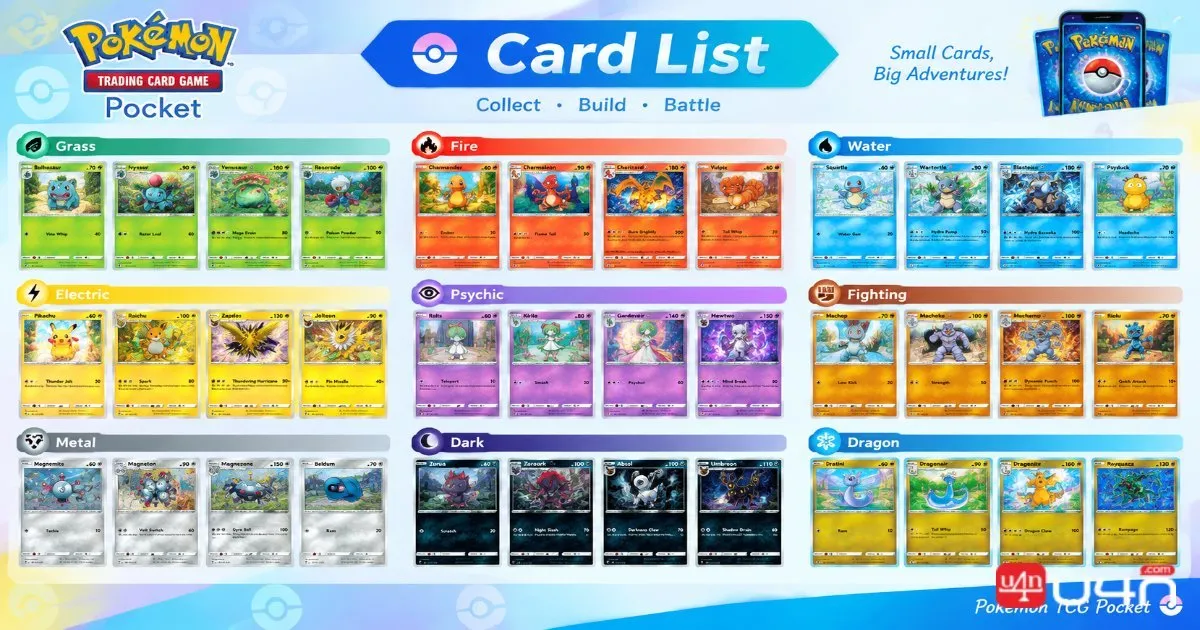
Pokémon TCG Pocket features a growing digital card collection organized into expansion sets, rarity tiers, promotional releases, and individual card numbers. From iconic Pokémon such as Charizard, Pikachu, and Mewtwo to powerful Pokémon ex cards and alternate-art collectibles, understanding the collection structure helps players track their progress, build competitive decks, and identify missing cards.
The game's card catalog includes standard expansion cards, secret rares, special illustrations, and limited-time promotional cards. Its early collection is built around the A Series, beginning with Genetic Apex (A1), while subsequent releases expand the available Pokémon, Trainer cards, strategies, and collectible artwork.
This guide covers the main collection categories, the three Genetic Apex booster packs, and a sample card list covering the first 50 catalog entries.
Understanding the Pokémon TCG Pocket Card Collection
The Pokémon TCG Pocket collection is divided into several categories, each serving a different purpose for collectors and players.
| Collection category | Description | Primary purpose |
|---|---|---|
| A Series expansions | Early expansion sets, including Genetic Apex | Establish the foundational card pool |
| B Series expansions | A subsequent expansion series | Introduce additional cards and collection goals |
| Standard cards | Regular versions of Pokémon and Trainer cards | Deck construction and collection completion |
| Secret rares and special-art cards | Higher-rarity cards featuring distinctive illustrations | Collecting and visual customization |
| Promo-A and Promo-B cards | Promotional cards distributed through events or special releases | Obtaining limited or alternate card versions |
Expansion sets generally organize cards by set identifier and individual collector number. These identifiers make it easier to distinguish cards from different releases, even when the cards feature the same Pokémon.
Promotional cards may follow separate numbering conventions and distribution schedules. Players who want a complete collection should therefore track expansion cards and promotional releases separately.
Genetic Apex (A1): The Foundational Expansion
Genetic Apex is the debut expansion associated with the game's initial card collection. Its three themed booster packs focus on different iconic Pokémon and offer distinct starting points for collecting and deck building.
The supplied catalog describes Genetic Apex as containing 226 standard cards and 60 secret art rares, for a stated total of 286 cards.
| Genetic Apex attribute | Details |
|---|---|
| Set identifier | A1 |
| Expansion name | Genetic Apex |
| Standard card count | 226 |
| Additional secret art rares | 60 |
| Stated total | 286 |
| Main Pokémon focus | Generation I, particularly the Kanto region |
| Booster pack variants | Charizard, Pikachu, and Mewtwo |
Card-count note: The 286 figure follows the supplied breakdown of 226 standard cards plus 60 additional rare cards. Exact totals can vary depending on whether a checklist counts unique card identities, alternate-art versions, promotional cards, or individual catalog entries. Collectors should use a clearly defined counting method when comparing completion percentages.
The Three Genetic Apex Booster Packs
Each Genetic Apex pack features a different collection of cards. Choosing a pack based on a preferred Pokémon or deck archetype can help players focus their collecting efforts.

1. Charizard Booster Pack
The Charizard pack appeals to collectors seeking powerful Fire-type Pokémon, recognizable Kanto favorites, and iconic character cards.
Notable cards and themes include:
• Charizard ex: A major Fire-type attacker associated with high-damage strategies.
• Arcanine ex: A durable offensive option for Fire-focused decks.
• Exeggutor ex: A Grass-type Pokémon that provides an alternative approach to attacking.
• Mewtwo ex: A prominent Pokémon ex card sought by players interested in Psychic strategies.
• Blaine: A Gym Leader-themed Trainer card that supports particular Fire-type strategies.
This pack is worth considering for players who want to explore Fire-oriented decks while collecting several recognizable Pokémon from the original generation.
2. Pikachu Booster Pack
The Pikachu pack emphasizes Electric-type Pokémon alongside important Water-type attackers. It offers a mix of recognizable Pokémon ex cards and options for different deck-building approaches.
Key cards include:
• Pikachu ex: A central Electric-type card for aggressive strategies.
• Zapdos ex: An Electric-type Pokémon with strong offensive potential.
• Blastoise ex: A Water-type attacker that rewards investment in its evolution line.
• Starmie ex: A Water-type option valued for its potential to deliver efficient attacks.
Players interested in Electric and Water archetypes may find this pack particularly appealing. It also provides access to familiar Pokémon that can anchor themed collections.
3. Mewtwo Booster Pack
The Mewtwo pack places greater emphasis on Psychic-type Pokémon, with additional options for Darkness-focused strategies.
Its notable cards and collection themes include:
• Mewtwo ex: A signature Psychic-type Pokémon ex card.
• Gengar ex: A Ghost-type Pokémon that supports disruptive strategies.
• Articuno ex: A Legendary Pokémon associated with Water-type gameplay.
• Marowak ex: An offensive option with a different damage profile.
• Gardevoir evolution line: A collection of Psychic-type cards that can support energy-oriented strategies.
This pack is a natural starting point for players interested in Psychic Pokémon, evolution-based strategies, and recognizable Legendary Pokémon.
Choosing a booster pack: Pack selection should reflect both collection priorities and deck-building goals. Since individual card availability and card acquisition methods can change with updates, players should check the current in-game card list before committing resources to a particular pack.
Pokémon TCG Pocket Card List: Genetic Apex #001–050
The following sample checklist organizes the first 50 Genetic Apex catalog entries by card number, Pokémon name, elemental type, and key attributes.
The numbering and card details below follow the supplied reference list. Where multiple cards occupy a range, the table summarizes the group rather than assigning unverified individual statistics to every card.

Grass-Type Cards: A1 #001–032
Grass-type cards in this portion of Genetic Apex include complete evolution lines, defensive options, and attackers that can apply status effects or exploit variable damage.
| Set number | Card name or group | Type | Key details |
|---|---|---|---|
| A1 #001 | Bulbasaur | Grass | 70 HP; Basic Pokémon |
| A1 #002 | Ivysaur | Grass | 90 HP; Stage 1 Evolution |
| A1 #003 | Venusaur | Grass | 160 HP; Stage 2 Evolution |
| A1 #004 | Venusaur ex | Grass | 190 HP; Pokémon ex card |
| A1 #005–007 | Caterpie, Metapod, Butterfree | Grass | Three-stage evolution line ending at 120 HP |
| A1 #008–010 | Weedle, Kakuna, Beedrill | Grass | Evolution line associated with damage and status setup |
| A1 #011–013 | Oddish, Gloom, Vileplume | Grass | Evolution line with status-oriented utility |
| A1 #014–017 | Paras, Parasect, Venonat, Venomoth | Grass | Secondary attackers and supporting Pokémon |
| A1 #018–020 | Bellsprout, Weepinbell, Victreebel | Grass | Disruption-oriented options; the supplied summary cites damage potential up to 140 HP |
| A1 #021–023 | Exeggcute, Exeggutor, Exeggutor ex | Grass | Includes a coin-flip damage strategy and an ex attacker |
| A1 #024–032 | Tangela through Gogoat | Grass | Additional Grass-type attackers and support options |
Notable Grass-Type Collection Highlights
Venusaur ex is one of the major cards in this section. Its 190 HP makes it a substantial presence on the field, while its evolution line gives collectors three related cards to track.
The Caterpie and Weedle lines illustrate another important aspect of collecting: obtaining an evolved Pokémon is not always enough to complete an evolution-based collection. Players may also need the corresponding Basic and Stage 1 cards to assemble the full line.
Other cards, including Victreebel and Exeggutor ex, add variety to the collection through disruption and damage-focused mechanics. Their usefulness depends on the complete deck, available support cards, and the current game rules.
Fire-Type Cards: A1 #033–050
The Fire-type section begins with Charmander and includes several high-profile Pokémon, from Charizard ex to Moltres ex.
| Set number | Card name or group | Type | Key details |
|---|---|---|---|
| A1 #033 | Charmander | Fire | 60 HP; Basic Pokémon |
| A1 #034 | Charmeleon | Fire | 90 HP; Stage 1 Evolution |
| A1 #035 | Charizard | Fire | 150 HP; Stage 2 attacker |
| A1 #036 | Charizard ex | Fire | 180 HP; high-damage Pokémon ex card |
| A1 #037–038 | Vulpix, Ninetales | Fire | Evolution-based offensive support |
| A1 #039–041 | Growlithe, Arcanine, Arcanine ex | Fire | Durable frontline options |
| A1 #042–044 | Ponyta, Rapidash, Magmar | Fire | Flexible mid-tier damage dealers |
| A1 #045 | Flareon | Fire | 120 HP; Eeveelution |
| A1 #046–047 | Moltres, Moltres ex | Fire | Notable Fire-type support and energy acceleration theme |
| A1 #048–050 | Heatmor, Salandit, Salazzle | Fire | Alternative damage and Poison-related strategies |
Notable Fire-Type Collection Highlights
The Charmander evolution line is one of the most recognizable groups in the Genetic Apex collection. Charmander, Charmeleon, Charizard, and Charizard ex represent different stages of the collection and provide a clear example of how regular and Pokémon ex cards contribute to deck-building options.
Charizard ex stands out as a key collectible for players who enjoy powerful attackers. Its 180 HP, according to the supplied list, distinguishes it from the regular Charizard entry at 150 HP.
Moltres ex is another important card to track because of its association with Fire-type energy acceleration. Support cards that help prepare an attacker can be just as important as the attacker itself, particularly when a strategy requires several Energy to operate.
The remaining cards expand the Fire-type catalog with different evolutionary paths and tactical choices. Ninetales, Arcanine ex, and Flareon offer additional collection targets for players who want more than a single Charizard-centered strategy.
What Makes Pokémon ex Cards Important?
Pokémon ex cards are a distinct card category within Pokémon TCG Pocket. They often feature higher-impact abilities or attacks and can form the centerpiece of a deck.

Their strategic value should be evaluated alongside their Energy requirements, evolution conditions, supporting cards, and the rules governing Pokémon ex knockouts. A powerful card is not automatically the best option for every deck.
When organizing a collection, it is useful to track Pokémon ex cards separately from their regular counterparts.
| Collection consideration | Why it matters |
|---|---|
| Pokémon identity | Helps distinguish regular and ex versions of the same Pokémon |
| Evolution requirements | Shows which supporting cards are needed for an evolution line |
| HP and attacks | Helps compare durability and offensive potential |
| Energy requirements | Indicates how much preparation a card needs |
| Supporting cards | Identifies Trainers and Pokémon that improve consistency |
| Rarity and artwork | Supports collection goals beyond competitive play |
Players pursuing complete sets should also distinguish between owning a Pokémon and owning every version of that Pokémon. A regular card, an ex card, and an alternate-art version may represent separate collection targets.
Promo Cards and Special Releases
Promo cards expand the collection beyond the standard expansion catalog. Pokémon TCG Pocket has used special distributions and events to introduce additional cards, including alternate artwork and event-specific releases.
The supplied reference identifies Promo-A and Promo-B as promotional subsets. Their contents and availability should be checked against the current in-game catalog because limited-time distributions can change.
| Promo category | General role | Collector recommendation |
|---|---|---|
| Promo-A | Promotional card subset | Record the card number and distribution source |
| Promo-B | Additional promotional subset | Check event and reward availability |
| Event rewards | Cards tied to specific in-game activities | Track event deadlines and eligibility |
| Login distributions | Cards or rewards provided through login campaigns | Review reward conditions during the distribution period |
| Alternate-art promotions | Special visual versions of cards | Separate artwork variants from standard card ownership |
Promotional cards can be especially important for completionists because they may not follow the same acquisition process as standard expansion cards. Missing a promotional release does not necessarily mean a player lacks the regular version of the Pokémon.
A reliable collection tracker should therefore include the promo identifier, card name, artwork version, acquisition method, and ownership status.
How to Track Your Pokémon TCG Pocket Collection
A structured checklist makes it easier to monitor collection progress and identify gaps in a particular expansion.
The following workflow works well for both casual collectors and players building decks around specific Pokémon.
- Start with the expansion identifier. Record each card under its set label, such as A1 for Genetic Apex.
- Track individual card numbers. Use the collector number to distinguish entries and avoid confusing similar Pokémon.
- Separate standard and alternate-art cards. Decide whether your completion goal includes every artwork and rarity variant.
- Record promotional releases separately. Keep a dedicated section for event cards and promo subsets.
- Track evolution lines together. Check Basic, Stage 1, and Stage 2 cards when completing a family.
- Prioritize missing deck components. If competitive play is your goal, focus on cards that complete a usable strategy before pursuing every collectible.
- Recheck the catalog after updates. New expansions and promotional releases can change the total number of cards available.
Example Collection Tracker
| Set number | Card | Type | Owned? | Priority |
|---|---|---|---|---|
| A1 #001 | Bulbasaur | Grass | Yes / No | Medium |
| A1 #004 | Venusaur ex | Grass | Yes / No | High |
| A1 #033 | Charmander | Fire | Yes / No | Medium |
| A1 #036 | Charizard ex | Fire | Yes / No | High |
| A1 #047 | Moltres ex | Fire | Yes / No | High |

The priority column is optional and can be adjusted according to personal goals. Competitive players may prioritize cards required for a particular deck, while collectors may focus on missing evolution lines, rare artwork, or promo releases.
Build a More Complete Pokémon TCG Pocket Collection
A well-organized Pokémon TCG Pocket card list is useful for more than simply counting owned cards. It helps players identify missing evolution pieces, compare expansion coverage, prioritize Pokémon ex cards, and keep track of promotional releases.
Genetic Apex provides a useful starting point through its Charizard, Pikachu, and Mewtwo packs, while the broader collection continues to grow through new expansions and special distributions. By tracking set numbers, card versions, rarity categories, and promo identifiers separately, collectors can maintain a clearer picture of their progress and make more informed decisions about which cards to pursue next.