



Mesos are the foundation of almost every major upgrade in MapleStory Artale. Whether you're preparing for a new weapon, buying better equipment, stocking up on potions, or improving your character's damage, you'll eventually need a reliable source of income. The problem is that not every popular training map is equally profitable, and simply defeating more monsters doesn't always mean you'll earn more.
In our experience, the most effective farming strategy combines three things: consistent monster kills, equipment that can be sold to NPCs, and valuable drops that other players actually want. If you're looking for ways to build your in-game budget without wasting hours on inefficient maps, this guide will help you choose better farming locations and make smarter decisions with every drop. You can also explore cheap Maplestory Artale Mesos as part of your broader Mesos planning.
How Mesos Farming Works in MapleStory Artale
Before choosing a farming map, it's important to understand where your income actually comes from. In Artale, a good farming session can generate several types of value at the same time. Players who focus only on the Mesos that appear on the ground often overlook a significant part of their potential earnings.
The Three Main Sources of Farming Income
| Income Source | How It Works | Best Use |
|---|---|---|
| Direct Mesos Drops | Collect coins dropped by defeated monsters | Consistent baseline income |
| NPC Equipment Sales | Sell unwanted equipment to NPC merchants | Reliable additional income |
| Player-Traded Drops | Sell valuable scrolls, throwing stars, and equipment through the Auction House | Higher potential profits |
Direct Mesos drops are the easiest income to understand. You defeat monsters, collect the coins, and gradually build your balance. However, the real difference between an average farming session and a productive one often comes from equipment and valuable drops.
For example, a map with dense monster spawns may provide a steady supply of equipment that can be sold to NPCs. Another location may have a more attractive chance of dropping a valuable scroll. These maps serve different purposes, so we shouldn't judge them by the same standard.
Why the Auction House Matters
Artale's economy gives valuable equipment and scrolls a second purpose beyond their direct NPC value. Items that help players improve their characters can be worth considerably more to another player than they are to a merchant.
The Auction House is therefore an important part of a serious Mesos farming routine. Before selling an item to an NPC, check whether players are currently looking for it. This is especially important for upgrade scrolls, throwing stars, and equipment used by popular builds.
The key is to distinguish between an item that is technically rare and one that has actual market demand. A rare drop is not automatically a profitable drop.
Best MapleStory Artale Mesos Farming Maps by Level
The best farming map depends on your character's level, damage, mobility, and potion consumption. A high-level monster may drop attractive equipment, but if it takes too long to defeat, your actual income can suffer.
The following locations are useful starting points based on commonly discussed Artale farming routes and drop opportunities. Treat the level ranges as practical guidelines rather than strict requirements, and check current monster and item information before committing to a long farming session.
Recommended Mesos Farming Locations
| Map or Location | Suggested Level Range | Main Income Potential | Why Consider It? |
|---|---|---|---|
| Henesys Hunting Ground 1 | Early game | Scroll drops and ordinary equipment | Accessible starting point with multiple monster types |
| Perion Excavation Sites | Around 20–30+ | INT scrolls and other valuable drops | Useful for players targeting scroll demand |
| Burnt Land 2 | Around 30–40+ | Wolbi Throwing Stars, Korean Fans, and equipment | Fire Boars offer both training and farming potential |
| Monkey Forest 2 | Around 40–50 | Direct Mesos and NPC equipment sales | Suitable for steady grinding and party farming |
| Path of Time 1 | Around 40–50+ | Glove for ATT 60% Scroll potential | Worth considering for players targeting valuable scrolls |
| Forest of Golems | Around 50–70 | NPC equipment sales, Tobi Throwing Stars, and other drops | Dense spawns can support consistent farming |
| Wild Kargos | Around 50–70 | Equipment drops and regular monster farming | An option for characters capable of handling stronger monsters |
Early Game: Henesys Hunting Ground 1
Henesys Hunting Ground 1 is worth considering when you're still building your first meaningful supply of Mesos. Its appeal is not based on one spectacular drop. Instead, the location gives newer characters an accessible place to defeat familiar monsters, collect ordinary equipment, and look for potentially valuable scrolls.
Red Snails and Orange Mushrooms are particularly worth checking for their associated scroll drops. Overall Armor for DEX and Shoe Jump scrolls are examples of items that players may want for equipment upgrades.
We recommend treating this location as an early-game income supplement rather than expecting it to outperform higher-level farming maps. If your character can defeat stronger monsters efficiently, moving to a map with better overall drops may be a more productive choice.
Mid-Level: Perion Excavation Sites and Burnt Land 2
Perion Excavation Sites are interesting because some of their value comes from scroll drops rather than direct Mesos. Wooden Masks and Rocky Masks are commonly associated with INT scroll farming, making the area worth testing if those items have healthy demand.
Burnt Land 2 offers a different opportunity. Fire Boars are associated with Wolbi Throwing Stars and Korean Fans, which can appeal to players looking for useful Thief-related equipment and consumables.
These locations are particularly useful when your character is still progressing through the mid-game. Instead of separating leveling and money-making into completely different activities, you can choose a map that supports both.

Higher-Level Farming: Path of Time 1 and Forest of Golems
Path of Time 1 is a notable location for players interested in the Glove for ATT 60% Scroll drop associated with Platoon Chronos. Because upgrade scrolls can attract demand from players improving physical damage builds, this location deserves a place on your farming shortlist.
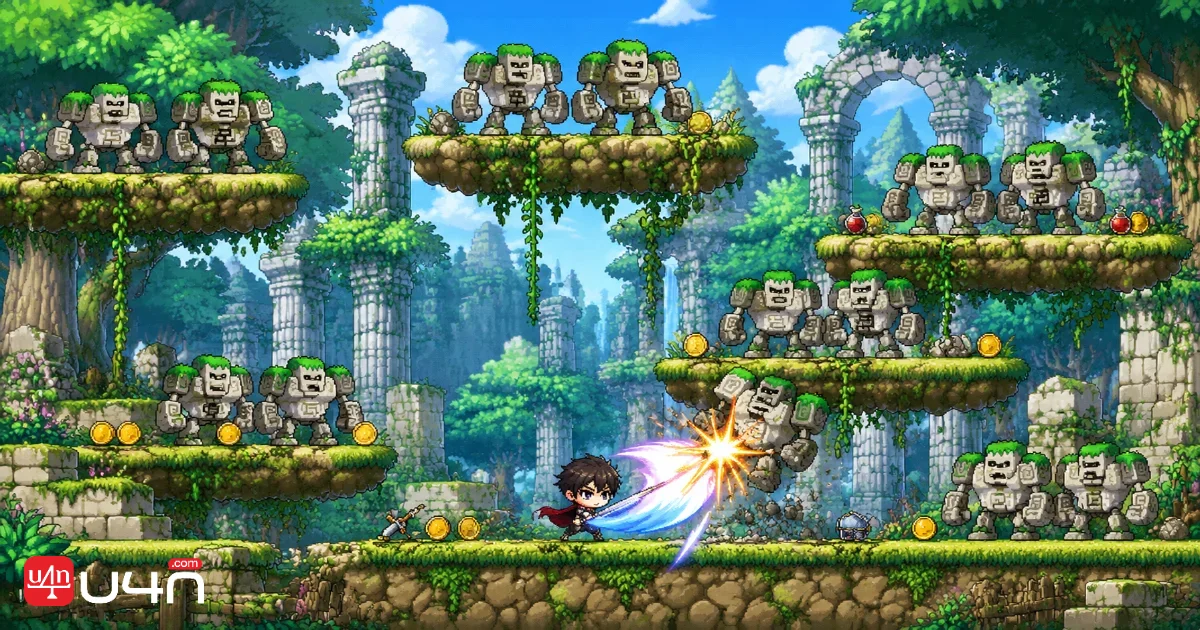
Forest of Golems is another strong candidate for sustained farming. Its appeal comes from the combination of dense monster spawns, equipment that can be sold to NPCs, and potentially valuable drops such as Tobi Throwing Stars.
We wouldn't automatically assume that Forest of Golems is the best map for every character, though. A class that clears another location faster may earn more overall, even if that alternative has fewer high-value drops.
Most Valuable Drops to Farm and Sell in Artale
A strong farming strategy doesn't end when an item enters your inventory. Knowing what to keep, what to sell, and what to discard is just as important as choosing the right monsters.
Valuable Scrolls
Scrolls are among the most interesting drops for players who want to earn more than ordinary monster income. They help other players improve their equipment, which gives them a potential market value beyond their NPC selling price.
| Scroll | Associated Farming Location | Potential Buyer Interest |
|---|---|---|
| Cape for INT 60% | Perion Excavation Sites | Players upgrading Mage equipment |
| Earring for INT 60% | Perion Excavation Sites | Players improving INT-focused builds |
| Glove for DEX 60% | Perion Excavation Sites | Bowman and Thief equipment upgrades |
| Glove for ATT 60% | Path of Time 1 | Players improving physical attack |
| Overall Armor for DEX 10% | Henesys Hunting Ground 1 | Players working on DEX equipment |
| Shoe Jump 10% | Henesys Hunting Ground 1 and Empty House | Players improving movement-related equipment |
These drops are worth investigating, but their value depends on the current market. A scroll that sells quickly during one period may become harder to move when more players start farming the same monster.
Our advice is simple: check current Auction House listings before deciding which scrolls deserve a dedicated farming session. Don't build your entire income plan around an old price screenshot or an outdated community estimate.
Throwing Stars and Other Equipment
Throwing stars are another category worth watching, particularly if you're farming monsters associated with Thief equipment.
- Wolbi Throwing Stars: Associated with Fire Boars in Burnt Land 2.
- Tobi Throwing Stars: A drop worth watching at Forest of Golems.
- Korean Fans: Another Fire Boar-related drop that may attract interest from players.
Ordinary equipment also matters. Even when an item has no meaningful Auction House demand, selling it to an NPC can provide a dependable source of income. This is one reason high-density maps can perform well over longer sessions.
How to Decide Whether a Drop Is Worth Keeping
We recommend using three simple questions before selling or discarding an item:
- Does it have real player demand? Check whether similar items are listed and whether their prices appear competitive.
- Can it sell for more than its NPC value? Compare the potential market return with the guaranteed merchant price.
- How quickly can you sell it? An item that sits in your inventory for days may be less useful than a cheaper item with steady demand.
Remember that listed prices are not necessarily completed sales. If the Auction House has many identical items at increasingly lower prices, the market may already be saturated.

Best Money-Making Methods Beyond Monster Grinding
Monster farming is a reliable foundation, but it shouldn't be your only source of income. Combining several methods makes your Mesos supply less dependent on rare drops and market fluctuations.
Sell Unwanted Equipment to NPCs
This is one of the easiest habits to develop. During a normal farming session, monsters will drop equipment that your character doesn't need. Keeping every item wastes inventory space and can make long sessions inconvenient.
We recommend checking equipment before selling it. Set aside items with useful stats, unusual demand, or potential trading value. Sell ordinary unwanted equipment to NPC merchants so that your inventory stays manageable.
Farm Scrolls for Player Demand
Scroll farming can provide a higher-value opportunity than ordinary equipment sales, but it also introduces more uncertainty.
Choose a location based on the scrolls it can drop and the current demand for those items. If players are actively upgrading a particular equipment slot, the related scrolls may become more attractive.
However, don't spend an entire session chasing one rare drop without considering the income you're giving up elsewhere. A balanced map with regular equipment sales may be more reliable.
Complete Quests for Early Income
Quests can help newer characters build their initial Mesos supply while progressing through the game. Some quests offer direct Mesos rewards, while others provide items that can be useful or potentially tradable.
Rather than ignoring every side quest in favor of grinding, consider completing quests that fit naturally into your route. This is particularly useful when you're still learning the world and don't yet have enough damage to farm higher-level monsters efficiently.
Use Party Farming When It Improves Efficiency
Party farming can be useful when a map has multiple platforms or enough monster density to support coordinated clearing. Monkey Forest 2 is one location commonly discussed for this type of approach.
The important point is that a party should improve the group's overall clearing efficiency. If you spend more time waiting for respawns, traveling between platforms, or negotiating loot distribution than defeating monsters, solo farming may be the better option.
How to Maximize Your Mesos per Hour
Choosing a popular map is only the first step. To understand whether a location is actually profitable, you need to look at what your character earns after expenses.
We recommend using a simple net-profit calculation:
Net Mesos per Hour = Direct Mesos + NPC Equipment Sales + Estimated Market Sales − Farming Costs
Your farming costs may include:
- HP and MP potions.
- Travel expenses.
- Other consumables used during the session.
- Applicable Auction House fees or selling costs.
Compare Maps Using the Same Test
A practical way to find your best farming location is to test two maps under similar conditions. Spend 30 minutes at each location, then record the results.
| Farming Metric | Map A | Map B |
|---|---|---|
| Farming Time | 30 minutes | 30 minutes |
| Direct Mesos | Record result | Record result |
| NPC Equipment Sales | Record result | Record result |
| Valuable Drops | Record items and estimated value | Record items and estimated value |
| Potion Costs | Record expenses | Record expenses |
| Net Profit | Calculate total | Calculate total |
For a fair comparison, use the same character, equipment, buffs, and approximate farming conditions. If you change maps and gear at the same time, it becomes difficult to identify what actually improved your income.
Don't Ignore Clear Speed and Map Competition
A map with valuable drops can still be inefficient if monsters take too long to defeat. Likewise, a theoretically excellent location may not be worth using if several other players are competing for the same spawns.
We generally prefer a map where a character can maintain a consistent rotation over one that requires frequent waiting or channel changes. Less downtime means more monsters defeated, more opportunities for drops, and more predictable income.
Potion consumption matters too. If a stronger monster forces you to spend much more on HP and MP recovery, the extra drops may not compensate for the additional cost.
The best map is the one that produces the strongest net result for your character, not necessarily the one with the highest-level monsters.

How Different Classes Should Approach Mesos Farming
Different classes have different strengths, so the same map won't produce identical results for every character. Attack range, mobility, area coverage, and potion consumption all influence farming efficiency.
| Class Type | Farming Strength | Recommended Approach |
|---|---|---|
| Warrior | Durability and close-range combat | Choose maps where monsters can be defeated consistently without excessive potion use |
| Magician | Skill-based clearing and area coverage | Look for maps where spells can hit multiple monsters efficiently |
| Bowman | Ranged attacks and positioning | Prioritize maps with favorable platforms and clear attack lanes |
| Thief | Mobility and throwing-star gameplay | Consider maps with useful Thief-related drops and efficient movement routes |
Build Around Your Actual Damage
A character's level alone doesn't determine whether a map is suitable. Two characters at the same level may have very different equipment, skill investments, and clearing speeds.
If you need several attacks to defeat each monster, a lower-level map may generate better returns. If your character can clear groups quickly, a denser location may be more profitable.
Balance Damage, Mobility, and Potion Costs
We recommend testing your character on a map before committing to a long farming session. Pay attention to how often you need to heal, how much time you spend moving between platforms, and whether your attacks consistently hit the available monsters.
A good farming setup isn't necessarily the one with the highest damage number. It's the setup that lets you defeat monsters efficiently while keeping operating costs under control.
New Areas and Multi-Character Farming: Opportunities to Watch
Artale's November 10, 2026 update introduced several changes that may influence how players approach progression and the in-game economy. The update opened New Leaf City, Malaysia Island, and the Mesos Machine area, while also introducing a multi-character system.
These additions create new opportunities to explore, but players should distinguish between a new area and a proven farming location. A region may contain unfamiliar monsters and new quests without automatically offering better Mesos per hour than established maps.
Explore the New Leaf City Regions
New Leaf City and the surrounding Malaysia Island content introduce additional monsters and quests to the world. The Mesos Machine area also provides a new environment for players to investigate.
For farmers, the most important questions are:
- How quickly can your character defeat the new monsters?
- Do their equipment drops have NPC or Auction House value?
- Are there useful quest rewards or materials?
- Is the map less crowded than established farming locations?
- Does the area offer enough monster density for consistent grinding?
We recommend testing these locations rather than assuming they immediately replace Forest of Golems or other established farming spots. As more players explore the update, drop information and market demand may become clearer.
Make the Most of the Multi-Character System
The new multi-character system gives players more room to explore different classes and progression paths. This can be useful when deciding which character is best suited to a particular farming role.
For example, one character may be more comfortable with close-range grinding, while another may clear groups of monsters more efficiently. Having more than one character to experiment with can help you identify the most suitable farming approach for your account.
However, don't assume that every resource, item, or Mesos balance is automatically shared between characters. Check the actual storage and transfer rules before building a farming plan around account-wide resource movement.
For the latest confirmed details, see the official November 10 Artale update announcement.
Common Mesos Farming Mistakes to Avoid
Even a good farming map can produce disappointing results if you approach it inefficiently. These are some of the mistakes we recommend avoiding:
- Choosing monsters that take too long to kill: Higher-level enemies aren't always more profitable.
- Ignoring potion expenses: Gross income can look impressive while net profit remains low.
- Selling valuable drops too quickly: Check Auction House demand before sending every item to an NPC.
- Following outdated market prices: Historical prices don't guarantee current selling value.
- Staying on crowded maps: Time spent waiting for spawns or changing channels reduces your effective farming time.
- Keeping every item: Excessive inventory clutter makes longer sessions less efficient.
- Chasing rare drops without a backup income source: A map should ideally provide some regular income even when valuable drops don't appear.
The most important lesson is to judge a farming location by its consistent results. A map that provides steady income over several sessions is often a better long-term choice than one that only looks attractive because of a rare drop.
Build a Smarter Mesos Farming Routine
Making Mesos in MapleStory Artale is less about finding one magical farming spot and more about building a routine that fits your character. Early-game players can start with accessible maps and ordinary equipment sales, while mid-level and higher-level characters can explore scroll farming, throwing-star drops, and denser monster locations.
Our recommendation is to test your farming maps, track your expenses, and pay attention to what players are actually buying. Keep valuable drops separate from ordinary equipment, use the Auction House carefully, and don't be afraid to move to a less crowded location when competition starts reducing your efficiency.
As Artale continues to expand, new regions and character options may create additional farming opportunities. For now, a balanced approach built around consistent kills, useful drops, and controlled costs remains the most dependable way to grow your Mesos supply. When you're planning your next equipment upgrade or looking to save time on progression, you can also buy Maplestory Artale Mesos on U4N and focus your in-game farming time on the activities you enjoy most.