
The Noxious Strain introduces a more dangerous type of Terminid encounter in Helldivers 2. These mutated bugs combine poison damage, stacking vulnerability, movement disruption, and aggressive melee attacks. Even the smaller Noxious Scavengers can become a serious threat when several attack together, while Noxious Spewers add ranged web attacks and powerful leaps to the fight. Understanding their attack patterns is essential if we want to survive without wasting valuable resources, including Helldivers 2 Medal rewards on unnecessary progression choices.
Our team has examined the available combat footage and tested the behavior of both enemy types to understand how their poison effects work. We'll break down the difference between active poison and poison vulnerability, explain each enemy's attacks, and look at how targeting their legs can reduce their mobility. Some findings also differ from early Wiki descriptions, so we'll distinguish observed results from mechanics that still need further testing.
How Poison Works in Helldivers 2
Before looking at individual enemies, we need to understand the poison system. Noxious Strain attacks do more than deal immediate damage. Repeated exposure increases poison vulnerability, making subsequent poison attacks more dangerous.
There are two separate effects to watch:
| Effect | How It Works | Combat Impact |
|---|---|---|
| Active Poison | Deals damage over approximately 6 seconds | Gradually reduces health |
| Poison Vulnerability | Builds up when players are hit by poison attacks | Increases the damage from subsequent poison exposure |
| Maximum Vulnerability | Reaches 4 stacks | Can trigger movement restrictions and blurred vision |
| Slow | Appears when vulnerability reaches a critical level | Prevents sprinting temporarily |
The most important distinction is that active poison damage can end while accumulated poison vulnerability remains. Repeated poison attacks therefore become increasingly dangerous, even when the previous damage-over-time effect has expired.
The distinction between active poison and vulnerability is particularly important. The damage-over-time effect can end while the accumulated vulnerability remains. If another poison attack connects afterward, the player continues from the existing vulnerability level rather than starting from zero.
What Happens at Maximum Poison Vulnerability
As vulnerability builds, the HUD provides visual warnings. The screen initially develops a yellow tint, accompanied by a small yellow poison icon above the stamina bar.
At higher levels, the HUD turns green, and the poison icon gains a red background or border. Blurred vision may also occur. Once vulnerability reaches four stacks, our observations indicate that the player can lose the ability to sprint and receive a Slow status effect.
However, a green HUD does not necessarily mean movement restrictions have already started. We observed situations where players could still move normally at that stage. The fourth vulnerability stack appeared to be the more consistent trigger for the movement penalty.
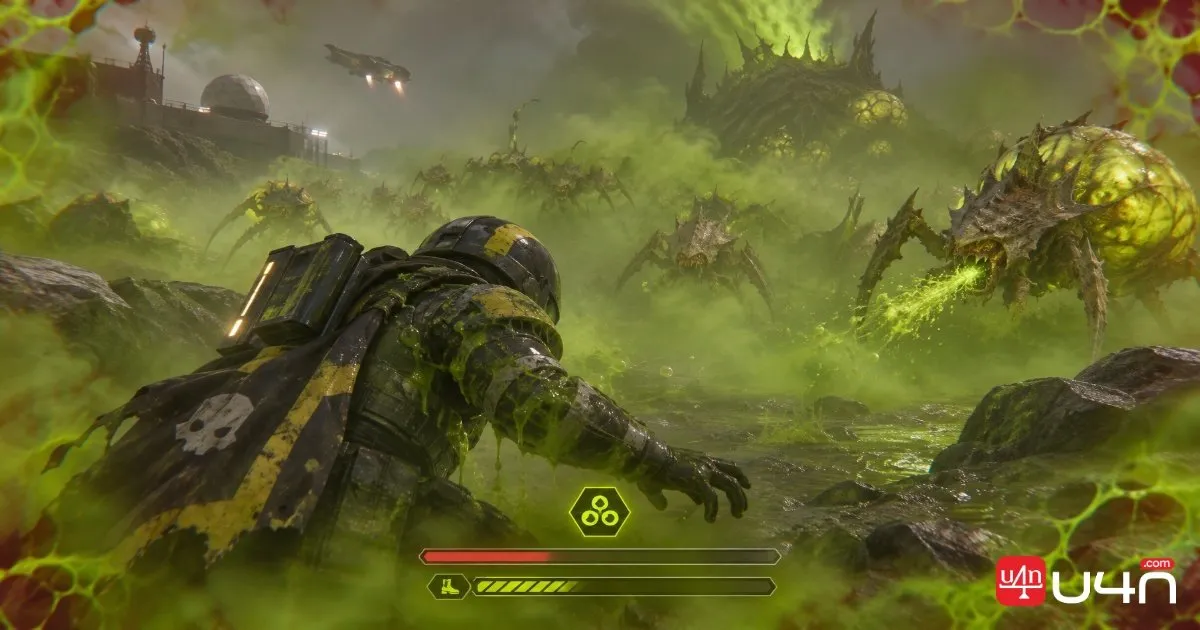
Can Stim Remove Poison?
Stim is useful when dealing with Noxious Strain enemies, but it does not completely counter their poison mechanics.
During our tests, using a Stim appeared to remove approximately two vulnerability stacks while restoring health much faster than the poison could drain it. However, two limitations are worth remembering:
- Stim does not immediately stop active poison damage.
- It does not instantly restore sprinting once the movement restriction has activated.
If you are surrounded by Terminids, recovering health does not automatically give you a way to escape. We recommend creating distance before relying on healing to survive another attack.
Noxious Scavenger Attacks and Poison Stacks
Noxious Scavengers may look relatively harmless compared with larger Terminids, but their ability to accumulate poison vulnerability makes them dangerous in groups.
We identified three distinct attack patterns.
| Attack | Observed Behavior | Poison Vulnerability |
|---|---|---|
| Foreleg Slam | Strikes the player with its front legs | No confirmed poison stack |
| Weak Bite | Short forward lunge with a quick bite | Approximately 1 stack |
| Strong Bite | Brief preparation followed by a longer, more forceful lunge | Approximately 2 stacks |
Weak Bite vs. Strong Bite
The most important difference is the attack animation.
A weak bite is relatively quick. The Scavenger moves forward and brings its claws inward to bite the player. In our observations, this attack caused little or no noticeable stagger and did not produce significant stamina loss.
A strong bite has a more recognizable preparation animation. The creature briefly pauses and shakes or moves its body before launching a longer attack. It can also approach quickly before biting.
This stronger attack causes a noticeable stagger and drains a considerable amount of stamina. Based on the vulnerability progression visible in our tests, it appears to apply two stacks instead of one.
The difference becomes easier to understand when we look at how attacks combine:
- One strong bite applies approximately two vulnerability stacks.
- A subsequent weak bite raises the total to three.
- Another weak bite reaches four stacks and can trigger movement restrictions.
Four weak bites can produce the same result. This explains why the number of attacks required to trigger the most dangerous poison effects can vary between encounters.

Why Groups of Scavengers Are Dangerous
A single Scavenger is usually manageable. Several attacking together are a different problem.
Their relatively fast movement makes it difficult to maintain distance, especially when other Terminids are already pressuring the squad. Each additional bite can increase vulnerability, making subsequent poison exposure more punishing.
Our recommendation is to avoid letting multiple Scavengers surround you. Eliminate nearby attackers before their repeated bites turn a manageable encounter into a movement-control problem.
Noxious Spewer Attacks and Web Mechanics
Noxious Spewers introduce a more complicated threat. Unlike Scavengers, they can combine close-range attacks, powerful leaps, and ranged web projectiles.
We identified three main attack patterns during testing.

Foreleg Stab and Leap Bite
At close range, a Noxious Spewer can attack with one of its front legs. Its more dangerous option is a powerful leap bite that rapidly closes the distance.
During our tests, the leap attack was attempted from approximately 10–12 meters away. The impact can cause substantial direct damage, particularly when the head connects, and appears to apply two poison vulnerability stacks.
We did not confirm a separate weak-bite variation during our testing. Players should therefore treat the leap bite as the primary poison-related melee threat until further evidence becomes available.
Web Shooter: A Different Kind of Threat
The web attack is particularly dangerous because it can set up another attack immediately afterward.
A small protrusion near the upper part of the Spewer's abdomen launches web projectiles. Unlike its bite, the web itself does not appear to apply poison.
However, being hit can cause three effects:
- A noticeable stagger.
- Some stamina loss.
- Reduced movement speed for approximately four seconds.
Our testing showed web attacks beginning at around 20 meters, with an observed effective range of approximately 10–20 meters.
This creates an important overlap between the Spewer's attack ranges. At roughly 10–12 meters, it may choose either a web attack or a leap bite. These attacks do not follow a fixed sequence, so players cannot rely on a predictable rotation.
The real danger comes from their combination. A web hit slows your movement and gives the Spewer an opportunity to close the distance. If it is followed by a leap bite, you may suffer direct damage, stagger, and additional poison vulnerability before recovering control.
When several Scavengers are nearby, this combination becomes even more dangerous.

Weak Points and Best Ways to Counter Noxious Spewers
Fortunately, Noxious Spewers do not appear to have armor stronger than light armor on their vulnerable sections. Our tests indicate that light penetration weapons are sufficient, so bringing a higher penetration weapon specifically to deal with them is unnecessary.
However, their legs offer another useful tactical opportunity.
Destroy Their Legs to Reduce Mobility
Shooting one of the Spewer's legs can significantly reduce its movement speed. We initially tested this with the rear legs, but additional testing showed that destroying a front leg produces a similar effect.
Removing another leg further reduces mobility. More importantly, once enough mobility is lost, the Spewer can no longer perform its leap bite.
This makes leg targeting a useful option when the enemy is approaching too quickly or when your squad needs additional time to reposition.
| Leg Damage | Observed Effect |
|---|---|
| One leg destroyed | Reduced movement speed |
| Additional leg destroyed | Further movement reduction |
| Sufficient leg damage | Leap bite becomes unavailable |
There is one important limitation: destroying the legs does not completely neutralize the enemy.
A damaged Spewer can still:
- Fire web projectiles.
- Attack with its remaining front leg at close range.
- Perform its powerful bite when within melee range.
In other words, leg destruction removes its ability to rapidly leap toward you, but it does not eliminate every threat. Keep your distance and continue attacking rather than assuming the enemy is harmless.

Recommended Combat Priorities
When fighting both Noxious variants, we recommend prioritizing threats according to their ability to restrict movement.
| Combat Situation | Recommended Response | Reason |
|---|---|---|
| Several Scavengers approaching | Reduce their numbers quickly | Prevent repeated poison stacking |
| Spewer preparing a leap | Dodge or create distance | Avoid a high-impact bite |
| Spewer closing the gap | Target its legs | Reduce mobility and disable its leap |
| Hit by a web projectile | Watch for an immediate follow-up attack | Avoid being caught in a control chain |
| Poison vulnerability approaching 4 stacks | Avoid further poison exposure | Prevent movement restrictions |
| Health dropping while poisoned | Use Stim when necessary | Restore health without relying on it to remove Slow |
Our main combat priority is to prevent enemies from controlling your movement. Reduce Scavenger numbers, avoid Spewer web attacks, and target its legs when necessary. Healing alone will not solve a situation where you can no longer sprint away.
We would not recommend spending too much time focusing on a damaged Spewer if other enemies are already attacking your squad. Once its leap ability is disabled, repositioning and dealing with more immediate threats may be the better choice.
Summary: How to Survive Noxious Strain Encounters
Noxious Strain changes the way players need to approach Terminid combat. Its biggest threat is not simply poison damage, but the combination of vulnerability stacking, movement restrictions, and attacks that prevent players from escaping.
Here are the most important lessons from our testing:
- Poison vulnerability can reach four stacks, and active poison ending does not automatically reset those stacks.
- Scavengers become particularly dangerous when several attack together.
- Strong Scavenger bites appear to apply twice as many vulnerability stacks as weak bites.
- Spewer web attacks create opportunities for follow-up attacks by slowing players.
- Destroying a Spewer's legs reduces mobility and can prevent its leap bite.
- Stim helps restore health and may reduce vulnerability, but it cannot immediately remove an active movement restriction.
Our biggest takeaway is that controlling enemy movement is just as important as dealing damage. If you are planning your next loadout or progression route and looking for ways to buy Helldivers 2 Super Credits, remember that better preparation should complement good combat decisions, not replace them. Understanding attack animations, managing poison exposure, and targeting the right weak points will make these encounters much easier to handle.
FAQ
How many poison vulnerability stacks can players receive?
Our tests support a maximum of four stacks. Reaching this level can trigger blurred vision and movement restrictions, including the inability to sprint.
Does poison disappear after six seconds?
The active poison damage lasts approximately six seconds, but accumulated vulnerability does not automatically reset when that damage ends.
Can Stim cure Noxious Strain poison?
Stim restores health and appeared to remove approximately two vulnerability stacks during our testing. However, it does not immediately stop poison damage or instantly remove an existing sprint restriction.
How do you avoid the Noxious Spewer leap attack?
Maintain distance and watch for its approach. If it gets too close, attack its legs to reduce mobility and eventually prevent it from performing the leap bite.
Does the Noxious Spewer's web attack cause poison?
We did not observe a direct poison effect from the web projectile. It instead causes stagger, stamina loss, and approximately four seconds of reduced movement speed.
What weapons are effective against Noxious Spewers?
Weapons with light armor penetration are sufficient for damaging their vulnerable sections.