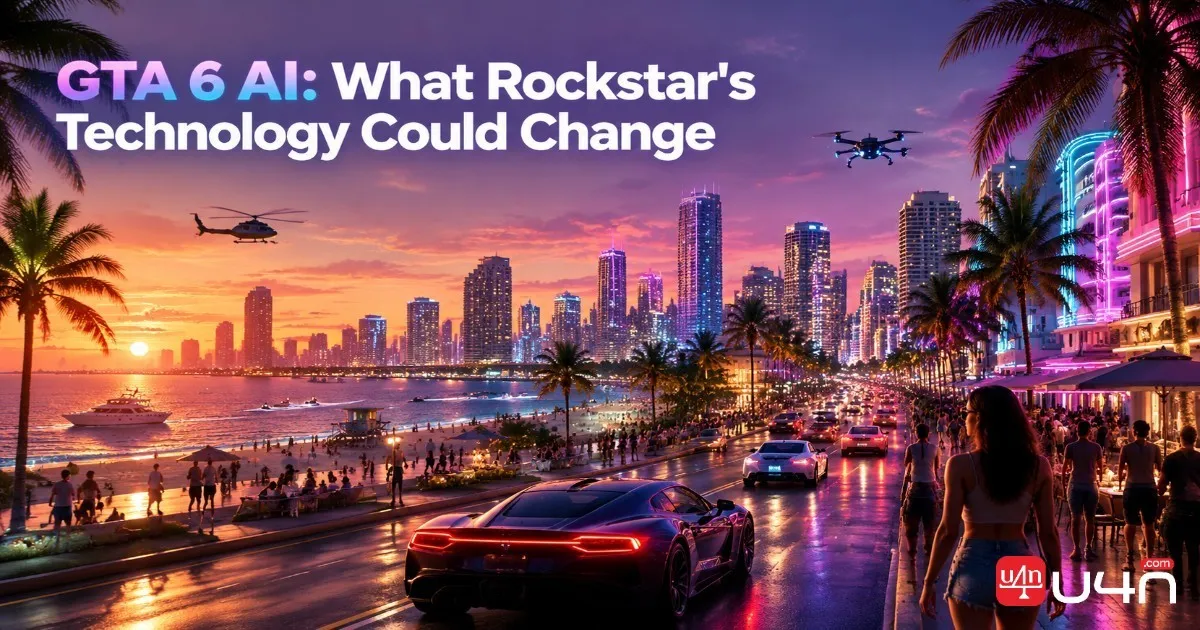
Grand Theft Auto VI is generating plenty of discussion about artificial intelligence, but the biggest question is not whether Rockstar is using AI as a buzzword. It is how the studio's technology could make Vice City feel more alive. From pedestrian reactions to traffic behavior and character animation, the systems running beneath the surface may have a greater impact on immersion than any single visual upgrade.
For players who already spend time in GTA Online, believable NPC behavior is only part of the bigger picture. Progression, the in-game economy, and preparation for new content also shape the experience, although services such as buy GTA money cheap from U4N are relevant to the existing online economy rather than confirmation of any GTA 6 feature. To understand what the next game might deliver, we need to separate generative AI from the traditional game AI that controls what happens inside an open world.
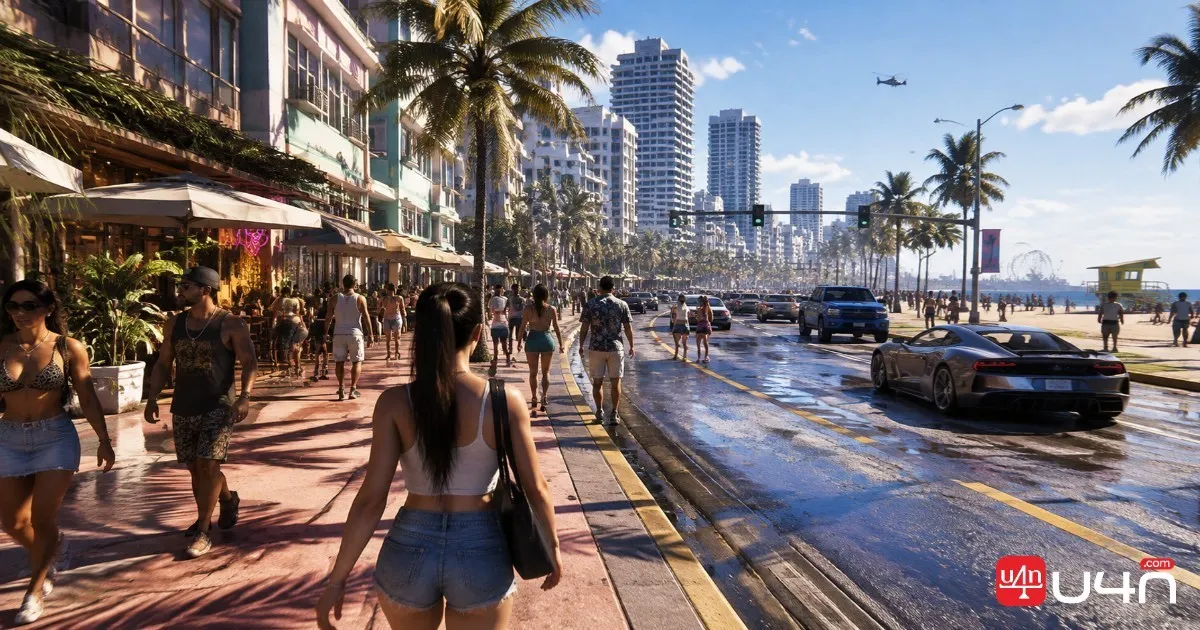
Does GTA 6 Use Generative AI?
The discussion around Rockstar's approach to AI often mixes two different questions: whether developers use generative tools to create content and whether the finished game uses intelligent systems to control characters and environments.
Generative AI can produce or transform text, images, audio, and other material. Traditional game AI, by contrast, governs gameplay decisions such as navigation, combat behavior, pedestrian reactions, and traffic movement. These systems do not need to generate new content to make a game world feel responsive.
Claims that GTA 6 has absolutely no generative AI involvement should be treated carefully unless they are supported by a clear, attributable statement from Rockstar or Take-Two. A company's creative philosophy does not automatically reveal every tool used during production, including internal development and testing workflows.
For us, the more useful question is what players will actually experience. Will pedestrians respond convincingly to danger? Will traffic behave naturally when a road becomes blocked? Will police encounters feel less predictable without becoming unfair? Those are the details that can make a practical difference during ordinary exploration and high-pressure missions.
The key distinction is between generative AI used to create content and game AI that controls interactive behavior. Understanding that difference is essential before judging what Rockstar's technology could change in GTA 6.
Take-Two CEO Strauss Zelnick stated in a February 2026 interview that generative AI had no part in what Rockstar was building for GTA 6, describing its worlds as handcrafted. This statement concerns generative AI in the game's creation and should not be interpreted as proof that every form of traditional game AI or automation is absent. Read the report on Take-Two's statement.
Generative AI vs. Traditional Game AI
Although the terms sound similar, their roles in game development are fundamentally different.
| Technology | Primary purpose | Potential relevance to GTA 6 |
|---|---|---|
| Generative AI | Creates or transforms content | Could support certain development workflows, depending on the tools and policies used |
| NPC decision systems | Select actions based on game conditions | Can influence how pedestrians, drivers, and other characters react |
| Navigation systems | Calculate movement and routes | Can help characters and vehicles move through changing environments |
| Procedural animation | Adjusts movement according to context | Can help characters respond to terrain, obstacles, and changing body positions |
| Machine learning | Learns patterns or supports automated analysis | May assist selected development or testing tasks, but specific GTA 6 uses require evidence |
These technologies can work together, but they are not interchangeable. A pedestrian who changes direction to avoid a collision does not necessarily use generative AI. That behavior may come from conventional navigation logic, animation blending, collision detection, or a combination of established techniques.
Our team also recommends avoiding the assumption that a more sophisticated system automatically creates better gameplay. NPC behavior needs to remain readable and consistent with the situation. If every civilian reacts unpredictably, the city may feel chaotic rather than convincing. The goal is believable variation within rules that players can understand.
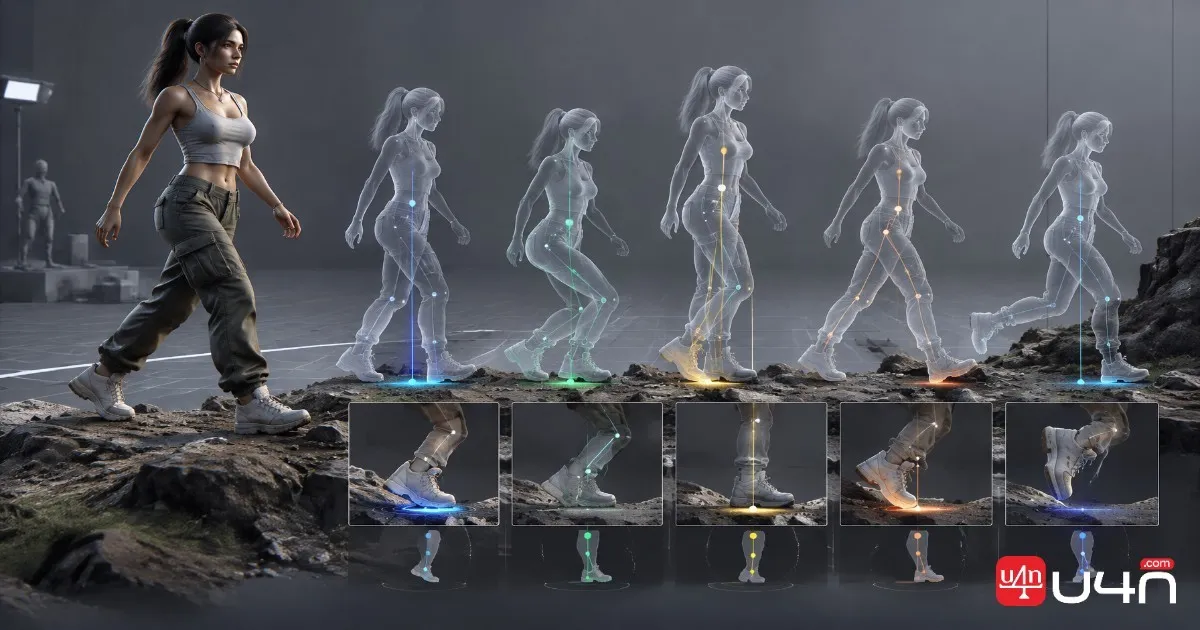
What Take-Two's Patents Could Reveal
Patents are useful when examining the direction of a developer's technical research, especially when they describe virtual character movement, navigation, or animation adaptation. However, a patent is evidence of a documented technical proposal, not proof that the same system appears in a particular game.
When evaluating patents associated with Take-Two, we should look beyond a headline or a simplified online explanation. The original filing, its claims, its publication history, and any verifiable connection to GTA 6 all matter.
Three areas are especially worth examining:
- Virtual character locomotion: Systems that adjust movement to changing conditions could help characters handle uneven ground, obstacles, or transitions between actions.
- Navigation and route selection: More flexible pathfinding could allow characters or vehicles to respond to local obstacles rather than repeatedly attempting the same route.
- Character state and behavior: Systems that retain information about events or update behavior states could support more consistent reactions across gameplay situations.
The distinction between possibility and implementation is crucial. Even if a patent describes a promising approach, we cannot conclude that GTA 6 uses it, that every NPC benefits from it, or that the final result works exactly as a patent summary suggests.
For players, the most meaningful evidence will come from official technical explanations and the finished game's behavior. A feature that works consistently during real gameplay matters more than an impressive patent description on its own.
One relevant example is Take-Two's patent titled System and method for virtual character locomotion. It documents a proposed approach to virtual character movement, but the patent itself does not establish that the technology is implemented in GTA 6.
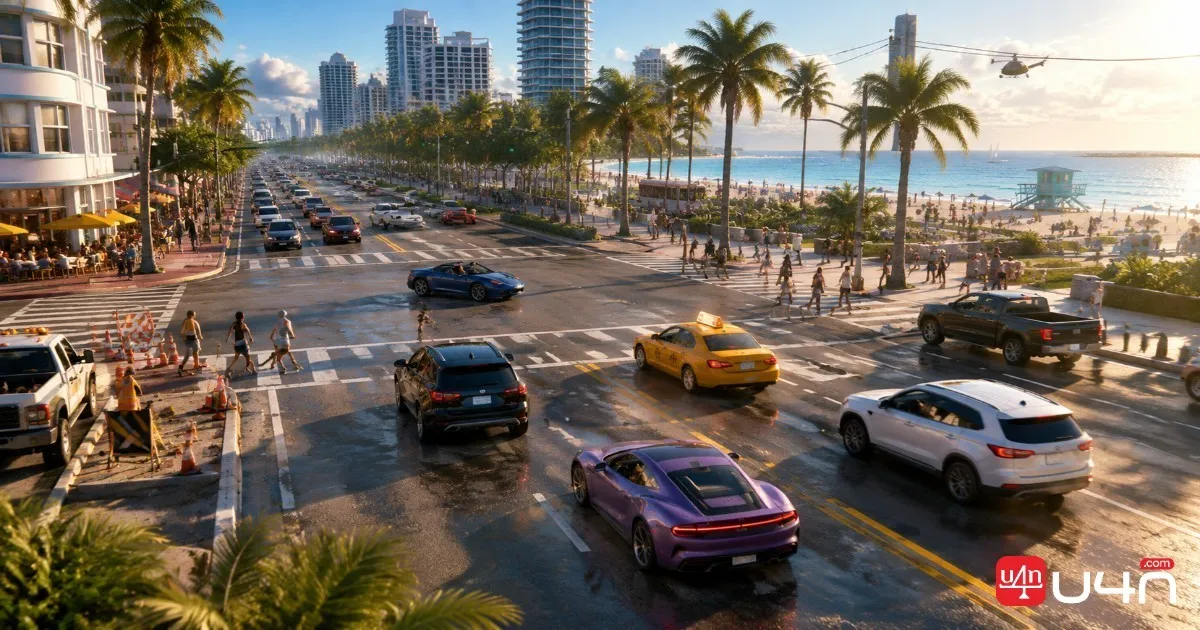
NPC Behavior, Traffic, and Animation
NPC behavior is where the AI discussion becomes especially interesting. A large open world can look impressive in screenshots, but immersion depends on what happens when players stop following the expected path.
Pedestrians and environmental reactions
Consider a crowded sidewalk. If a player approaches quickly, a convincing pedestrian system might encourage nearby characters to step aside, hesitate, turn away, or react to a sudden disturbance. Small differences in timing and movement can make repeated encounters feel less scripted.
That does not mean every pedestrian needs an independent personality or a persistent memory of every interaction. Well-designed behavior rules, varied animations, and appropriate responses to local events can already produce a convincing result.
Traffic and navigation
Driving through Vice City will provide another useful test. Traffic feels more natural when vehicles respond to nearby cars, obstacles, intersections, and changing road conditions rather than appearing to follow an entirely rigid pattern.
However, realistic traffic is not simply traffic that avoids every collision. Drivers also need to behave consistently enough for players to anticipate their actions. If vehicles react too aggressively or hesitate without a clear reason, the system can become frustrating instead of immersive.
Procedural animation and movement
Animation can contribute just as much to realism as decision-making. A character who adjusts their balance, changes stride, or reacts naturally to an obstacle feels more grounded than one who abruptly switches between fixed poses.
Procedural techniques can modify movement in response to the surrounding environment, while authored animations can provide carefully designed actions and transitions. Modern games often combine these approaches rather than relying exclusively on one method.
The important point is that better movement does not necessarily mean every action is generated in real time. A carefully blended animation system can produce believable results without eliminating pre-authored animation altogether.
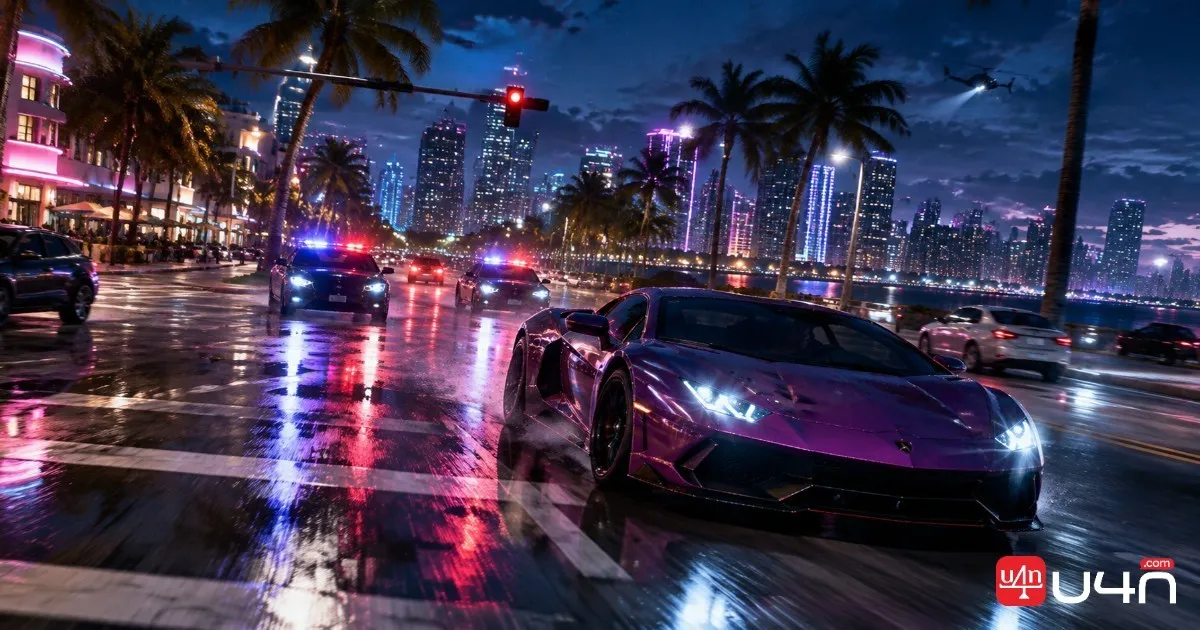
How Smarter AI Could Change GTA 6 Gameplay
The real test of GTA 6's AI will be whether it changes how players interact with the world, not merely whether the city looks busy.
| Gameplay situation | What players will want to see | What remains to be verified |
|---|---|---|
| Causing a disturbance | Reactions that fit the situation and nearby characters | How consistently NPCs respond across different locations |
| Driving through traffic | Convincing vehicle movement and obstacle avoidance | How traffic handles complex or unusual situations |
| Escaping the police | Pursuits that create pressure without feeling arbitrary | The exact detection, search, and pursuit rules |
| Exploring crowded areas | Varied pedestrian movement and environmental interactions | How much behavior varies and persists during extended play |
| Repeating activities | Fewer obviously repetitive reactions | Whether the underlying systems provide meaningful variation |
Police behavior deserves particular attention because it directly affects the rhythm of open-world gameplay. If detection, pursuit, and searching are connected in a convincing way, escaping a wanted level could feel like a sequence of decisions rather than a simple race to break line of sight.
But more complex police AI is not automatically better. Players need to understand why they have been detected, how pursuit develops, and what options are available. A fair system provides useful feedback and consistent rules, even when the outcome is challenging.
The same principle applies to NPC memory. If the game retains information about previous events, that could make certain encounters feel more connected. Yet we should not assume that individual pedestrians remember the player indefinitely, recognize every disguise, or report past crimes unless those mechanics are demonstrated or confirmed.
Ultimately, we will judge the technology through ordinary play: whether the city reacts naturally, whether encounters feel varied, and whether the systems create interesting situations without constantly drawing attention to themselves.
The real measure of smarter game AI is not how complicated the technology sounds. It is whether players experience more believable reactions, more coherent pursuits, and fewer repetitive encounters without losing control or clarity.
Summary: What Matters Most About GTA 6 AI?
The most important distinction in the GTA 6 AI discussion is the difference between how a game is developed and how its world behaves at runtime. Generative AI concerns content creation, while navigation, decision-making, animation, and environmental reactions are established areas of game AI.
Take-Two's patents may offer useful clues about possible technical directions, but they should not be treated as a feature list for the finished game. Claims about exact animation counts, persistent NPC memories, intelligent police tactics, or specific machine-learning workflows need reliable evidence before they can be presented as confirmed facts.
Our view is that the most meaningful advances will be the ones players notice through experience rather than marketing language. More natural movement, coherent traffic, readable police behavior, and convincing pedestrian reactions could all strengthen the sense of living in Vice City.
As launch information develops, we should also keep technical speculation separate from confirmed progression and economy details. GTA6 Items and other gameplay systems deserve their own evidence-based coverage rather than being treated as proof of how the underlying AI works.
FAQ
Does GTA 6 use generative AI?
The exact scope of generative AI use during GTA 6's development should not be stated as a certainty without a verifiable official source. Generative content tools and in-game AI systems are different technologies, so claims about one do not establish the use or absence of the other.
What is the difference between GTA 6 AI and generative AI?
Generative AI creates or transforms content. Game AI controls or supports interactive behavior, including navigation, decision-making, and reactions to the environment. A game can feature complex NPC behavior without using generative AI to create that behavior.
Will NPCs in GTA 6 remember the player?
Persistent NPC memory is an interesting possibility, but specific claims about pedestrians remembering past crimes, recognizing disguises, or retaining information across visits require direct evidence. A patent describing memory-related technology does not establish that these mechanics are present in GTA 6.
Will GTA 6 have smarter police AI than GTA 5?
That is one of the most interesting areas to watch, but the exact detection and pursuit mechanics should not be assumed before they are confirmed or demonstrated in sufficient detail. The key question is whether police encounters become more coherent, challenging, and understandable.
Can patents confirm GTA 6's AI features?
No. Patents can document proposed inventions and technical approaches, but they do not prove that a specific game implements those approaches. A reliable analysis should connect the original patent to verifiable evidence about the actual game before describing a feature as confirmed.