Cart Empty
Continue ShoppingWith the global launch of College Football 27 scheduled for July 9, 2026, and early access opening on July 2, players are preparing to transition from last year's release.
While College Football 26 successfully brought the beloved franchise back into the modern era, College Football 27 focuses on mechanical adjustments, dynamic features, and highly requested mode revamps.
Here is a quick look at how the two titles stack up.
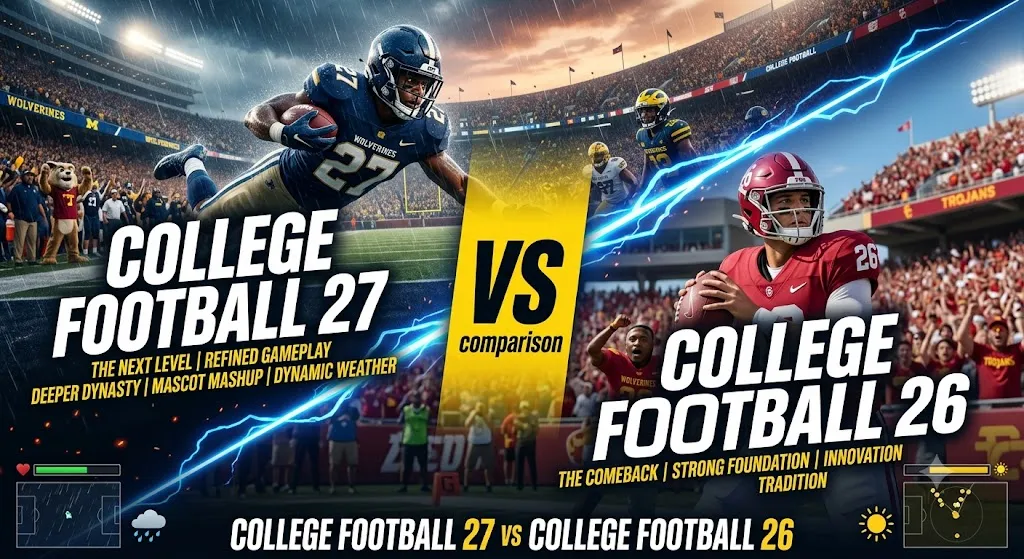
| Feature | College Football 26 | College Football 27 |
|---|---|---|
| Standard Cover Athletes | Quinn Ewers, Travis Hunter, Donovan Edwards | Dante Moore, Malachi Toney, Kewan Lacy |
| Broadcasting Mix | Chris Fowler and Kirk Herbstreit as primary pair | Overhauled presentation; Kirk Herbstreit is removed from the rotation |
| Weather Systems | Standard static weather presets | Dynamic weather (conditions shift mid-game) |
| Defensive AI | Prone to pursuit-angle errors and deep zone gaps | Coverage overhaul and smarter pursuit AI |
| Passing/Catching Mechanics | Standard execution | Timing-based catching and custom adjustments |
| Fan-Favorite Game Modes | Standard roster options | Return of Mascot Mashup |
The differences between the two editions are clearest on the field. College Football 26 laid down the foundational framework, but player feedback highlighted legacy issues like broken pursuit angles, inconsistent AI quarterback decision-making, and secondary coverage breakdowns.
Atmosphere drives the college football experience. College Football 26 built solid baseline stadiums, but College Football 27 pushes the environment further.
While College Football 26 used Ultimate Team Coins as the singular, direct gateway for unlocking player cards, purchasing packs, and buying core attribute upgrades, College Football 27 introduces a split-currency economy designed to alter the pacing of team progression.
| Economy Feature | College Football 26 | College Football 27 |
|---|---|---|
| Primary Pack Currency | Ultimate Team Coins | Ultimate Team Coins |
| Marketplace Transaction Method | Player-to-player via Coins | Player-to-player via Coins |
| Player Item Progression | Purchased directly using Coins or Training | Managed via Skill Points (SP) earned through item-specific objectives |
| Progression Speed | Pay-to-progress (High coin balances bypass time constraints) | Performance-bound (Cards must be actively used on the field to earn SP) |
| Attribute Cap Restrictions | Static overall restrictions based on tier | Dynamic archetype-driven caps that expand via "Cap Breakers" |
By shifting card upgrades from standard Coin investments to gameplay-earned Skill Points, College Football 27 reduces the gap between players who simply buy vast amounts of coins and those who invest hours on the field.
For players who spend hundreds of hours in single-player or online modes, the structure of the primary menus has shifted.
Authored by elite gamers and industry insiders, the U4N Editorial Team delivers authoritative game updates, patch notes breakdowns, and expert strategies for trending titles including World of Warcraft, Path of Exile 2, MapleStory, Aion 2, and Arc Raiders.
From deep-dive guides to the latest meta shifts, our in-house veterans test every tactic firsthand to keep you ahead of the game.