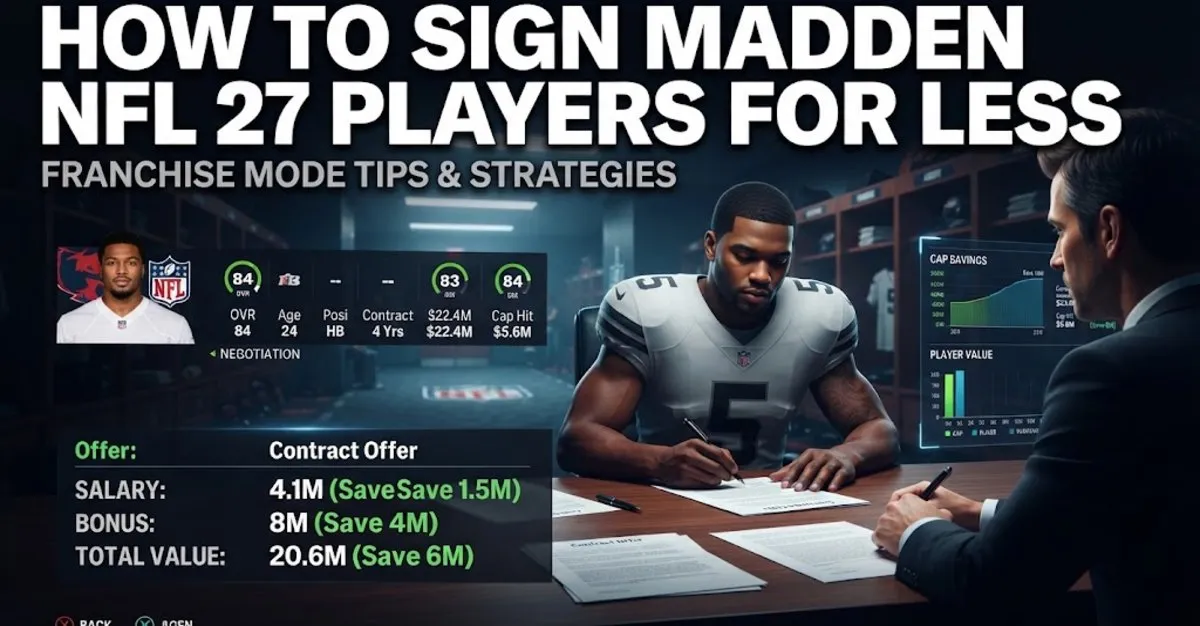
Building a strong roster in Madden NFL 27 is not only about finding talented players. Managing the salary cap can be just as important, especially when you're trying to keep several stars under contract at the same time. Whether you're saving your Madden 27 coins for other parts of your team or simply trying to build a better Franchise roster, getting players to accept less money can make a huge difference.
The key is understanding how contract negotiations work. Instead of immediately accepting the amount a player asks for, you can use the negotiation system to gradually lower the cost. The process takes patience, but when done correctly, it can save millions over the length of a contract.
Start With the Initial Contract Offer
Jaylen Carter provides a useful example of how this strategy works. In the example, his expected contract was around $27.9 million in total salary, with an average salary of roughly $17 million. Accepting that opening offer is the safest way to guarantee that you keep an important player, but it is not necessarily the best way to manage your salary cap.
Once you move beyond the initial offer, the negotiation mini-game gives you several choices. Many of those choices involve increasing salary, adding years, or offering a larger bonus. If your objective is to reduce the contract cost, you generally do not want to immediately give the player more money.
Instead, look for options that maintain or reduce the current deal. Choices such as selling the current deal or refusing to raise the salary can help you continue negotiations without unnecessarily increasing the contract.
Don't Be Afraid of Negative Feedback
One of the most interesting parts of the negotiation system is that a response that sounds negative does not necessarily hurt your chances of signing the player.
During the early stages of negotiations, the player's interest can actually rise even when you choose an option that reduces what they're asking for. This allows you to keep pushing the contract price downward.
The important thing is to avoid making the player too interested too quickly. Once the interest meter gets close to the signing point, you have fewer opportunities to continue negotiating. Your goal is to stretch the process across multiple weeks and use each negotiation window to find another way to reduce the contract.
Use Salary Reduction Opportunities
Some of the best options are the ones that directly reduce salary. For example, a no-trade clause can sometimes appear as a way to reduce the player's salary by 8%. In the example, this option could be selected more than once, even though the player already had a no-trade clause.
That means the same type of reduction could appear again during another negotiation window. If a hometown discount is available, that can be even better because the example shows a possible 10% reduction.
The important lesson is to pay attention to every option instead of automatically choosing the one that sounds most positive. A contract negotiation is about finding the choices that give you the best financial result while keeping the process alive.
Give Yourself Several Weeks
Patience is one of the biggest parts of this method. The player's patience can reset as you move into another week, giving you another opportunity to negotiate.
In the example, patience increased by about 50% each week. Rather than waiting several weeks unnecessarily, negotiating every week gives you more chances to find salary-reduction options.
This approach can turn a contract that initially looks extremely expensive into a much more manageable deal. It may feel strange to keep making offers that appear unfavorable to the player, but the negotiation system does not always react the way a real contract negotiation would.
Be Careful With the First Offer
There is an important difference between negotiating after the initial offer and making the initial offer too low.
If you reduce the initial contract offer too aggressively, the player can immediately reject the negotiation. In the example, lowering the offer too far resulted in only 2% interest and 10% patience, followed by a complete refusal to continue.
Once that happens, the player may decide to test the free-agent market instead. According to the example, recovering from this situation can be extremely difficult.
Because of that, the initial offer is the most dangerous part of the process. If a player is extremely important to your roster, accepting the original offer can be the safest choice. After that, you can start working on lowering the contract during future negotiations.
Use the 8% Rule
A useful way to approach the initial offer is to calculate a reduction of roughly 8% of the total salary. This is presented as a safer range than immediately trying to remove 10%.
For example, if the player's total salary expectation is $27.9 million, 8% is approximately $2.2 million. Rounding that to about $2.3 million gives you a reasonable reduction while avoiding the much greater risk of an immediate rejection.
The example suggests that 8% is the safer target, while 9% can be used when you're more comfortable taking a risk. Going all the way to 10% is described as more aggressive and better suited to players you are not worried about losing.
Keep Testing the Contract Floor
Once the player is successfully into the negotiation process, you can continue testing how low the deal can go.
In the example, an option to test the player's floor resulted in the interest meter dropping all the way to 0%. That might look like a disaster at first, but the player still returned the following week to continue negotiations.
This is an important distinction. The initial offer can cause the negotiation to end completely if it is too low, while later negotiation choices can push interest extremely low without necessarily ending the process.
That gives you more freedom to experiment once you've safely passed the first stage.
Add Years When the Trade-Off Makes Sense
Salary reduction is not the only useful option. Sometimes the best deal involves giving the player an additional year while lowering the average salary.
For a younger player such as Jaylen Carter, adding another year can make sense because you're securing the player for longer while simultaneously reducing the yearly cost. The example uses a choice that reduces salary by 5% while adding a year, creating a useful trade-off.
There are also moments when you may have to accept a less favorable option to keep negotiations alive. If the only available choices involve increasing a bonus or accepting a guaranteed year, walking away can mean losing the player altogether.
The Final Savings Can Be Huge
After several weeks of negotiations, the example contract for Jaylen Carter was reduced from an opening average salary of about $17.2 million to around $11.2 million. That represents savings of roughly $6 million per year compared with the original figure.
The comparison with Jordan Davis' real-life salary numbers in the example also highlights how significant the difference can become. By repeatedly using salary reductions, contract extensions, and other favorable negotiation options, you can create much more room under the salary cap.
The biggest takeaway is simple: don't rush through Franchise contract negotiations. Protect the player during the initial offer, then use each weekly negotiation to search for another opportunity to lower the cost. With the right approach, you can keep important players while preserving money for the rest of your roster.
Managing your roster this way can leave you with more flexibility for other moves throughout the season. If you're also looking for ways to stretch your overall Madden budget, keeping an eye out for cheap Mut 27 coins can give you another option for building your team efficiently.