

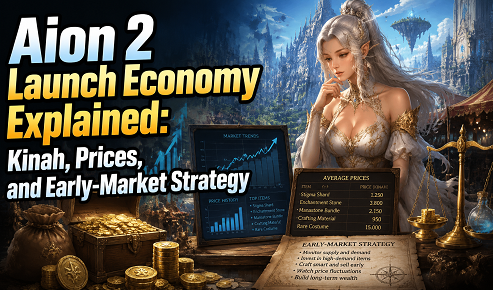
A new MMO economy rarely behaves normally during its first few weeks. Players begin with limited currency, incomplete knowledge, and almost identical needs. In Aion 2, Aion 2 Kinah will sit at the center of this process as players try to level their characters, improve equipment, craft useful goods, and prepare for more demanding content. When thousands of players want similar resources at the same time, prices can move dramatically before the market has enough information to establish stable values.
This does not necessarily mean the economy is badly designed. Instead, launch markets are discovering prices for the first time. A material that seems extremely valuable during the opening days may become common once more players unlock gathering or crafting systems. Likewise, an item that commands a premium because it saves several hours of progression may lose much of that premium several weeks later.
The psychology of a launch also matters. Players competing for early progression often value time more highly than currency. Spending heavily to obtain an upgrade immediately can make sense for someone racing toward endgame content, even if the same purchase would look inefficient a few weeks later.
Where Currency Enters and Leaves the Economy
The most important concept for understanding Kinah is the relationship between currency sources and currency sinks. Currency sources introduce money into the player economy, while sinks remove it.
Typical MMO sources include quests, hunting enemies, selling unwanted equipment, gathering, and other forms of regular gameplay. On the other side, players spend currency on progression, crafting, enhancement, consumables, marketplace fees, and other in-game services or systems.
The balance between these two sides determines whether players feel wealthy or constantly short on money. During launch, players can experience both conditions at once. A player with valuable materials may generate currency quickly, while another player focused on gear upgrades may spend almost everything they earn.
This creates an important distinction between earning power and purchasing power. A player does not necessarily become richer simply because they earn more Kinah. If important upgrades become more expensive at the same time, their real purchasing power may remain limited.

The First Month Can Be Divided Into Three Stages
The opening month is likely to develop through several recognizable stages, although exact prices and timing will depend on the actual live economy.
Days 1–7: Early Scarcity
During the first week, supply is limited because most players are still learning systems and progressing through early content. Basic materials, useful consumables, and progression-related resources can command unusually high prices. Players who gather efficiently may benefit from this temporary shortage.
At this stage, unnecessary spending can be particularly expensive. Buying an item simply because it is available immediately may mean paying a premium that disappears once supply improves.
Weeks 2–3: Supply Catches Up
More players begin specializing. Gathering becomes more efficient, crafting networks develop, and players gain a better understanding of which resources actually matter. As supply increases, prices for common goods can fall sharply.
This is also when early market participants begin separating themselves from casual players. Some will have accumulated resources, learned profitable production chains, or built relationships with regular buyers.
Week 4 and Beyond: Market Specialization
By the end of the first month, the economy should begin moving toward a more recognizable structure. Prices will still change, but players will have better information about production costs and demand.
Rather than selling everything they obtain, experienced players can begin specializing in particular materials, crafted goods, or market opportunities.
Gear Progression Creates Constant Demand
Equipment progression is usually one of the strongest economic forces in an MMO. Players want stronger gear, and improving that gear often requires repeated spending.
Enhancement materials, crafting components, consumables, and other progression resources can therefore maintain demand even after the initial launch excitement disappears. Competitive players may spend heavily because small improvements can affect their ability to participate in harder content.
This produces an early economic squeeze. Players want more upgrades at precisely the point when their income sources are still developing. A player who spends every Kinah on immediate progression may find themselves unable to afford an important crafting material or enhancement attempt later.
The practical lesson is simple: not every upgrade has the same urgency. Understanding which purchases directly improve progression and which can safely wait can make a significant difference during the volatile opening period.
Turning Playtime Into Currency
Every MMO eventually establishes an informal exchange rate between time and money. One player may be willing to spend several hours gathering resources, while another may prefer crafting, trading, or simply progressing through combat content and selling what they obtain.
Gathering is often attractive early because it requires relatively little preparation. Crafting can become more profitable after players invest in the necessary skills and materials. Trading requires a different kind of investment: market knowledge.
The best opportunity can therefore vary from player to player. Someone who understands supply chains may make more from trading than from direct farming, while a player with limited market knowledge may be better served by gathering and selling resources consistently.
The important point is that launch conditions reward flexibility. A method that works exceptionally well during week one may become much less attractive once thousands of additional players adopt it.
How the Economy Changes After Launch
The most extreme launch prices generally cannot last forever. As more players reach higher levels, acquire better gear, and participate in gathering and crafting, supply becomes more predictable.
The economy will still react to new content, balance changes, equipment updates, and changes in player demand. A new update can suddenly make an overlooked material valuable, while a progression adjustment can reduce demand for an entire category of goods.
Inflation is another long-term consideration. As more currency enters circulation, developers may introduce additional currency sinks to prevent excessive accumulation. The resulting economy can look very different from the one players experience during the first few days.
For ordinary players, this stabilization can make economic decisions easier. Instead of reacting to dramatic hourly price changes, players can establish reliable routines and focus on consistent income.
Understanding the Value of Patience
The biggest advantage during an MMO launch is not necessarily having the most currency. It is understanding why prices are moving.
Players who recognize temporary scarcity can sell resources while demand is high. Players who recognize temporary premiums can delay purchases until supply improves. Players who specialize early can establish useful positions before markets become crowded.
The same principle applies to Aion 2 Items. Before spending heavily, consider whether an item provides immediate progression value or whether it is mainly attractive because it is currently rare. Early scarcity can make ordinary resources appear much more important than they will become later.
As the market matures, Aion 2 Items will increasingly be valued according to their practical uses, production costs, availability, and long-term demand rather than launch excitement alone. Understanding that transition can help players make more informed economic decisions throughout the game's early life.