


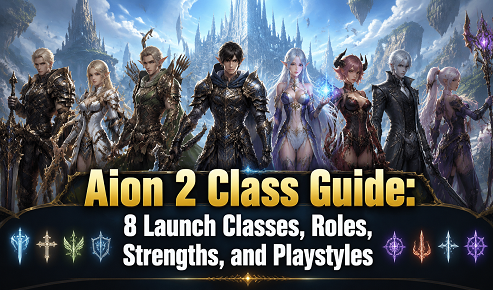
Aion 2 features eight playable classes at launch, with each class offering a distinct combat identity and gameplay experience. Whether you prefer fast burst damage, consistent ranged attacks, pet management, complex spell rotations, tanking, healing, or party support, there is a class suited to your preferred style. Progression also depends heavily on Aion 2 Kinah, which is used for various aspects of gearing, upgrades, and character development.
The balance between classes may change as the game receives future updates, so choosing a class only because it is considered powerful at a particular moment can be risky. Instead, players should consider the mechanics they enjoy and the role they want to perform. Some classes require precise positioning and timing, while others offer more consistent performance. This guide explains all eight launch classes, including their main strengths, weaknesses, PvE performance, PvP potential, and ideal playstyles.
Assassin: High Burst and Precise Timing
The Assassin specializes in short periods of extremely high damage. Instead of maintaining consistent DPS throughout an entire encounter, it focuses on preparing the right buffs and positioning before unleashing a powerful sequence of attacks.
One of its important mechanics is Elusive Clone, which can remove the cooldown of a key damage ability and create an opportunity for a devastating burst window. Proper timing is essential because the Assassin's damage can fall noticeably after its major buffs expire.
Positioning is another major part of the class. Several passive effects become more effective when attacking from behind, making it important to stay behind enemies whenever possible. High mobility helps the Assassin maintain this position, particularly against mobile targets.
In PvP, the Assassin can combine invisibility, crowd control, mobility, and burst damage to eliminate vulnerable opponents. It performs particularly well in smaller encounters where it can isolate a target. However, its lower durability makes large-scale battles more dangerous because it must enter melee range to deal damage.
The Assassin is an excellent choice for players who enjoy careful preparation, fast movement, precise positioning, and explosive damage windows.

Ranger: Consistent Ranged Damage
The Ranger is one of the most versatile classes available at launch. It offers reliable single-target and area damage while allowing players to fight from a distance.
Its ranged attacks provide consistent pressure, and its self-buffs can further improve offensive performance. Unlike the Assassin, however, the Ranger does not depend as heavily on short burst windows or strict positional requirements. This makes its gameplay relatively straightforward during difficult encounters.
Rangers are particularly comfortable in open-world content because they can attack enemies from a safe distance while maintaining strong damage output. Their performance remains competitive as characters progress into more challenging content.
PvP is another area where the Ranger performs well. Stuns, snares, knockbacks, and kiting abilities allow skilled players to control distance and prevent opponents from reaching them easily. These tools are useful in both small-scale fights and larger battles.
Players who want a dependable ranged damage dealer that can perform well across many types of content should consider the Ranger.
Spiritmaster: Pet Management and Sustained Damage
The Spiritmaster revolves around elemental spirits and the different effects they provide. Players can work with water, earth, wind, and fire spirits, along with an ancient spirit, giving the class a flexible collection of offensive and defensive options.
The main challenge is learning when to use each spirit. Different spirits can provide area damage, single-target pressure, healing, or taunting effects. Combining these abilities with the Spiritmaster's own skills creates a layered combat system.
The class is particularly effective during longer PvE encounters. When there is enough time to establish its full setup, the Spiritmaster can build strong sustained damage. Short fights can be less favorable because some of its potential requires preparation.
In PvP, the Earth Spirit's taunt can provide valuable control when used correctly. However, the Spiritmaster can struggle if an opponent attacks before the player has enough time to establish their setup.
This class is well suited to players who enjoy managing pets, adapting their abilities to different situations, and gradually building pressure throughout a fight.
Sorcerer: Complex and Interconnected Spell Rotations
The Sorcerer is the classic high-damage magical attacker. Fire abilities provide reliable damage, while frost abilities offer additional utility and burst potential.
The defining feature of the Sorcerer is the interaction between its spells. Certain abilities can reduce or reset other cooldowns, allowing players to create extended chains of spells. As a result, the class becomes increasingly rewarding as players learn how its abilities interact.
The early gameplay experience may feel less complete because the class benefits significantly from additional skill investment and progression. Once its toolkit is developed, however, the Sorcerer can produce powerful combinations.
In PvP, it can use slows, pulls, crowd control, polymorph effects, and burst damage to control engagements. Its main weakness is survivability. Poor positioning can result in the Sorcerer being eliminated quickly, so maintaining distance and choosing the right moment to attack are extremely important.
The Sorcerer is best suited to players who enjoy complex rotations, spell combinations, and mastering detailed combat mechanics.
Templar: Reliable Defensive Tank
The Templar is the traditional sword-and-shield tank. Its primary responsibilities include maintaining enemy attention, protecting teammates, controlling opponents, and surviving heavy incoming damage.
Durability is not its only strength. Well-timed blocks can provide additional benefits for the party, while defensive abilities can reduce pressure on teammates. The Templar can also deal respectable damage when built with a more offensive approach.
In PvE, its combination of durability and utility makes it particularly useful for difficult group encounters. It can protect vulnerable teammates while continuing to contribute to the group's overall performance.
In PvP, the Templar can focus heavily on survivability and crowd control, making it difficult for opponents to eliminate. Alternative builds can place greater emphasis on offensive pressure.
Players who enjoy protecting their teammates, controlling enemy attention, and remaining difficult to defeat will find the Templar a strong choice.
Gladiator: Aggressive Bruiser Tank
The Gladiator provides a different approach to tanking. Rather than relying primarily on defensive mitigation, it combines durability with strong offensive pressure and self-sustain.
Its great-sword attacks can deal substantial damage, while lifesteal mechanics allow the Gladiator to recover health during combat. This combination gives the class strong independence and makes it capable of remaining effective during extended encounters.
The Gladiator can also provide useful benefits to the group through defensive mechanics and additional lifesteal support. During progression content, a Templar may provide a more traditional defensive experience, while the Gladiator can become increasingly attractive when players are familiar with encounter mechanics and want to increase overall damage.
PvP is another strong area for the Gladiator. Its combination of damage, durability, crowd control, and self-sustain allows it to remain dangerous during prolonged fights.
The Gladiator is ideal for players who want a tank that can actively attack, recover health through combat, and contribute meaningful damage.
Cleric: Dedicated Healing and Group Survival
The Cleric is the primary dedicated healer among the eight launch classes. Its toolkit includes direct healing, healing-over-time effects, cleansing abilities, defensive cooldowns, and resurrection.
Effective Cleric gameplay requires more than repeatedly using healing abilities. Players need to anticipate incoming damage and select the appropriate response. Sometimes immediate healing is required, while other situations may call for cleansing, sustained recovery, or a defensive ability.
The Cleric can also contribute personal damage when teammates are healthy. However, its most important responsibility in difficult PvE content remains keeping the group alive.
PvP provides a different challenge. Limited crowd control can make solo encounters difficult, but the Cleric becomes extremely valuable in group battles. Strong healing and defensive abilities can allow teammates to survive situations that would otherwise end in defeat.
Players who enjoy supporting a group, reacting to incoming damage, and taking responsibility for team survival will likely enjoy the Cleric.
Chanter: Buffs, Healing, and Utility
The Chanter combines healing and shielding with powerful party support. Its most distinctive feature is its collection of mantras, which can improve party damage, movement speed, sustain, and overall combat efficiency.
This makes the Chanter particularly useful in normal dungeons, faster runs, and group content where improving the performance of every party member is valuable. It can also contribute respectable personal damage rather than functioning purely as a passive support class.
Compared with the Cleric, the Chanter is more focused on overall party utility. During extremely demanding progression content, its dedicated healing toolkit may not provide the same level of specialization as the Cleric. However, the two classes can work extremely well together.
In PvP, the Chanter provides useful healing, buffs, defensive utility, and sustain for group engagements.
The Chanter is a strong option for players who want to support teammates while still participating actively in combat.
Choosing the Right Class in Aion 2
The eight launch classes provide very different experiences, but players should not assume that every class is restricted to a single function. Tanks can contribute meaningful damage, healers can participate offensively, and support classes can influence battles through more than simple healing.
The Assassin is ideal for players who enjoy burst damage and precise positioning. The Ranger offers consistent ranged pressure and versatility. The Spiritmaster focuses on pet management and sustained damage, while the Sorcerer rewards players who master interconnected spell rotations.
The Templar and Gladiator offer two different approaches to tanking. The Templar emphasizes reliable defense and protection, while the Gladiator combines tanking with aggressive damage and self-sustain. The Cleric focuses on dedicated healing, whereas the Chanter emphasizes buffs, healing, and overall party utility.
As characters progress, Aion 2 Kinah becomes increasingly important for gear, consumables, upgrades, and other aspects of character development. Some players may also choose to buy Aion 2 Items when they want to speed up progression, explore different equipment setups, or spend less time on repetitive farming.
Ultimately, the best class is the one whose combat style you genuinely enjoy. Balance changes can alter the strength of individual abilities, but understanding your class's positioning, cooldowns, resources, defensive options, and combat mechanics will remain valuable. If you decide to buy Aion 2 Items, using that progression to experiment with different builds can also help you understand which setup fits your preferred playstyle.
Whether you prefer fast assassinations, ranged attacks, spirit management, powerful spell chains, durable tanking, aggressive bruising, dedicated healing, or party-wide support, Aion 2 gives you several distinct ways to approach the game. Choose the class that matches how you want to play, learn its mechanics thoroughly, and focus on mastering it rather than constantly chasing short-term changes in the meta.