Cart

Cart Empty

Continue Shopping
Total $0.00
Checkout
Home / Blog

MLB The Show 26 Missing Legends & Missing Current Players

Written by:  U4N
Published: Mar 19, 2026
479

In MLB The Show 26, several notable legends and current players appear to be missing from the initial launch roster or Diamond Dynasty.
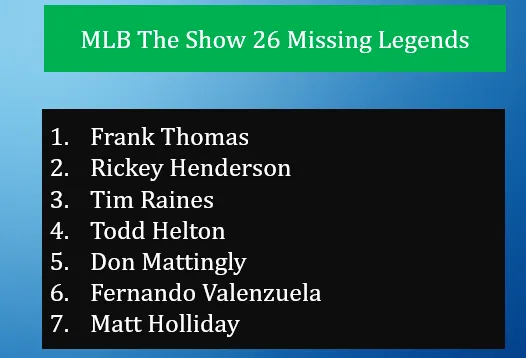
MLB The Show 26 Missing Legends

Missing Legends

A major topic of discussion among players is the removal of established legends, likely due to expired licensing agreements. The following legends are reported as missing in the 2026 edition:

  • Frank Thomas
  • Rickey Henderson
  • Tim Raines
  • Todd Helton
  • Don Mattingly
  • Fernando Valenzuela
  • Matt Holliday

Missing Current Players & Prospects

Some active players and highly-rated prospects are also reportedly absent from certain modes or the default roster:

  • Pete Alonso (Mets): Reported missing from "March to October" (MTO) mode rosters.
  • Alex Bregman (Red Sox/Astros): Reported as absent from the Red Sox roster in some modes.
  • Emmanuel Clase: Rumored to be out of the game's initial card pool.
  • Prospects: Players like Marcelo Mayer, Roman Anthony, and Miguel Bleis (Red Sox) have been noted as missing from various rosters or requiring manual updates.
  • International Newcomers: Players such as Ogasawara (Nationals) and Sugano (Orioles) may be missing until they officially appear in an MLB game to satisfy licensing requirements.

If you're looking to complete your roster and add some missing players like Pete Alonso or Alex Bregman, acquiring stubs might be the fastest way to get the cards you need. However, it’s important to use a MLB The Show 26 stubs safe website to ensure that your account remains secure. U4N is a trusted source where you can buy stubs without worrying about safety or delays, allowing you to focus on building your perfect team while keeping your personal information protected.

Reasons for Missing Players

  • Licensing Rights: San Diego Studio (SDS) must annually renew individual contracts with retired legends. If an agreement isn't reached, the player is removed from the game.
  • Roster Cut-offs: The "Live Roster" often has a cut-off date (usually mid-to-late February). Players who sign late or join from international leagues might not appear until the first major roster update.
  • Mode-Specific Bugs: Some players like Pete Alonso may technically be in the game but are missing from specific modes like "March to October" due to roster logic bugs.

For the most up-to-date roster, it is recommended to check the official MLB The Show News for weekly roster updates that often add missing players and prospects.

PREVIOUS Next

About the Author: U4N

U4N is a leading online marketplace offering secure, fast transactions for in-game items, currencies, accounts and boosting services. Covering a wide range of popular games, U4N provides players with reliable services, including fast delivery and verified sellers, ensuring a smooth and safe gaming experience.

Related Articles
MLB The Show 26 Reviews: A Comprehensive Technical and Critical Analysis
Written by:  U4N
336
The release of MLB The Show 26 arrives at a period of profound transition for the sports simulation genre, as developer San Diego Studio attempts to navigate the increasingly complex intersection of legacy hardware support, current-generation expectations, and the volatile economics of live-service card-collecting modes. For over two decades, the franchise has been regarded as the gold standard of licensed sports games, often praised for its consistent on-field excellence and a consumer-friendly approach to its Ultimate Team analogue, Diamond Dynasty. However, the 2026 iteration represents a moment of significant friction. While the core simulation engine remains a peerless recreation of baseball, the surrounding infrastructure—spanning visual fidelity, mode innovation, and marketplace ethics—has reached a tipping point that has polarized both professional critics and the dedicated community. The critical reception of MLB The Show 26 has been noticeably more muted than in previous years, culminating in a Metacritic score of 69—the lowest for the series on current-generation hardware. This dip in sentiment is not primarily attributed to the on-field gameplay, which remains addictive and highly polished, but rather to a perceived lack of foundational innovation and a controversial shift in the game's internal economy. As the industry moves deeper into the 2020s, the "iterative" model that has sustained the franchise for years is facing renewed scrutiny, particularly regarding the aging visual assets and the decision to implement a 20-card marketplace ownership limit that fundamentally alters the "No Money Spent" (NMS) viability of the title.