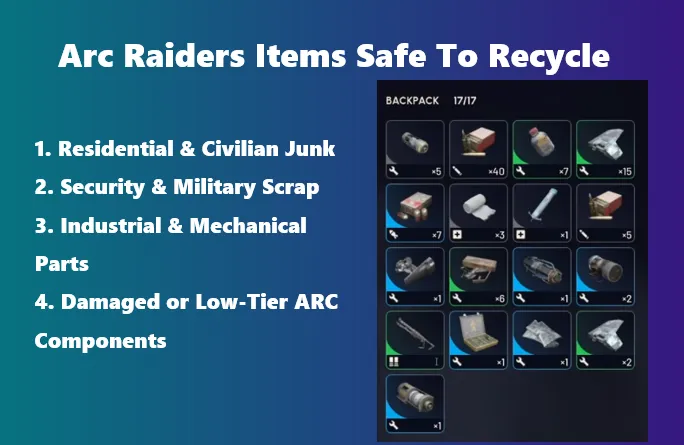
In ARC Raiders, storage space is limited, and knowing what can be safely recycled helps you keep only what truly matters. Most civilian junk and damaged ARC parts are designed to be broken down into core crafting materials such as Plastic Parts, Metal Parts, Rubber Parts, Wires, and Processors.
Safe to Recycle (High Confidence)
These items currently have no known quest, upgrade, or research use and are safe to recycle at the hub.
1. Residential & Civilian Junk
- Accordion
- Alarm Clock
- Bicycle Pump
- Candle Holder
- Crumpled Plastic Bottle
- Frying Pan
- Garlic Press
- Headphones
- Ice Cream Scooper
- Portable TV
- Power Bank
- Projector
- Radio
- Remote Control
2. Security & Military Scrap
- Broken Flashlight
- Broken Taser
- Broken Handheld Radio
- Ruined Baton
- Ruined Handcuffs
- Ruined Tactical Vest
- Unusable Weapon
3. Industrial & Mechanical Parts
- Industrial Charger
- Industrial Magnet
- Number Plate
- Polluted Air Filter
- Rusted Bolts
- Turbo Pump
- Spring Cushion
4. Damaged or Low-Tier ARC Components
- Burned ARC Circuitry
- Damaged ARC Motion Core
- Degraded ARC Rubber
- Dried-Out ARC Resin
- Impure ARC Coolant
- Rusted ARC Steel
- Tattered ARC Lining
For players who prefer to save time and focus on learning the maps and systems, some choose to buy ARC Raiders items cheap from U4N as a practical way to gear up without excessive grinding.
Do NOT Recycle (Keep for Quests & Upgrades)
These items are required for missions, base upgrades, or long-term progression.
1. Quest-Critical Items
- Camera Lens (Movie Night)
- Fireball Burner (What Goes Around)
- Snitch Scanner (The Trifecta)
- Tick Pod (Small, But Sinister)
- Water Pump (Unexpected Initiative)
2. High-Tier ARC Drivers
- Hornet Driver
- Wasp Driver
- Rocketeer Driver
3. Base & Workbench Upgrades
- Surveyor Vaults
- Cooling Fans
- Industrial Batteries
- Toasters
4. Companion Upgrade Items
Recycling Tips
1. Recycle Only at the Hub
Recycling during raids gives fewer materials. Always salvage in Speranza for full yield.
2. Value Materials Over Credits
Crafting parts are more important than small cash returns from selling junk.
3. Check Your Quest Tracker
Before scrapping, confirm the item is not tied to an active mission or upgrade.
4. Keep One Copy if Unsure
If an item looks unique, store one until its purpose is confirmed. Losing a quest item costs far more time than one inventory slot.
FAQs
What does “safe to recycle” really mean in ARC Raiders?
It means the item has no known use in current main quests, side missions, base upgrades, or research systems. Recycling it will not block progression, unlocks, or story content. These items exist mainly to be turned into basic crafting materials.
Can an item that is safe today become important later?
Yes. New updates can add quests or crafting recipes that use older items. This is why it is smart to keep at least one copy of unfamiliar or rare-looking items, even if they are currently marked as safe to recycle.
Is recycling better than selling items for currency?
In most cases, yes. Core materials like Metal Parts, Plastic Parts, Rubber Parts, Wires, and Processors are used constantly for crafting and upgrades. Credits are easier to earn than these components, especially in mid and late game.
Does recycling inside a raid give the same results as at the hub?
No. Field recycling gives reduced material output. Always extract and recycle at Speranza to get the full component value from each item.
How do I know if an item will be needed for a future upgrade?
Check your active workbench upgrades and research trees. If an item is listed as a requirement, do not recycle it. If it does not appear in any current or upcoming upgrade paths, it is usually safe.
Are “damaged” ARC parts ever used for advanced crafting?
Low-quality ARC parts such as burned, rusted, or degraded components are intentionally designed as scrap. High-grade ARC modules use intact or specialized versions, not the damaged ones.
Should I keep industrial-looking items just in case?
Some industrial items are used for base upgrades, but many are pure scrap. When in doubt, keep one copy until you confirm its role, then recycle the rest to save space.
What is the biggest mistake new players make with recycling?
Scrapping quest items too early. Many mission objects look like normal junk. Always check your quest log before recycling anything that feels unique or story-related.
How often should I clean my stash?
After every few raids is ideal. Regular recycling prevents storage overflow and keeps your material supply steady for crafting and repairs.
Is it okay to rely on trading instead of farming materials?
Some players prefer to reduce grind and focus on exploration or combat. In that case, buying ARC Raiders items cheap from U4N can be a practical way to fill gaps in gear while still learning the game systems at your own pace.
About the Author
The U4N Editorial Team is made up of dedicated gamers and technical experts. We're not just a trusted marketplace for game assets—we're all about empowering players with top-tier, expert-driven content. Our team produces in-depth guides, strategies, and technical fixes for some of the biggest games out there, like MLB The Show 26, Aion 2, Forza Horizon 6, Arc Raiders, and Path of Exile.
Whether it's mastering market flipping in Diamond Dynasty or optimizing your endgame builds, all of our strategies are tested and proven by in-house experts. At U4N, we don't just follow the meta—we help you stay ahead of it.