購物車空
繼續購物In MLB The Show 26, the trade system has undergone a major overhaul, introducing more realism and depth. Gone are the days of instant trades and easy exploits; the new system revolves around careful negotiations and managing multiple offers at once. With the introduction of the "Trade Hub," the entire process feels more immersive and strategic, requiring you to navigate a delayed system where offers can take several in-game days to respond to. To help you navigate this new system, here's a guide to mastering trades in your franchise mode.
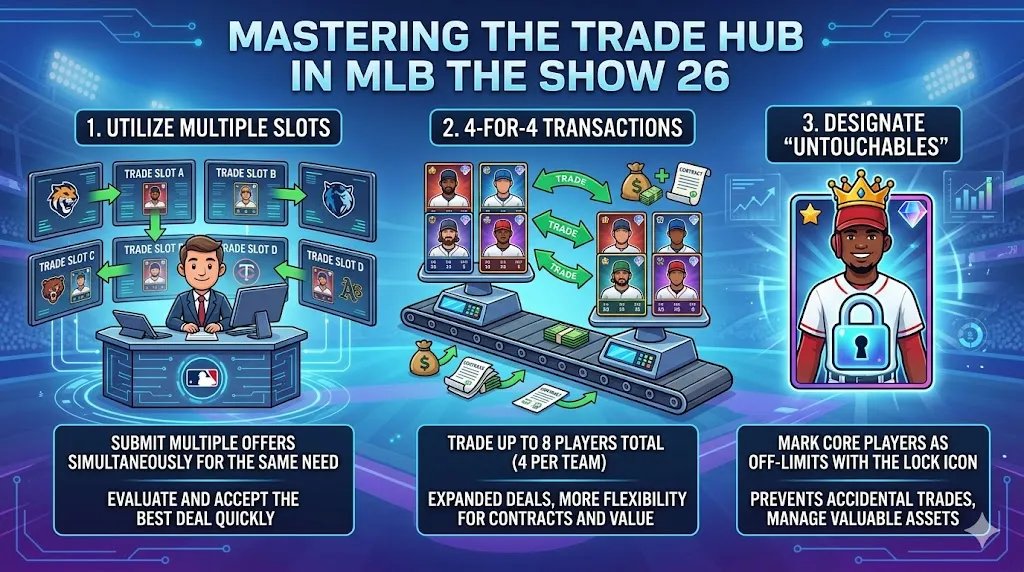
The Trade Hub is your central dashboard for all things related to trades, including roster moves, team rumors, and ongoing negotiations. It's where you'll spend most of your time when trying to reshape your team through trades.
One of the key features of the Trade Hub is that you now have four active trade slots. This means you can submit offers to different teams for the same player need at the same time. By doing this, you can quickly evaluate which team is most likely to bite first and what kind of return you're getting. This added flexibility is perfect for those who want to quickly make moves or are unsure which offer will get accepted.
The new trade system allows for expanded deals, where you can trade up to eight players total (four per team). This is a big change and gives you more flexibility to balance player value or even offload multiple contracts in a single trade. Whether you're trying to acquire a superstar or rebuild your roster, the extra slots open up many more possibilities to get creative with how you manage your trades.
A great new feature in MLB The Show 26 is the ability to mark certain players as "Untouchable." By clicking the lock icon on a player, you signal that they are off-limits for trade discussions. This helps prevent you from accidentally trading away your core players, and it's a good tool for managing your most valuable assets. Keep in mind that CPU teams also use this feature for their own core players, so don't expect to be able to trade for a team's superstar without offering a huge package in return.
Mastering the Trade Hub in MLB The Show 26 gives you more control and flexibility than ever before, allowing you to reshape your roster with ease. Utilizing multiple trade slots, expanding transactions to 4-for-4 deals, and marking players as "Untouchable" can significantly enhance your trade strategy. With these tools, you can carefully navigate offers and find the right balance between improving your team and managing assets.
If you’re looking to improve your team faster, having enough Stubs can make a big difference. For a 100% secure buy of MLB 26 Stubs, you can trust U4N for all your in-game purchases. Their reliable service ensures that you can focus on building your ultimate team without any worries.
In the past, trades in MLB The Show were a bit more straightforward. Now, however, the AI evaluates each deal based on "Market Sentiment" and the team's overall goals. This means you need to understand the team's current situation to make the best offer.
The AI now categorizes teams as either “Buyers” (contenders) or “Sellers” (rebuilders). Contenders are looking for MLB-ready veterans to help them win now, while rebuilders prioritize acquiring young prospects and players who can contribute in the long term. Understanding whether a team is in "win-now" mode or rebuilding will help you tailor your offer appropriately. If you're after a contender's star player, be ready to offer high-quality MLB talent or prospects.
Teams in small markets are often more desperate to shed large, long-term contracts, especially if they're struggling to compete. If your team has the budget, these "salary dumps" are a prime opportunity to acquire elite talent at a fraction of the usual prospect cost. By targeting these teams, you can bolster your roster without sacrificing your top farm system assets.
Another aspect the AI now considers is a player's secondary positions. For example, a player who can fill multiple roles on the field, like a utility infielder or a versatile outfielder, is much more valuable in trade negotiations than someone with a singular position. Having players who can play more than one spot gives you greater flexibility in filling roster holes and can make it easier to target different positions in a trade.
Trading within your division or with a direct competitor can come at a high cost. The AI is programmed to avoid helping direct competitors. If you're trying to trade with a division rival, be prepared to offer more than usual. Rival teams will demand a premium, so don't expect to get a good deal unless you're willing to overpay.
Now that you understand the basics, let's dive into some pro-level strategies that will give you the upper hand in the Trade Hub.
Check the Rumor Board frequently. While not every rumor is accurate, many times they give you hints on which players might be available for trade. Acting on these rumors early can give you an edge before another team swoops in and snags your target. If you're quick to act on rumors, you could get a deal done before other teams even know a player is on the market.
One of the most underrated strategies is to target relievers who have high stamina and a good pitch mix, such as Eric Lauer. If you convert these pitchers from relief to starting pitchers on the roster screen, their Overall (OVR) rating can rise significantly. This makes them more valuable assets, or in some cases, reliable starters who can be used in your rotation. Finding undervalued players like this and giving them a new role can pay off big time.
In the draft, focus on players who have a low current Overall but a high potential gap. These players are statistically more likely to reach their maximum potential than balanced players who already have high ratings. Targeting high-potential prospects allows you to build a farm system that can pay dividends in the long run, especially when you develop them into superstars.
U4N編輯團隊由一群熱愛遊戲的分析師和技術專家組成。我們不僅是一個可靠的遊戲資產市場——我們的核心目標是通過專業內容幫助玩家。我們的團隊為一些大熱門遊戲製作詳細的攻略、經濟策略和技術問題解決方案,包括《MLB The Show 26》、《Aion 2》、《Forza Horizon 6》、《Arc Raiders》和《Path of Exile》等。
無論是掌握遊戲市場的買賣技巧,還是幫助你打造最強的遊戲角色或策略,我們發布的每一份內容都經過我們團隊的實際測試。在 U4N,我們不僅跟隨遊戲的趨勢,我們還幫助你領先一步