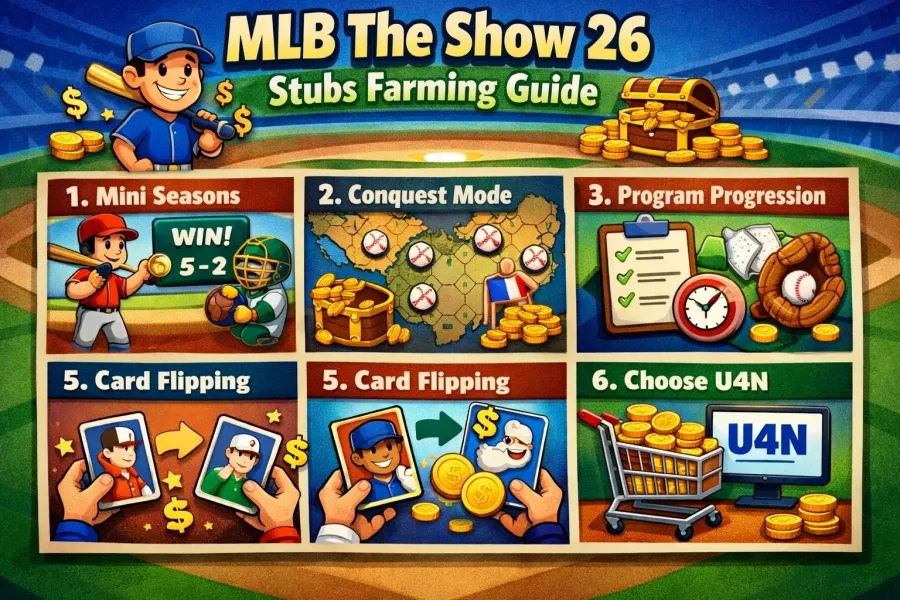
In MLB The Show 26, stubs are the in-game currency that allows you to buy packs, players, equipment, and other essential items to enhance your team. Efficiently farming stubs is key to progressing without having to spend real money. If you're looking to skip the grind and quickly boost your roster, you can also choose to buy MLB The Show 26 stubs from trusted platforms like U4N. This guide highlights seven of the best methods for earning stubs, catering to various playstyles. Whether you're a casual player or aiming for maximum efficiency, these strategies will help you grow your collection and team over time.
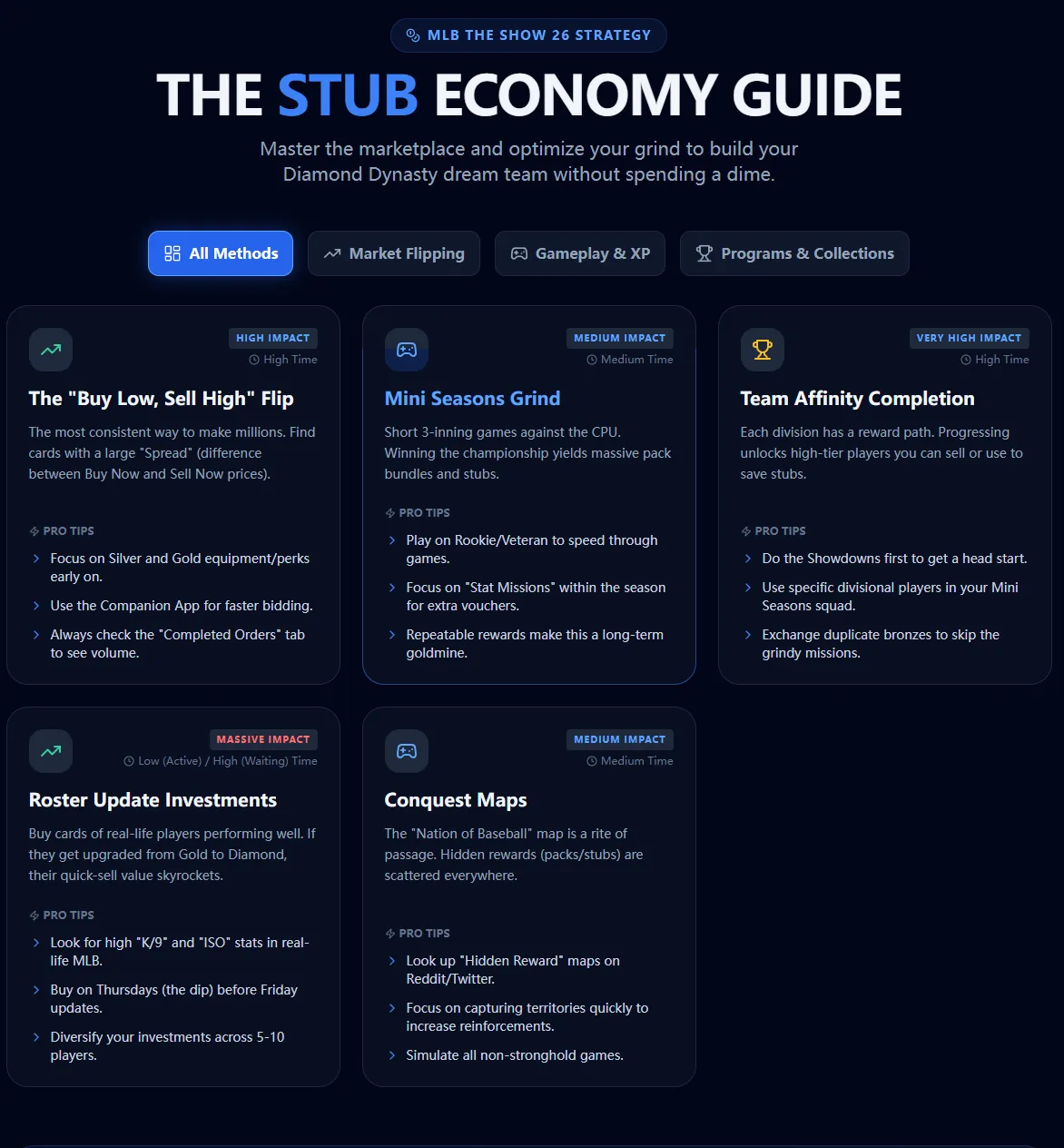
1. Marketplace Flipping Cards(Best overall)
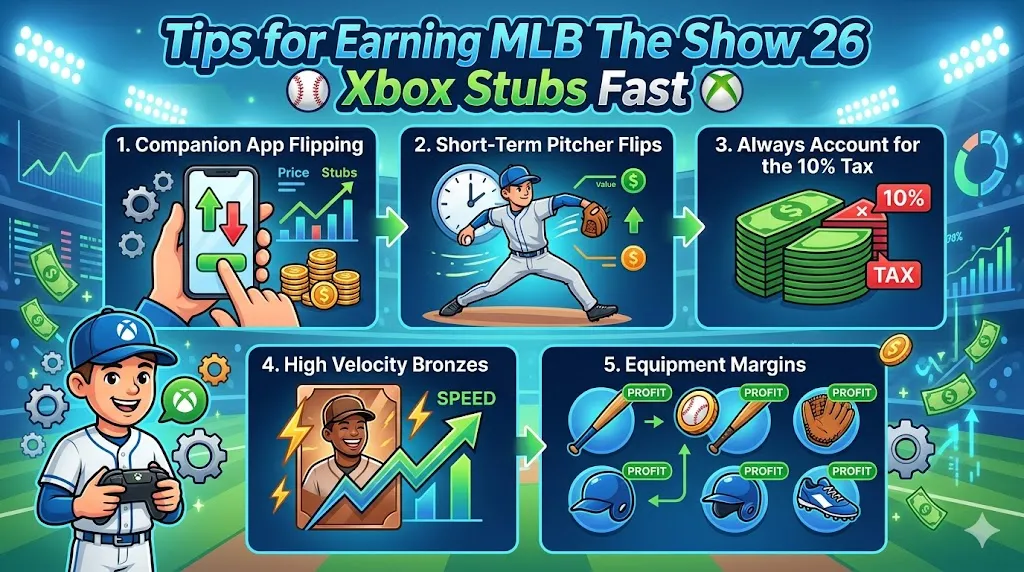
The "best" cards for flipping aren't necessarily the ones with the highest ratings, but the ones with the highest velocity (how often they are bought and sold) and a healthy profit margin (the "gap" between the Buy and Sell price).
1.1 The "Sweet Spot": 80–84 Overall Golds
Gold cards are the overall king of flipping because they have high volume and predictable margins.
Why: Players need them for daily exchanges and Team Affinity collections.
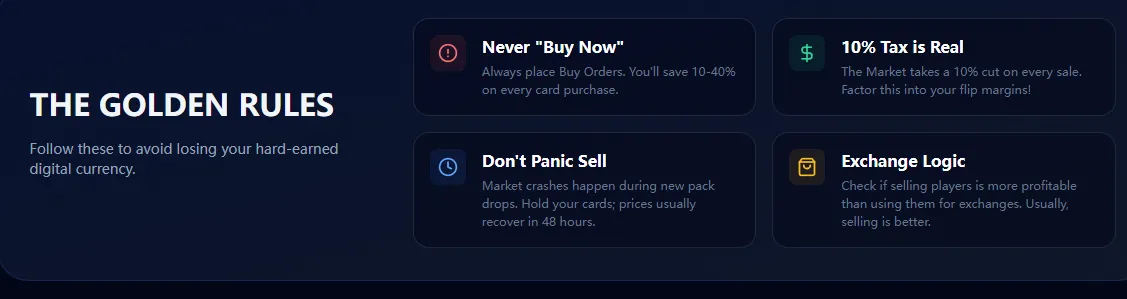
The Math: Look for a gap of at least 400–600 stubs. After the 10% tax, a 500-stub gap nets you a clean 350–400 stub profit per flip.
Strategy: Use the Companion App to place 20+ orders on different Gold players simultaneously
1.2 High-Volume Silvers (75–79 Overall)
If you have fewer stubs to start with, Silvers are your best bet.
Why: These cards move incredibly fast because they are cheap and required for massive exchange sets.
The Math: Look for a gap of 150–250 stubs. While the profit per card is lower, you can often flip 50 of these in the time it takes to flip one Diamond.
Strategy: Focus on popular teams (Yankees, Dodgers, Braves) as their cards usually have the highest demand.
1.3 Equipment and Perks (The "Hidden" Market)
Many players ignore the Equipment and Perks tabs, leading to much larger margins than player cards.
1.4 "Live Series" vs. Flashbacks
Live Series (Active Players): Best for consistent, fast flipping. Use these for your daily "bread and butter" income.
Flashbacks/Legends: Best for overnight flipping. These move slower but often have massive price swings. Place low Buy Orders before you go to sleep and Sell Orders when you wake up.
1.5 Summary
Card Tier
Ideal Gap
Best Tool
Strategy
Silver
200+ Stubs
Companion App
High Volume / Rapid Fire
Gold
500+ Stubs
Companion App
The "Reliable" Grind
Diamond Equipment
3,000+ Stubs
Console/App
High Margin / Patient
Pro Tip: Always check the "Completed Orders" tab in the Marketplace to see how frequently a card is actually selling before you sink your stubs into it.
2. Top Daily Methods
To maximize your stub count in MLB The Show 26, you should establish a daily routine that balances quick administrative tasks with repeatable gameplay.
2.1 The "Daily Essentials" Checklist
These tasks take less than 15 minutes and provide consistent, low-effort income:
Daily Exchanges: Use the Exchange menu to trade in low-rated duplicates (Bronze/Silver) for higher-tier packs. This clears inventory clutter while giving you a daily shot at high-value Gold or Diamond cards.
Moments Systematic Run: Complete newly released Daily Moments or program-specific scenarios. These are bite-sized (often just 1 at-bat) and reward instant stubs and program progress.
Market Order Maintenance: Use the Companion App to check your active buy/sell orders at least twice a day. Relist items that have been undercut to keep your liquid stubs moving.
Challenge of the Week: Participate in this weekly skill challenge (accessible via the main menu) to earn stubs based on your leaderboard ranking.
If you have 1–2 hours to play, focus on these high-yield, repeatable modes:
WBC Mini Seasons Loop: This is currently the most efficient repeatable grind. A full season (plus playoffs) is only 7 games. Reward: Championship wins guarantee 11 Show Packs and a Ballin' Is A Habit pack. Pro Tip: Play on Rookie difficulty and use a hitter-friendly custom stadium like "Homer Haven" to finish offensive missions faster.
Mission Stacking: Never play a game without a "mission-specific" lineup. Fill your team with players from specific Team Affinity (TA) divisions to earn extra stubs and packs through PXP (Parallel XP) goals while you play other modes.
Showdown Speed-Runs: The Starter and WBC Showdowns provide large chunks of XP and stubs. Unlike Conquest, these can often be completed in 20–30 minutes, offering a better "stubs-per-hour" ratio for skilled players.
2.3 Summary of Daily Farming Efficiency
Method
Estimated Stubs/Hour
Effort Level
Best For
Marketplace Flipping
5,000+
Medium
Daily active players
Mini Seasons
1,500 - 3,000
Low-Medium
Mission stacking
Conquest Maps
2,000 - 4,000
Low
Casual grinders
Moments & Events
500 - 1,500
Low
Completionists
If you don’t want to spend time farming stubs and are wondering “Is buying MLB 26 Stubs safe?”, U4N is a reliable option to consider.
3. Core Roster Update Strategy
Investing in Roster Updates is the most reliable way to multiply your stubs in MLB The Show 26. This strategy relies on "Quick Sell Arbitrage," where you buy cards at their current tier's floor and profit when their rating increases to a higher tier with a better Quick Sell value.
3.1 The Core Update Schedule
Frequency: Roster updates typically occur every two weeks (usually on Fridays).
Update Focus: Most bi-weekly updates handle transactions and position changes, but major attribute changes often happen every 3–4 weeks based on real-world performance over that window.
The "Hype" Window: Buy your investments 2–3 days before the update. Waiting until the day of the update usually means prices have already spiked, erasing your profit margin.
3.2 Quick Sell Arbitrage Tiers
The goal is to buy a player for less than the Quick Sell value of the next tier. If they are upgraded, you can instantly "Quick Sell" them for a guaranteed profit, bypassing the 10% marketplace tax.
Current Tier (OVR)
Current QS Value
Next Tier (Target)
Target QS Value
Silver (75-79)
50 - 150
Gold (80)
400
Gold (84)
1,500
Diamond (85)
3,000
Diamond (89)
7,000
Diamond (90)
8,000
Values based on established Live Series trends.
3.3 How to Identify "Good Buys"
Don't just look at batting average; look at specific attributes that have "room" to grow.
The "Room to Grow" Rule: If a player has Common (low) hitting stats but is currently on a hitting streak, they are a better investment than a player who already has Diamond (90+) hitting stats.
Performance Tracking: Follow real-life MLB box scores and advanced metrics. Tools like the ShowZone Roster Update Predictor use performance data to flag potential upgrades.
Low Risk, High Volume: The safest strategy is buying dozens of a card at its current Quick Sell floor. Even if they don't get upgraded, you can Quick Sell them back to break even without losing stubs.
3.4 Advanced "Flash Sale" Reinvestment
During short Flash Sale windows (often 1 hour), the market crashes as players undercut each other to sell rare cards.
The Strategy: Keep a reserve of stubs. Buy high-tier Live Series cards or Flash Sale specific cards during the dip.
The Turnaround: Hold these cards for 24–72 hours. Prices almost always stabilize back to their pre-sale levels, allowing for "fat profits".
4. Top Mini Seasons Strategies
In MLB The Show 26, Mini Seasons is widely considered the most efficient offline mode for farming stubs and packs due to its condensed format and repeatable rewards.
4.1 Prioritize the World Baseball Classic (WBC) Mini Season
Currently the top method for fast turnaround, this mode is shorter than a standard season.
Speed: Only requires 7 games total (4 pool play and 3 playoff games).
Championship Rewards: Winning the title guarantees 11 Show Packs and 1 Ballin' Is A Habit pack.
Repeatability: You can restart the season immediately after winning to farm these packs again.
4.2 The "Homer Haven" Custom Stadium Trick
To speed up offensive missions, play your home games in a hitter-friendly environment.
Custom Stadiums: Search the Stadium Creator for the username GomesDaLegend to download "Homer Haven".
Why it works: It features extremely short fences (approx. 270 ft), making it easy to hit 10+ home runs a game and clear mission goals rapidly.
4.3 Mission Stacking & Efficiency
Maximize every inning by addressing multiple objectives at once.
Lineup Construction: Build your team using players who fit specific mission criteria (e.g., specific divisions for Team Affinity or specific card tiers like Silver pitchers).
Difficulty: Play on Rookie difficulty. There is rarely an economic benefit to playing higher difficulties for standard farming; Rookie allows you to end games quickly and rack up stats for missions like "40 hits" or "10 home runs".
Goal Tracking: Regularly check the Goals tab. Look for repeatable missions like "10 home runs for 3 packs" that can be completed multiple times within a single season.
4.4 Strategic Restarts
You do not always have to finish a 28-game "Classic" season to be profitable.
Early Exit: If you have completed all the high-value repeatable missions (like total bases or strikeouts) but are nowhere near the playoffs, it is often more efficient to Restart Season and refresh those missions rather than grinding out low-value
4.5 Championship Vouchers
Winning championships earns you vouchers that can be exchanged in the Diamond Dynasty menu for additional Stubs and XP. This provides a massive boost to your overall progress while you are simultaneously earning pack rewards.
5. Best Conquest Maps
In MLB The Show 26, Conquest maps serve as a passive "reward engine." You can earn thousands of stubs and dozens of packs by uncovering hidden rewards without playing a single inning, or by completing specific map goals.
5.1 High-Yield Conquest Maps
USA West, Central, and East: These maps are currently the most efficient for building a roster. USA West provides 12 Show Packs and a 10-pack bundle for capturing all strongholds. Completing all territories on these maps rewards a Spring Breakout Choice Pack, which is repeatable for continuous farming.
Nation of Baseball: A massive map of the entire USA. While time-consuming, it is a staple for earning a large 20-pack bundle upon completion.
"3 is the Magic Number": A specialized, small-grid map designed for rapid completion. It is often the only map where the completion reward (usually 5 Show Packs) is repeatable, making it a favorite for quick stub farming.
WBC Conquest: Capturing its strongholds rewards WBC Gold Player Packs and high-value World Baseball Classic cards that can be sold or collected.
5.2 Hidden Reward Strategy
Every new map contains "Hidden Rewards" tucked under specific territories.
Simulate, Don't Play: You do not need to play games to find hidden rewards. Simply "Attack" and "Simulate" territories to uncover packs and stubs.
Standard Hidden Loot: Most maps hide at least one Ballin' Is A Habit pack and multiple Standard Show Packs.
Shark & Shamrock Maps: When these seasonal maps drop, prioritize them immediately. They are legendary for having hidden rewards in nearly every third or fourth territory.
5.3 Conquest Efficiency Tips
Target Strongholds Directly: Instead of capturing every territory, create a single, dominant "attack path" directly to the enemy stronghold to save time.
Stack Reinforcements: Numerical advantage is key. Mass your fans in one territory to attack on Rookie difficulty, which ensures faster games and easier mission progress.
Lineup Stacking: Always use players from a specific Team Affinity division or program while playing Conquest games to earn extra stubs and progress rewards simultaneously.
Map Name
Primary Reward
Repeatable?
Best Strategy
USA West
10-Pack Bundle + Spring Breakout Pack
Yes (Map Completion)
Capture all territories
3 is the Magic Number
5 Show Packs
Yes
Quick completion for packs
WBC Map
WBC Gold Player Packs
Yes
Target WBC specific goals
Draft Conquest
~15,000 Flat Stub Reward
No
Reliable "floor" for earnings
6. Program Progression
In MLB The Show 26, Program Progression is your primary source of "passive" stubs. You earn rewards simply by playing the game, but the key to farming is stacking missions to complete multiple programs simultaneously.
6.1 Main XP Reward Path (The "Wheel")
This is the background program that tracks all XP earned across any mode.
Stub Milestones: Look for specific levels that grant 5,000 to 10,000 stubs instantly.
The Reward Wheel: Once you complete the main path, every additional 25,000 XP grants a spin on the wheel. This is a repeatable way to pull Diamond Duos packs or large stub bundles.
Double XP Weekends: Save your high-XP tasks (like finishing a Conquest map or a Mini Season) for these events to reach the wheel faster.
6.2 Team Affinity (TA) Efficiency
Team Affinity is the most lucrative program for "No Money Spent" players.
Sellable Rewards: While many TA cards are "No Sell," the vouchers and packs earned along the way contain sellable items.
The "March to October" Shortcut: Completing a season in this mode provides a massive burst of TA progress for your chosen team, often clearing 50-70% of a program in one go.
Stat Mission Stacking: Always fill your roster with players from the division you are working on (e.g., all AL West players). This allows you to earn progress for gameplay missions while playing unrelated modes like Conquest.
6.3 Other High-Value Programs
Other Programs (Spotlight/Theme): These are usually time-limited. Prioritize them because they often offer exclusive packs (like Draft or All-Star packs) that sell for a premium on the marketplace shortly after release.
Evolution Programs: These require you to "evolve" a Rookie card into a Diamond. Completing these usually rewards a significant amount of stubs and a high-tier card that can be used for larger collections.
6.4 Collection Bonuses
Programs often feed into "Collections."
Don't "Lock In" Early: Avoid "collecting" cards into a program unless you are certain you want the final reward. Once locked, they cannot be sold.
Tier Bonuses: Collecting a certain number of cards (e.g., 20 Live Series Red Sox) often triggers a "Stub Bonus" of 1,000–5,000 stubs. This is a great way to "cash out" on cheap Silver/Bronze cards you've accumulated.
6.5 Program Specific Vouchers
Winning Mini Seasons or Showdowns often rewards Program Vouchers.
Strategic Turn-In: Hold onto your vouchers until a new "Inning" or "Chapter" of a program drops. Turning them in on day one allows you to unlock and sell the new high-value rewards before their market price drops .
7. Core Flash Sale Strategies
Flash Sales are "market crashes in a bottle." For 1–3 hours, the developers release limited-quantity, high-value packs (like Diamond Duos or Chase Packs) every hour. This causes a massive influx of rare cards and a temporary price collapse.
7.1 The "10-Minute" Rule
The market is most volatile in the first 10 minutes after a new Flash Sale pack is released.
Panic Selling: Thousands of players open packs and immediately list their pulls at the lowest "Sell Now" price to get quick stubs.
Your Move: Do not sell during this window. Instead, have your stubs ready to buy cards that are being "fire-sold" at 30–50% below their usual value.
7.2 Targeted Buying (The Rebound)
Focus on cards that have high utility, as they rebound the fastest.
Live Series Diamonds: High-tier Diamonds (88+ OVR) often dip significantly during Flash Sales. These are "safe" buys because they are required for the Live Series Collection (like Derek Jeter or Mickey Mantle rewards) and will always return to their "floor" price.
Rare Round Choice Cards: If a Flash Sale features a "Choice Pack," the "Rare Round" cards (the highest-rated ones) will see a steep price drop. Buy these and hold them.
7.3 The "24-72 Hour" Hold
The key to Flash Sale profit is patience.
Stabilization: Prices almost never stay at Flash Sale lows. Most cards recover about 80–90% of their pre-sale value within 48 to 72 hours.
Exit Strategy: Once the market stabilizes, list your purchased cards for a standard "Sell Order." Aim for a 20–30% profit margin after the 10% tax.
7.4 Preparation Checklist
Liquidate Early: If you suspect a Flash Sale is coming (usually announced on social media or in the game's "Schedule" tab), sell your high-value inventory 24 hours before the sale to maximize your liquid stubs.
The Companion App: Use the app to monitor price drops while the sale is live. It's much faster to scroll through "Recently Sold" data to find the absolute bottom of a price dip.
Don't Buy the Packs: Mathematically, you are almost always better off using your stubs to buy the guaranteed cards others are pulling from the packs rather than gambling on the packs yourself.
7.5 Example Profit Loop
Friday 12:00 PM: Flash Sale starts; "Rare Pack" released.
Friday 12:15 PM: You buy a 95 OVR player for 45,000 stubs (usually costs 75,000).
Sunday 6:00 PM: Price recovers to 72,000 stubs.
Result: You sell for 72k. After 10% tax (7.2k), you keep 64,800. Total profit: 19,800 stubs on one card.
8. Earning Stubs in Diamond Quest
In MLB The Show 26, Diamond Quest is a board-game style mode that functions as a high-stakes reward engine. It's particularly lucrative because it bridges the gap between casual play and high-tier card hunting.
8.1 High-Value Reward Targets
Diamond Quest is the primary home for specific "Legend" cards.
The Big Three: Aim for Bob Feller, Stan Musial, and Alfonso Soriano. These cards consistently hold high market value (often 100k+ stubs early in the cycle) because they are required for major program collections.
Sellable Assets: Unlike some program rewards, the top-tier players pulled from Diamond Quest packs are usually sellable, making them a massive source of liquid stubs.
8.2 Difficulty Scaling (The "Legend" Bonus)
The difficulty you choose directly impacts your "Reward Tier" odds.
Legend Difficulty: Playing on Legend provides the highest probability of landing a Diamond player or a "Rare" choice pack.
Efficiency Hack: If you struggle with Legend, play on All-Star. It offers a balanced "stubs-per-hour" ratio, giving you decent odds without the high risk of losing and resetting your progress.
8.3 Strategy for Board Navigation
Node Prioritization: Focus on "Mystery" or "Pack" nodes rather than standard "Stub" nodes. The potential value of a Diamond Duos or Headliners pack far outweighs the 250–500 flat stubs found on basic tiles.
Avoid "Hazard" Tiles: These can reset your progress or strip your current rewards. Use "Shield" perks (if available in your run) to protect your accumulated earnings before reaching the final "Boss" node.
8.4 Combining with Team Affinity
PXP Stacking: Diamond Quest games count toward Parallel XP (PXP) missions.
The Strategy: Fill your Diamond Quest lineup with players from a specific Team Affinity division. By the time you reach the end of a board, you will likely have cleared several 500-PXP missions, netting you extra TA packs and stubs on top of your board rewards.
8.5 Repeatability
The Reset Loop: Once you clear a board and claim the final reward, you can restart immediately.
The Grind: Expert players can clear a full board in roughly 2–3 hours. If you land just one high-tier Diamond, your hourly "stub rate" can exceed 20,000–30,000 stubs, far surpassing standard Conquest or Mini Seasons.
9. XP Reward Path
In MLB The Show 26, the XP Reward Path is the backbone of your stub income. It rewards you for literally everything you do in the game—from a simple strikeout to winning a World Series.
9.1 The "Wheel of Fortune" (Infinite Rewards)
Once you complete the main program path, you enter the Infinite Tier.
The Loop: Every 25,000 XP earned after the "cap" grants you a spin on the reward wheel.
The Payout: This is the most consistent way to pull Diamond Duos packs, 10,000+ Stubs, or rare Chase Packs late in the season.
Pro Tip: Don't stop playing just because you finished the "main" program. The real stub farming happens on the wheel.
9.2 High-Value Stub Milestones
The path is peppered with guaranteed "Stub Drops."
Early Path: Focus on the first 100,000 XP, which usually contains several 2,500–5,000 Stub milestones to help you start flipping on the market.
End-of-Path Bosses: The "Boss" players at the end of the path are often the most expensive cards in the game for the first 48 hours. Sell them immediately if you reach them early; you can usually buy them back for 50% less two weeks later.
9.3 XP Stacking Strategies
To move through the path faster and reach those stubs, you must maximize your "XP per hour":
Double XP Weekends: These are "farming holidays." Save your high-yield tasks—like finishing a Conquest Map or a Mini Season Championship—for these windows to double your progression.
Gameplay XP Cap: There is a daily cap on XP earned specifically from gameplay (usually around 15,000–30,000 XP). However, Program Missions (like Team Affinity or "Other Programs") do not count toward this cap.
The "Double Dip": Always play with a lineup that finishes "Stat Missions" (e.g., 500 PXP with a specific player). These missions grant "Bonus XP" that bypasses the daily cap and pushes you toward the next stub milestone faster.
9.4 Mode-Specific XP Yields
Road to the Show (RTTS): Great for consistent, mind-off XP. Focus on "Archetype Programs" within RTTS to earn massive XP chunks (and Diamond Equipment you can sell for stubs).
March to October: Offers the single largest "lump sum" of XP. Completing a full season on All-Star or Hall of Fame difficulty can jump you 5–10 levels on the reward path instantly.
9.5 Summary: XP to Stubs Conversion
Feature
Best For
Stub Potential
Milestones
Guaranteed Income
High (Fixed amounts)
Reward Wheel
Repeatable Farming
Very High (Packs/Stubs)
Boss Cards
Early Market Sells
Massive (100k+ early on)
Collections
One-time Bonuses
Medium (Tiered rewards)
10. Cleaning out your inventory
Cleaning out your inventory is the fastest way to find "hidden" Stubs in MLB The Show 26. Over time, you accumulate hundreds of silver, bronze, and common items that have a guaranteed cash value.
The most efficient way to liquidate your inventory is through the Quick-Sell feature. Each card tier has a "floor" price that you can collect instantly:
Diamond (85-89 OVR): 3,000 Stubs
Gold (80-84 OVR): 400 - 600 Stubs
Silver (75-79 OVR): 100 - 150 Stubs
Bronze/Common: 5 - 25 Stubs
Pro Tip: Go to your My Inventory screen and look for the "Quick Sell Duplicates" button. This allows you to sell off every extra card you own (keeping one for your collection) in a single click, often netting 20,000 to 50,000+ Stubs if you haven't done it in a while.
High-Value Inventory Categories
Don't just look at players; these categories often hold massive value:
Equipment: Gold and Diamond bats, gloves, and cleats are highly sought after for Road to the Show. Some Diamond equipment can sell for 5,000 to 15,000 Stubs on the marketplace.
Stadiums: Silver and Gold stadiums often sell for more than their quick-sell value on the Community Market because players need them for collections.
Unlockables: Icons, Nameplates, and Home Run Calls are frequently earned in Programs. While they seem minor, selling a bulk of these can easily add several thousand stubs to your balance.
Sponsorships: These are primarily used in Franchise mode. If you only play Diamond Dynasty, sell these immediately.
Keep in mind that MLB The Show 26 has a new 20-card limit for duplicates of a single item in your inventory. If you hit this cap, you won't be able to earn more of that card from packs until you sell or exchange your current stock. Regularly clearing your inventory ensures you never "waste" rewards from packs.
Marketplace vs. Quick-Sell
Quick-Sell is best for Bronze and Common items where the market profit is negligible.
Marketplace Selling is better for Silver, Gold, and Diamond items. Always check the "Sell Order" price first; if it’s significantly higher than the Quick-Sell value, list it on the market to maximize your return.
11. The Companion App
The MLB The Show Companion App is an essential tool for "no-money-spent" players in MLB 26, specifically designed to accelerate stub accumulation through marketplace efficiency. It is available for download on iOS and Android.
High-Speed Marketplace Flipping: The app allows you to place buy and sell orders much faster than the in-game menus, sometimes reaching nearly one order per second.
Remote Order Management: You can monitor your active orders throughout the day, relisting cards that have been undercut or finalizing sales while away from your console.
Push Notifications: Enable notifications to receive instant alerts when your buy orders are fulfilled or when a sell order completes, allowing for immediate reinvestment of stubs.
Inventory & Collection Management: You can add items to Collections and perform Exchanges (such as Silver-to-Gold) directly from your phone to unlock pack rewards and stubs.
Strategic Tips for the App
Target High Volume, Not High Tier: While Diamonds have large spreads, they sell slowly. Use the app to flip Silver and Gold cards, which move rapidly and provide consistent, compounding profit.
The "1-Stub" Rule: To stay at the front of the queue, place Buy Orders for 1 stub more than the highest current bid and Sell Orders for 1 stub less than the lowest current listing.
Account for the 10% Tax: Always ensure the "spread" between your buy and sell price is large enough to cover the mandatory 10% marketplace tax.
Equipment & Perks: These categories are often less monitored than player cards, leading to wider profit margins for attentive flippers using the app's filter tools.
12. Invest in Event Rewards
Investing in Event Rewards in MLB The Show 26 is a "long-game" strategy that relies on the limited availability of these cards. Unlike standard packs, Event cards are often not re-released for several months, causing their value to skyrocket during major collection drops.
12.1 The "Sell Now, Buy Back" Strategy
Early in an Event, the supply of the top reward is low and demand is high among competitive players.
Action: If you earn an Event reward in the first 48 hours, sell it immediately at its peak price.
The Rebound: As the Event progresses and more players earn the card, the price will drop. You can often buy the card back for 30–50% less a week later to keep for your collection.
12.2 Holding for "Big Collections"
Event cards are high-value targets for long-term investors because they are required for "Legends & Flashbacks" collections (like the annual Jeter or Mantle-style rewards).
Scarcity: Once an Event ends, the card becomes unobtainable except through the Community Market.
Investment Goal: Hold these cards until the first major "99 OVR Collection" is announced. History shows that early-season Event rewards can double or triple in value as players scramble to finish collections.
12.3 Rewind Pack Arbitrage
San Diego Studio frequently includes "Rewind Packs" in later Events, allowing players to choose rewards from previous Events.
The Trap: When a Rewind Pack is announced, the value of old Event rewards will crash as supply suddenly increases.
The Play: Sell your "investment" Event cards before the new Event begins if you suspect a Rewind Pack is coming. You can then use the Companion App to buy them back at their new, lower "floor" price.
12.4 Competitive Tiering
For highly skilled players, reaching the 12-win or 20-win milestones in an Event provides the most valuable sellable assets.
Soft Competition: Participate in Events during the first 3 days. The "skill pool" is generally softer as casual players try the new content, making it easier to secure high-tier rewards before the pros dominate the leaderboard.
12.5 Summary of Investment Outlook
Event Phase
Recommended Action
Risk Level
Launch Day
Sell immediately for max profit
Low
Mid-Event
Buy if price is near "floor"
Medium
Post-Event
Hold for 4–8 weeks for collections
High
Rewind Drop
Sell 24h before new Event starts
Low
13. Grind on Lower Difficulty (Efficiency Method)
In MLB The Show 26, playing on Rookie or Veteran difficulty isn't just about making the game easier—it's the mathematically superior way to farm stubs per hour. High-difficulty play is for testing skill; low-difficulty play is for "the grind."
13.1 The "Mercy Rule" Efficiency
The faster you finish a game, the sooner you get your post-game rewards and move to the next mission.
The Strategy: On Rookie, you can consistently score 10+ runs in the first inning of a Mini Season or Conquest game.
The Benefit: Once you have a massive lead, you can simply "bunt out" or swing at everything to end the game quickly while still securing the win and all stat-based mission progress.
13.2 Maximizing Statistical Missions
Stubs are tied to "Stat Missions" (e.g., 20 Home Runs, 50 Strikeouts).
Plate Appearance Value: On Rookie, your PCI (Plate Coverage Indicator) is massive. This allows you to turn every at-bat into a Home Run or Extra Base Hit, completing "Total Base" missions in a fraction of the time it would take on All-Star .
Pitching Efficiency: CPU hitters on Rookie swing at almost anything near the zone. You can rack up 9+ strikeouts in a 3-inning game with minimal effort, quickly clearing Team Affinity pitching goals .
13.3 Parallel XP (PXP) Optimization
Every card has "Parallel" levels that grant stub bonuses and attribute boosts.
Performance Multipliers: While higher difficulties give a small PXP multiplier (e.g., 1.2x for All-Star), the sheer volume of stats you accumulate on Rookie (15 hits vs. 4 hits) far outweighs the multiplier.
The Goal: Getting a player to Parallel V provides a sense of "prestige" and often unlocks collection rewards that net thousands of stubs .
13.4 Custom Stadium Synergies
Combine lower difficulty with "Max Elevation" custom stadiums (like Homer Haven).
The Result: Routine fly balls become home runs. On Rookie difficulty in a tiny stadium, you can realistically hit 15–20 home runs per game, which is the fastest way to trigger "Repeatable Mission" pack rewards in Mini Seasons .
13.5 Lower Stress, Higher Consistency
Farming requires hours of repetition.
Consistency: Losing a game on Hall of Fame difficulty earns you almost zero progress toward many program rewards.
Guaranteed Returns: Playing on Rookie ensures a 100% win rate, meaning you never "waste" 15–20 minutes of your life on a game that doesn't pay out stubs or packs.
Difficulty
Hit/K Volume
Risk of Loss
Best For
Rookie
Extremely High
Near Zero
Stat Grinding & Mini Seasons
Veteran
High
Very Low
Conquest & Team Affinity
All-Star
Moderate
Low
Diamond Quest & Showdown
13.6 Summary of the 20 Methods for MLB The Show 26 Stubs
Authored by elite gamers and industry insiders, the U4N Editorial Team delivers authoritative game updates, patch notes breakdowns, and expert strategies for trending titles including World of Warcraft, Path of Exile 2, MapleStory, Aion 2, and Arc Raiders.
From deep-dive guides to the latest meta shifts, our in-house veterans test every tactic firsthand to keep you ahead of the game.