Cart Empty
Continue ShoppingThe release of MLB The Show 26 arrives at a period of profound transition for the sports simulation genre, as developer San Diego Studio attempts to navigate the increasingly complex intersection of legacy hardware support, current-generation expectations, and the volatile economics of live-service card-collecting modes. For over two decades, the franchise has been regarded as the gold standard of licensed sports games, often praised for its consistent on-field excellence and a consumer-friendly approach to its Ultimate Team analogue, Diamond Dynasty. However, the 2026 iteration represents a moment of significant friction. While the core simulation engine remains a peerless recreation of baseball, the surrounding infrastructure—spanning visual fidelity, mode innovation, and marketplace ethics—has reached a tipping point that has polarized both professional critics and the dedicated community.
The critical reception of MLB The Show 26 has been noticeably more muted than in previous years, culminating in a Metacritic score of 69—the lowest for the series on current-generation hardware. This dip in sentiment is not primarily attributed to the on-field gameplay, which remains addictive and highly polished, but rather to a perceived lack of foundational innovation and a controversial shift in the game's internal economy. As the industry moves deeper into the 2020s, the "iterative" model that has sustained the franchise for years is facing renewed scrutiny, particularly regarding the aging visual assets and the decision to implement a 20-card marketplace ownership limit that fundamentally alters the "No Money Spent" (NMS) viability of the title.
The primary achievement of MLB The Show 26 lies in its continued refinement of the "chess match" that occurs between the pitcher and the batter. San Diego Studio has focused this year's updates on increasing the strategic agency of the user while simultaneously lowering the barrier to entry for newcomers. The mechanical headliner for the 2026 cycle is Bear Down Pitching, a resource-management system designed to simulate the mental focus and "clutch" performance required of high-level hurlers.
Bear Down Pitching introduces a dedicated focus resource that pitchers accumulate through consistent performance, specifically by throwing strikes and racking up strikeouts. Once a "Bear Down" use is banked, the user can activate it during high-leverage situations—such as a bases-loaded jam in the fifth inning or a full count against a dangerous slugger in the ninth—to receive a temporary boost to velocity and control. This boost is directly tied to a pitcher's Clutch attribute, manifesting as a significant contraction of the Perfect Accuracy Region (PAR), which represents the area where a pitch is guaranteed to land on a perfect input.
| Pitching Feature | Mechanism | Impact on User Experience |
|---|---|---|
| Bear Down Pitching | Resource accumulation via strikes/K's; manual activation | Adds a tactical layer to mound management; rewards high-leverage timing |
| Real-Life Usage Rates | PAR size tied to pitch frequency in a player's repertoire | Encourages authentic pitching strategies; punishes over-reliance on secondary pitches |
| PitchCom Integration | Audio cues for pitch calls delivered via controller speaker | Enhances immersion on PS5; provides accessibility for visual tracking |
| Pitch History Expansion | R2/RT holding now tracks up to 25 previous pitches | Allows for more detailed scouting of opponent tendencies over long games |
This system effectively transitions pitching from a rhythmic, timing-based exercise into a strategic decision-making process. The analysis indicates that users must weigh the immediate benefit of using a Bear Down charge to escape an early threat against the risk of having no focus reserves available for the game's closing moments. However, some competitive veterans have argued that this mechanic introduces a "hand-holding" element that could potentially dilute the skill gap in online play, as it allows for artificial recovery from poor pitching situations.
Complementing the mound changes is a significant deconstruction of defensive ratings. The monolithic "Reaction" attribute has been replaced with a four-way directional reaction system: Forward, Backward, Left, and Right. This granular approach means that an elite shortstop like Francisco Lindor might exhibit exceptional lateral quickness to his left but struggle slightly when charging a slow-rolling bunt. By splitting reaction time into directional components, the game forces players to consider defensive positioning and roster construction with more nuance. A second baseman with strong rightward movement becomes a vital partner for a shortstop who is weaker in that direction.
The 2026 iteration introduces Big Zone Hitting and Fixed Zone Hitting, two new interfaces aimed at players who find the precision of the traditional Plate Coverage Indicator (PCI) too demanding. Big Zone Hitting simplifies the strike zone into broad quadrants, allowing for more frequent contact even if the user's stick placement is not surgically accurate. While this makes the game more approachable for casual fans, it carries a competitive trade-off: users using Big Zone Hitting are reportedly unable to achieve "Perfect-Perfect" contact, the highest tier of swing result that maximizes exit velocity and launch angle.
Fixed Zone Hitting offers a middle ground, providing a version of the traditional cursor-based system where the PCI does not automatically snap back to the center of the zone upon release of the analog stick. This allows hitters to "park" their PCI in a specific area—such as low and away—to wait for a specific pitch, which many community members have found particularly effective for hitting home runs in Diamond Dynasty.
| Hitting Feature | Description | Target Audience |
|---|---|---|
| Big Zone Hitting | Quadrant-based PCI with expanded contact area | Newcomers and casual players seeking ball-in-play frequency |
| Fixed Zone Hitting | PCI remains in placed location; does not recenter | Intermediate players looking to sit on specific pitch locations |
| PCI Sensitivity | Scalable movement speed for the contact indicator | Advanced players fine-tuning their reaction speed at high difficulties |
| Depth of Field Toggle | Background blur while batting to reduce visual distraction | Competitive players focusing on the ball out of the pitcher's hand |
Furthermore, the implementation of the Automated Ball-Strike (ABS) challenge system adds a new layer of realism and tactical decision-making to the plate. In offline and specific online modes, teams receive two challenges per game to contest home plate ball-and-strike calls. Successful challenges are retained, while failures are lost, mimicking the modern MLB rule set and forcing players to gauge the accuracy of the virtual home plate umpire.
The most visible transformation in MLB The Show 26 is the rebranding and expansion of the career mode into the Road to Cooperstown. The emphasis this year is on the prospect's "legacy," starting earlier in the journey and providing more texture to the amateur years than ever before. The integration of 19 officially licensed NCAA baseball programs, including the full branding and iconography of the NCAA College World Series, serves as the centerpiece of this expansion.
The Road to Cooperstown begins with a humble high school experience, but the transition to college has been reimagined as a "Sports RPG" system. Players are no longer simply assigned a draft slot; they must navigate a recruitment process where 19 top-tier universities offer various development packages. These packages include skill development boosts, equipment bonuses, and scouting exposure, with local colleges being easier to attract than high-profile out-of-state programs.
| Licensed NCAA Programs in MLB The Show 26 | ||
|---|---|---|
| LSU | Vanderbilt | Tennessee |
| Texas | Florida | UNC |
| Stanford | South Carolina | UCLA |
| Arkansas | Virginia | FSU |
| Oregon State | Wake Forest | Clemson |
| TCU | CSU Fullerton | Michigan |
This collegiate phase culminates in a digitally remastered recreation of Charles Schwab Field for the College World Series. While the game features official school logos, uniforms, and crowd chants, it notably excludes real-world college athlete names and likenesses (NIL), populating teams instead with generic rosters. The impact of performance in Omaha is significant: a standout tournament can catapult a player into the first round of the MLB Draft, while a poor showing might force the player to choose between a low-tier professional contract or returning to school for their senior year.
A persistent criticism of career modes in annual sports titles is the "grind" of playing 162 games over multiple seasons to reach career milestones. To address this, MLB The Show 26 introduces a reworked simulation engine known as Smart Sim. This engine uses the player's Overall (OVR) rating as the primary driver for simulated stats, ensuring that if a user skips games, their performance remains consistent with their player's current talent level.
The most innovative addition to this system is the Re-Entry feature. While simulating, the game monitors the career path for "big moments"—such as a high-leverage at-bat in a playoff game, a chance to break a historic record like the single-season home run mark, or a no-hit bid entering the seventh inning. When these moments arise, the simulation pauses and invites the player to jump back into the action. This provides a balance between the efficiency of simulation and the emotional payoff of direct gameplay, allowing users to experience a 20-year career in a fraction of the time required in previous entries.
While Road to Cooperstown targets the individual narrative, Franchise Mode has received a substantial overhaul focused on the operational realities of a Major League front office. The cornerstone of this update is the Trade HUB, a centralized dashboard that governs all executive business and introduces a more realistic logic for player movement.
The 2026 trade engine departs from the "instant gratification" of past years by introducing trade delays and pending offers. When a user submits an offer, the CPU logic takes time to evaluate the deal, during which rival teams may attempt to "steal" the trade or block it with a superior offer. This creates a more dynamic market environment where the timing of a deal is as important as the talent involved.
Furthermore, the "Trade Logic System" now accounts for market sentiment, categorizing teams as "Buyers" or "Sellers" based on their current standings and future projections. The logic also imposes stricter constraints on player movement: CPU teams are now far less likely to trade foundational stars who have just signed long-term contracts or players with more than five years of team control remaining. These changes prevent the immersion-shattering scenarios where AI-controlled teams would inexplicably dump superstars for mediocre prospects.
San Diego Studio has also addressed the "Manager Logic" that governs how CPU teams handle their rosters. In MLB The Show 26, batting orders are constructed using modern baseball analytics rather than traditional "speed and power" archetypes. Players with high On-Base Percentages (OBP) are prioritized for the lead-off spot, and the team's best overall hitter is frequently placed in the number two hole, mirroring the strategies of modern-day managers like Dave Roberts or Kevin Cash.
The game also introduces "Pitching by Committee" features, allowing users to designate bullpen games or series of openers to manage a staff through injuries. The injury system itself has been reworked to be more realistic, with the frequency and severity of ailments better reflecting the physical toll of a 162-game season.
| Franchise Feature | Improvement Over '25 | Strategic Impact |
|---|---|---|
| Trade HUB | Supports 4-for-4 player packages (8 total) | Enables complex, blockbuster multi-player deals |
| Modernized Lineups | Logic prioritizes OBP and performance splits | Creates more challenging and realistic AI competition |
| Market Sentiment | Differentiates "Buyers" from "Sellers" | Influences the cost of acquisition at the trade deadline |
| Scouting/Prospects | Reworked pipelines to prevent "spoiling" talent | Makes long-term rebuilding and draft strategy more rewarding |
Diamond Dynasty remains the flagship mode for competitive play and content collection. In 2026, the mode undergoes its most significant structural change with the introduction of the Red Diamond rarity tier and a fundamental shift in the marketplace rules that has divided the community.
The Red Diamond tier sits above the traditional 85-99 OVR Diamond cards, representing the absolute elite of baseball history and current performance. These cards are not just higher-rated; they are designed to be "meta-relevant" for the entire season cycle. The analysis suggests that the visual "crimson flash" during a pack opening has become the new ultimate target for collectors, replacing the thrill of pulling a standard Diamond.
This new tier is intrinsically linked to the Parallel XP (PXP) 2.0 system. While the traditional five tiers of Parallel progression (P1 through P5) return, granting a flat +1 to all attributes at each level, MLB The Show 26 introduces Parallel Mods. As a card progresses, players unlock "Mod Slots" that allow for targeted attribute customization. A player might choose a "Pure Power" mod for their Red Diamond slugger, which reallocates the Parallel bonuses to grant a massive +9 boost to Power attributes while sacrificing bonuses in Speed or Contact.
| Mod Tier | PXP Requirement | Unlock Condition | Customization Potential |
|---|---|---|---|
| Silver Mod | 1,000 PXP | Reach Parallel I | Minor reallocations of base attributes |
| Gold Mod | 3,000 PXP | Reach Parallel III + Stat Mission | Significant boosts to primary archetypes (e.g., +5 Power) |
| Diamond Mod | 10,000 PXP | Reach Parallel V + Elite Mission | Massive reallocations (+9 to +15 in key stats) |
This system allows for "budget beasts" to remain viable by applying mods that address their specific weaknesses, such as boosting the contact of a high-power hitter or the velocity of a control-oriented pitcher. However, it also introduces a "Mod Grind," as high-tier mods often require specific statistical milestones, such as 20 home runs or 30 stolen bases with that specific card, in addition to the PXP requirements.
The return of the World Baseball Classic (WBC) integration provides the primary content engine for the early season. Diamond Dynasty launches with a suite of WBC-themed programs, a dedicated Conquest map, and a tournament bracket in Mini Seasons. Players can earn international stars like Shohei Ohtani, Randy Arozarena, and Nolan Arenado through these programs, which feature a global roster of talent.
Mini Seasons itself has been overhauled to respect the player's time, offering 7-game or 28-game seasons and the choice between 3-inning or 9-inning matches. This flexibility allows solo players to grind for rewards at their own pace, a significant improvement over the rigid structures of previous years.
The most significant and controversial change in Diamond Dynasty is the introduction of an undisclosed 20-card ownership limit per individual card. In previous years, the "No Money Spent" community relied heavily on "Roster Update Investing"—purchasing hundreds of copies of a Silver or Gold card at a low price in anticipation of them being upgraded to Diamond status, then selling them for a massive profit.
By capping ownership at 20 copies per card, San Diego Studio has effectively neutered this strategy. The developer has defended the change as a measure to ensure "marketplace health" and prevent extreme inflation caused by multi-millionaires hoarding supply. However, the community perception is that this is a "cynical move" designed to funnel players toward purchasing Stubs with real currency.
Early marketplace data reveals a "deflationary" trend in mid-tier cards, but the price of top-tier "Live Series" gatekeepers like Shohei Ohtani has remained astronomically high, with Ohtani's price soaring to the 1-million Stub cap shortly after launch. For many NMS players, the removal of bulk investing has made completing the "Live Series Collections"—which reward elite Legend cards—appear significantly more difficult than in previous years.
A central theme in the discourse surrounding MLB The Show 26 is the growing divide between the game's consistent frame rate and its aging visual presentation. While the title is technically proficient, it continues to be "shackled" to legacy hardware, resulting in a visual package that many critics feel belongs in the previous console generation.
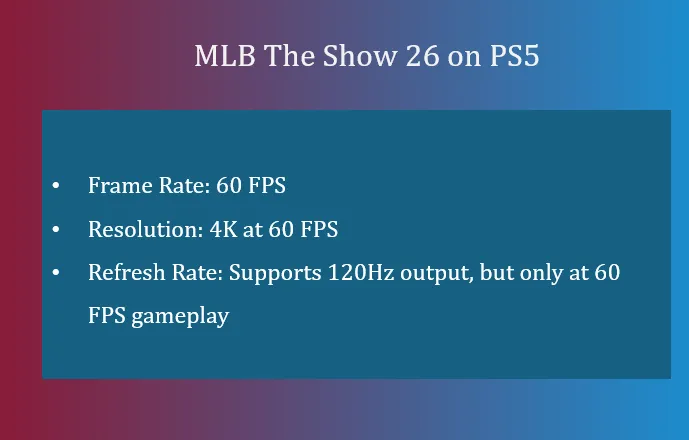
On the flagship consoles, MLB The Show 26 targets a native 4K resolution at 60 frames per second with HDR support. The simulation runs with exceptional smoothness, and the transition times between menus and gameplay have been reduced to approximately eight seconds. However, the player models and stadium environments are largely identical to those seen in MLB The Show 20 on the PS4 Pro.
Notably, the game lacks any specific enhancements for the PS5 Pro, a puzzling omission for a first-party Sony Interactive Entertainment release in 2026. Issues such as aliasing on the edges of players, low-detail crowds, and "plastic-looking" jersey textures persist. While superstars like Aaron Judge and Shohei Ohtani have received updated player models with more realistic stubble and eye reflections, mid-tier players and generic animations for dugout celebrations remain stale.
The 2026 cycle also marks the first season following the launch of the Nintendo Switch 2. While San Diego Studio did not release a dedicated Switch 2 port of MLB The Show 26, the game is "Switch 2 aware," allowing the new hardware to run the standard Switch version with significant performance benefits.
| Platform | Resolution (Docked) | Frame Rate | Key Technical Issues |
|---|---|---|---|
| PlayStation 5 | 4K | 60 FPS | No Pro enhancements; visible aliasing |
| Xbox Series X | 4K | 60 FPS | Minor stuttering in high-density stadiums |
| Xbox Series S | 1080p | 60 FPS (Inconsistent) | Frame rate drops reported at 1440p/4K settings |
| Switch 2 (BC) | 1080p | 60 FPS | Significant improvement over OG Switch; no custom stadiums |
| OG Switch | 720p | 30 FPS | Drastic graphical compromises; low-res textures |
On the original Nintendo Switch, the game continues to struggle with severe graphical compromises, including blurry textures and an unstable 30 FPS frame rate. However, on the Switch 2, the game runs at a smooth 60 FPS with a "crisper" 1080p resolution in handheld mode, resolving many of the visual complaints from the previous year. The lack of a dedicated Switch 2 version means the platform still misses out on features like the Stadium Creator mode, which remains exclusive to the current-generation PlayStation and Xbox consoles.
The launch of MLB The Show 26 on March 17 was marred by significant server instability and a range of technical glitches that plagued the early user experience. For the first ten days of the lifecycle, players reported frequent disconnections, matchmaking failures in Diamond Dynasty, and a UI that would frequently get stuck in a "loading loop".
One of the more chaotic bugs identified during the early access period was a physics error at the Rogers Centre in Toronto, where foul balls were being incorrectly registered as home runs. This was addressed in Game Update 2, which also resolved a freeze that occurred when out-of-position players appeared in online head-to-head matches.
| Patch Version | Key Fixes | Gameplay Impact |
|---|---|---|
| Update 2 (Launch) | Rogers Centre foul ball/HR fix; Online freeze fixes | Stabilized early access and day-one online matches |
| Update 3 (Week 1) | Pitcher velocity consistency; HR record presentation | Improved visual accuracy of player performance and milestones |
| Update 4 (Week 2) | Depth of Field camera adjustments; Server stability | Focused on performance optimization and preventing disconnections |
Despite these updates, the community remains critical of the new menu system. While the UI received an overhaul intended to make navigation easier, the consensus among both critics and players is that the menus are "sluggish," with noticeable lag when switching tabs in Diamond Dynasty or managing a roster in Franchise Mode. San Diego Studio has publicly apologized for the server issues, promising that "stability remains a top priority" and that Game Update 4 was specifically designed to address these backend failures.
When evaluated against its peers in the licensed sports genre—namely Madden NFL and NBA 2K—MLB The Show 26 continues to hold the title of the most authentic on-field simulation. The absence of "regressive" gameplay changes and the deep customization of the pitching and hitting interfaces allow it to maintain a level of mechanical integrity that other franchises have arguably lost.
However, the comparison becomes less favorable when discussing presentation and innovation. Critics have noted that while Madden and NBA 2K have made daring leaps in visual technology and "lifestyle" integration, The Show appears to be "spinning its wheels in the dirt". The removal of the "March to October" mode—a streamlined season experience that was popular with casual fans—has been cited as a "step back" for Franchise players, replaced only by a less engaging 94-game season toggle.
Furthermore, the "pay-to-compete" sentiment that has long plagued NBA 2K is now being echoed by the MLB The Show community following the implementation of the marketplace ownership limit. The perception is that the developer has identified its lack of competition in the baseball market and decided to "coast on its previous successes" while increasing its reliance on microtransactions.
The overall analysis of MLB The Show 26 reveals a product caught between its history of excellence and the reality of a modern, live-service-driven industry. On the field, the game is a masterpiece of strategic depth and tactical realism. The Bear Down pitching system and the directional defensive attributes are genuine improvements that make every at-bat feel more consequential than in previous years. The inclusion of the NCAA College World Series and the "Road to Cooperstown" rebranding provides a fresh coat of paint to a career mode that desperately needed more texture.
Yet, the experience is undermined by a series of technical and economic decisions that feel increasingly anti-consumer. The aging visuals, the sluggish UI, and the 20-card marketplace limit have alienated a significant portion of the game's most dedicated fans. The consensus from industry reviews is that if you skipped the last two or three entries, MLB The Show 26 is an essential purchase; if you bought MLB The Show 25, you already own 90% of this game.
Ultimately, MLB The Show 26 remains the best baseball game on the market, largely because it is the only baseball simulation on the market. While the core gameplay is addictive and peerless, the series is at a crossroads. Without a foundational visual overhaul and a return to the community-first economic policies that defined its heyday, the "undisputed king of the sports genre" faces the very real risk of falling behind the standard of excellence it helped create. For now, it is a solid improvement in the small, controlled steps that have come to define the franchise—a reliable "winning season" that nevertheless hints at a team in desperate need of a fresh perspective.
Authored by elite gamers and industry insiders, the U4N Editorial Team delivers authoritative game updates, patch notes breakdowns, and expert strategies for trending titles including World of Warcraft, Path of Exile 2, MapleStory, Aion 2, and Arc Raiders.
From deep-dive guides to the latest meta shifts, our in-house veterans test every tactic firsthand to keep you ahead of the game.